
Amoeba: Fish out of Water
Amoeba (2025) sharpens the coming-of-age genre with a nuanced exploration of adolescent defiance and institutional constraint at an all-girls’ Chinese school in Singapore. Tan Siyou’s feature debut, recognised with the FIPRESCI prize at the latest Taipei Golden Horse Film Festival, foregrounds how friendship and resistance question restrictive social norms.
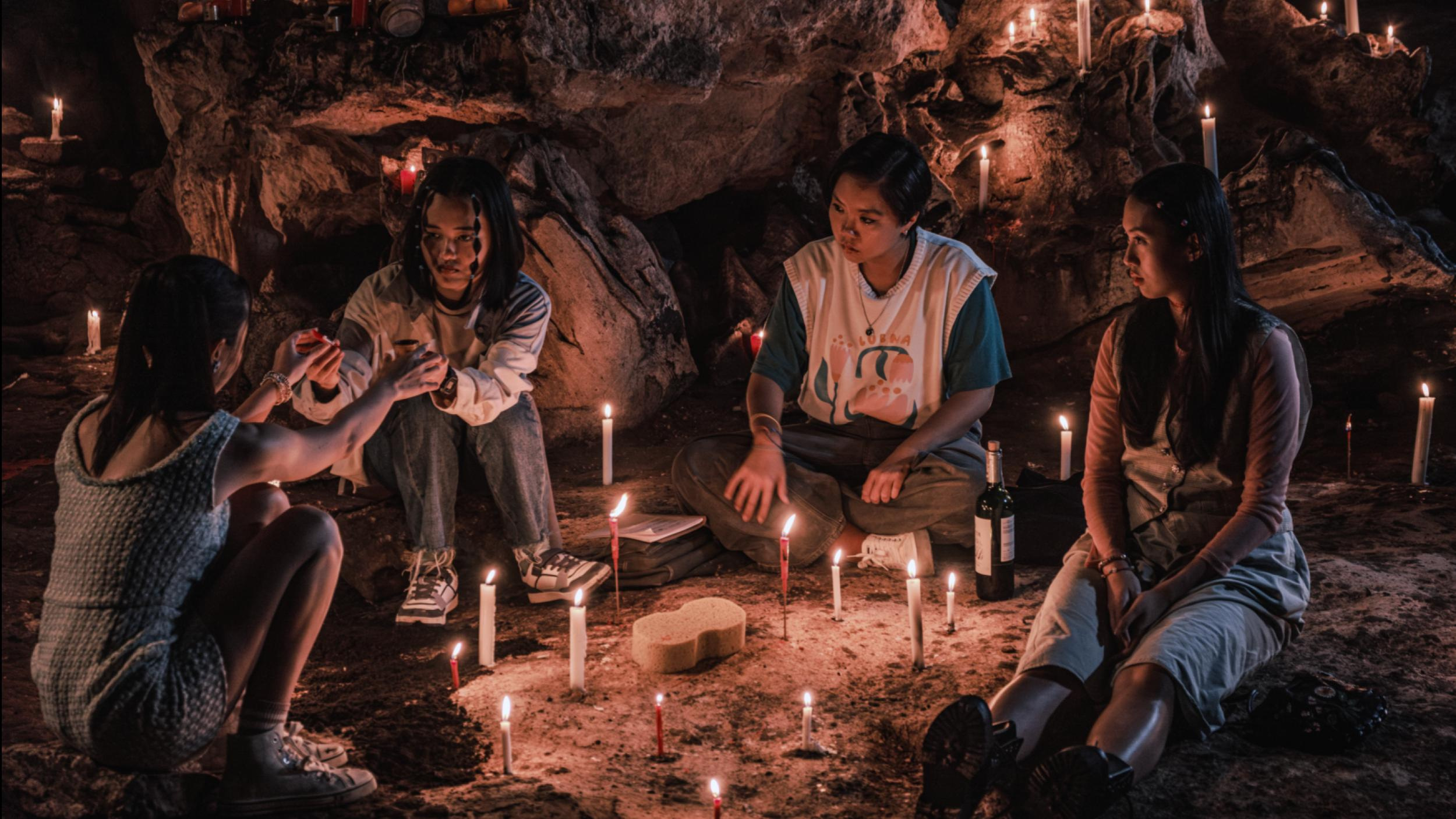
Growing up in post-communist 90s Romania, I still had a little taste of the repressive school regime meant to shape students into model citizens. Every morning, nails, handkerchiefs, and headpieces were inspected, starchy uniforms pinching my shoulders as I stood to greet my teachers and mechanically recited patriotic poems. The setting of Amoeba, an all-white, character-erasing secondary school, evoked memories of those times. The film follows 16-year-old Choo (Ranice Tay), a defiant newbie at the Confucian girls’ school, as she befriends three girls and challenges institutional boundaries. As she drags her desk into class in one of the film’s first scenes, one can sense she is trouble. Her skirt is too short, she talks back, confesses she is haunted by a ghost, and offers her classmates nap time instead of Good Citizen hour. Unlike typical teen movies, rich girl Sofia (Lim Shi-An), swimming star Vanessa (Nicole Lee), and Gina (Genevieve Tan) accept her immediately; there’s no bullying or mean-girl drama. Their rebellion isn’t about troubled families or unrequited crushes; they skip classes, goof around, ridicule norms, and sabotage the school play. Tan Siyou ties girlhood to Singapore’s emerging national identity and explores sociopolitical forces shaping her protagonists. In a country where gatherings of five or more require police permits and freedom of speech is guaranteed yet tightly controlled, their friendship verges on civil disobedience. The amoeba, a malleable organism changing shape to adapt for survival, is not only a metaphor for the island city-state, Singapore, which literally reclaims land to redefine itself and accommodate its growth as depicted in A Land Imagined (a title also produced by the same Akanga Film), but also for the girls’ need to adapt and thrive in a suffocating culture.
Unlike recent Southeast Asian films such as Arnold is a Model Student (2022, Sorayos Prapapan) or Sawo Matang (2023, Andrea Nirmala Widjajanto), which depict schools as dystopian training camps for their respective countries’ prosperity, Amoeba adopts a more toned-down style. With a nonlinear narrative, the film starts with a camcorder scene of Vanessa trying to capture Choo’s ghost on camera, then transitions to more polished cinematography and introduces the characters. This improvised SD aesthetic intertwines with the clean digital images, as the camcorder device is smoothly introduced into the plot. The narrow widescreen aspect ratio is a fitting solution to visually combine these elements, integrating the unseen world into the day-to-day. Additionally, the editing artfully parallels the girls’ attempts to catch on camera the supernatural presence tormenting Choo with an objective point of view: an unseen creature leaving marks on her mattress and moving things around in her bedroom.
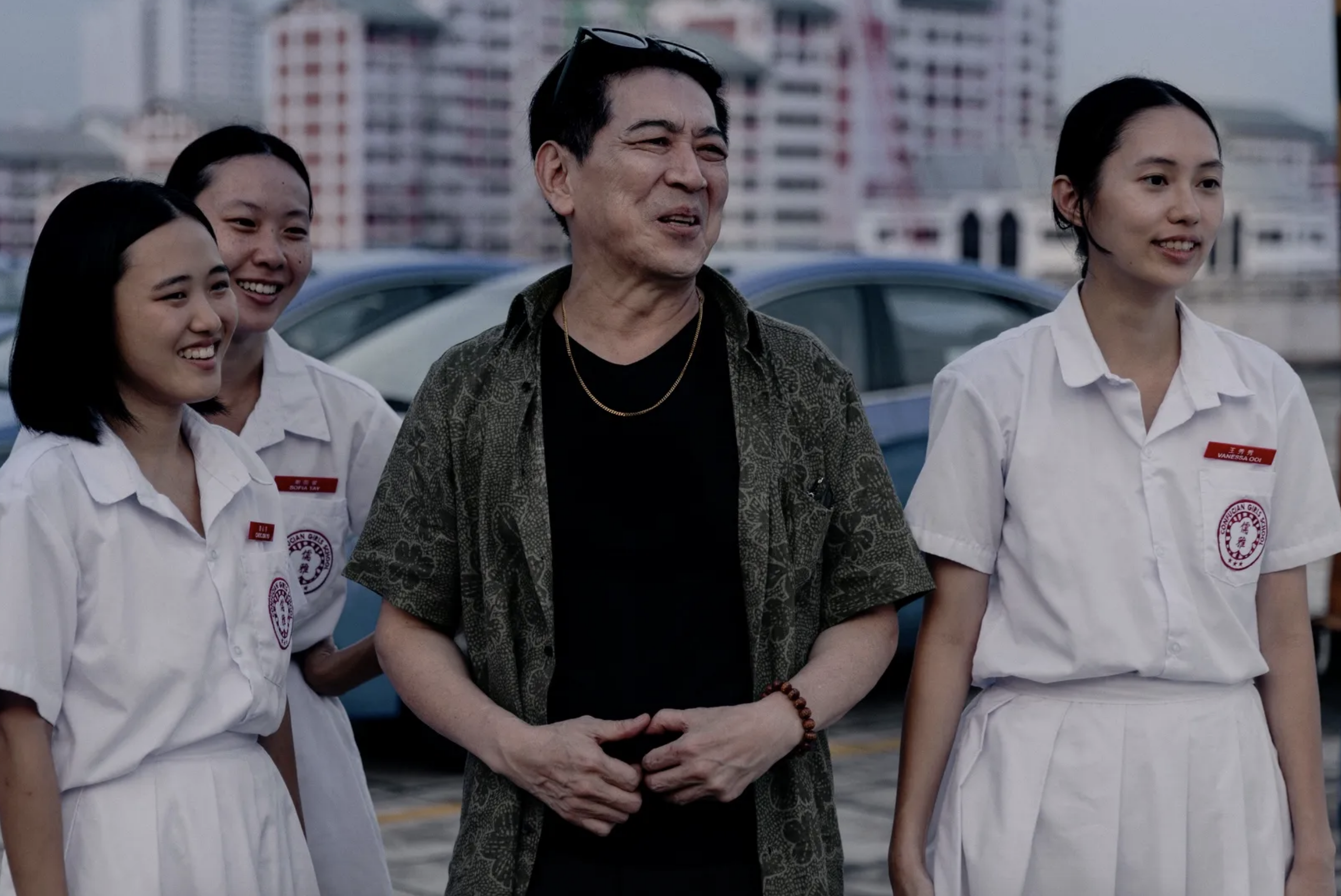
Definitely, the group’s most meaningful interaction with an adult is with Sofia’s family driver, Uncle Phoon. Played by Millennium Mambo’s Jack Kao, a former gang member (a playful nod to his gangster roles), he entertains the girls with stories and inspires them to form their own gang based on the principles of “loyalty, righteousness, brotherhood and truth,” contrasting with the school’s “purity, moral uprightness, diligence and filial piety”. He encourages them to express themselves freely, despite the constraints imposed by societal norms on female behaviour. On a couple of occasions, in some of the film’s most tender scenes, the gang put on a show displaying their “confusing talents for girls,” showcasing activities deemed unfeminine, like skating or kung fu. They are not interested in getting boys’ attention, but rather in knowing themselves, exploring their identity, and finding their place. An abandoned cave they discover on the school’s construction site sparks their imagination and some of the film’s best-lit scenes, leading them to perform their make-believe rituals rather than those officially instilled by their teachers. Siyou explores class differences naturally, avoiding clichés in depicting the protagonists’ interactions with the less privileged and hinting at social ladder pressures and expectations only in the final scenes.
Writer-director Tan Siyou incorporates a homoerotic element into the screenplay, enriching the storyline and characters’ development through Choo’s and Vanessa’s interaction. The complicity between the two regarding Choo’s ghost and their hiding their connection from the other girls adds another layer to the social commentary of Amoeba, Singapore legalising same-sex relations only recently. However, the queerness doesn’t take up much of the plot and is reduced to a few meaningful glances. In fact, Choo’s piercing gaze, an asset to the film’s performances, reveals her discomfort with the school’s discourse, which fabricates an entire history to fit the country’s propaganda about the birth of a great nation. One of her class assignments is to organise a school play based on the country’s origins, a theme connected to the conclusion of the film, the final exams, when the girls have to deliver the invented, official narrative about Singapore’s symbol, the Merlion, a mascot based on a constructed myth, a fish with a lion’s head. Dressed in handmade fish costumes in a whimsical, playful scene, the girls mock the founding postcolonialist indoctrination that the country is an idyllic fishermen’s village turned into a high-end metropolis.
Though upfront, the film’s political discourse lies in the girls’ passionate debates over the manufactured past of their culture, an artificial construct that cannot be hidden from their sharp minds. These are young adults who cannot be manipulated to fit into the greater puzzle of a perfect society. The confusion of the past shapes their perception of the future, a suffocating environment that the Singaporean director uniquely portrayed as swimming against the tide. For them, knowing the truth is crucial to their development, as Tan Siyou beautifully incorporates this dilemma into a fragmented yet meaningful search for identity. “How do we get out of this aquarium?”–Choo wonders. It is a perfectly valid dilemma for an up-and-coming director to watch.
Andreea Patru
©FIPRESCI 2025