
The award ceremony for the 2025 European Film Awards once more celebrated the best of film production releases in Europe over the previous year, while also paying homage to cinema legends. Many of those who came to the stage to present or receive an award did not shy away from commenting on the current state of the world, often reflected in the subject matter of films from the final shortlist.

The 38th European Film Awards took place again in Berlin as is consistently de rigueur every two years in the city that can be considered its spiritual home. This time the venue was at the House of World Cultures (a.k.a. HKW: Haus der Haus der Kulturen der Welt), a distinctive looking thin-shell structure (known locally as “Die schwangere Auster” (“The Pregnant Oyster”) that opened in 1957 and is located in Berlin’s Tiergarten, close to the new German Chancellery complex. It is also Germany’s national center for the presentation and discussion of international contemporary arts, with a special focus also on non-European cultures and societies. Therefore, it was a very appropriate venue for these awards in its reaching out from Europe to the rest of the world through the medium and message of film.
The awards have been presented annually since 1988 by the European Film Academy to recognize excellence in European cinematic achievements. Since 1998, the awards have consistently alternated every two years between Berlin and another European city, most recently in December 2024 in Lucerne, Switzerland. A co-production of the European Film Academy and its European Film Academy Productions arm, the award ceremony for the 2025 awards took place on 17th January 2026 so now moving to the following calendar year, and subsequently in tandem with major high-profile award ceremonies. The awards now take place just after the Golden Globes and prior to the U.K. BAFTAs and the U.S. Academy Awards (Oscars) that always take place in the first quarter of the following year.
The European Film Academy explained on its website that European nominees and winners will now be featured much more visibly within the international awards season, with Matthijs Wouter Knol, CEO and Director of the European Film Academy, explaining the change as follows: “It’s time for the European Film Awards to take a step up. The date change automatically means a prolongation of our new initiative Month of European Film, the season at the end of the calendar year during which the Academy celebrates European cinema in 45 countries simultaneously. In the next years, we will develop this program into a proper award season for films from Europe.”
The European Film Academy Productions, the in-house production company of the European Film Academy, was founded in 2006 to produce the European Film Awards Ceremony for television. This year, with around 1,000 international guests in attendance, there were 88 nominees in 22 categories. These included leading filmmakers, actors, and industry professionals for the latest celebration of European Cinema.
This year the awards were hosted by Mark Cousins, Irish-Scottish filmmaker and documentarian. His inclusion on the creative team of the award ceremony followed the wish of the European Film Academy to create more impact with its annual ceremony as an artistic experience in itself. The eccentric Cousins, a writer, broadcaster, and film documentarian, wearing a tartan kilt to display his cultural heritage, in contrast to his more formal suit and shirt, addressed the audience with the open-ended question of why is it that we love the cinema so much.
Accompanying Cousins on stage was German film composer Dascha Dauenhauer, who was responsible for the event’s musical concept, and theatre director Robert Lehniger, who as stage director overseen the award ceremony.
Lifetime Achievement Award: Liv Ullmann
Every year the European Film Awards pre-announces special awards, the most high-profile being the Lifetime Achievement Award. This year the recipient was Liv Ullmann, Norwegian actress and filmmaker.

Making her name as a stage actress in her native Norway in the mid-1950s, she came to worldwide prominence ten years later when she appeared in Ingmar Bergman’s films, starting with Persona (1966), and she would work with him for ten films, including Cries and Whispers (1972) and The Serpent’s Egg (1977).
She also appeared in television works that were released theatrically, including Scenes from a Marriage (1973) and its sequel Saraband (2003), the latter also Bergman’s final released work.
After being presented with the award from European Film Academy President Juliette Binoche, she was emotional and humble, thanking the academy for the prestigious honor.
In attendance with Liv Ullmann was her grandson, Halfdan Ullmann Tøndel, Norwegian filmmaker, also the grandson of Ingmar Bergman, and whose debut feature film Armand was nominated in three categories at the 2024 European Film Awards in Lucerne and was the European Discovery — Prix FIPRESCI winner.
Major Winners: Sentimental Value
Norway would also take center stage in the main awards as Sentimental Value (Affeksjonsverdi, 2025, Joachim Trier) swept the top award categories, winning five out of a total eight nominations.
It won:
- Best European Film
- Best European Director
- Best European Screenwriter for Eskil Vogt and Joachim Trier
- Best European Actor for Stellan Skarsgard
- Best European Actress for Renate Reinsve
In addition to these awards, Hania Rani won as Best Composer for the film.
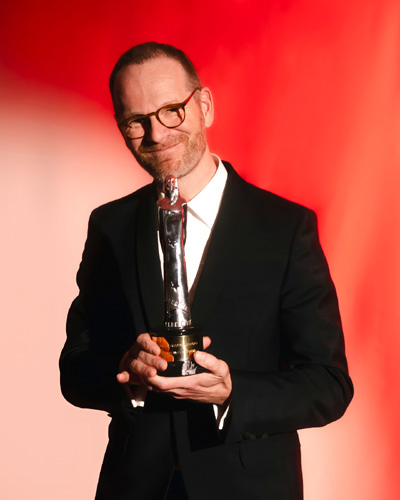
Accepting the award for Best Director, Joachim Trier, Norwegian filmmaker, talked of infrastructure and culture in his home country and spoke of how different worlds can come together through culture and the cinema.
Other Key Films
Mascha Schilinski’s German production Sound of Falling (In die Sonne schauen), and Jafar Panahi’s It Was Just an Accident (Yek tasādof-e sāde; Un simple accident) were both tied with three nominations each.
Panahi, who opened this year’s ceremony, addressed the current situation in Iran, and called on the influential entertainment community to make their voices heard.
The Spanish-French co-production Sirat, directed by Óliver Laxe, was nominated in the main award categories but did not win any of them, missing out to Sentimental Value.
However, with five wins in the craft categories, it equaled the number of awards on the night.
Prix FIPRESCI for European Discovery 2026
The shortlist for the Prix FIPRESCI for European Discovery 2026 award was selected by a committee coordinated for FIPRESCI by Paola Casella, Italian film critic and programmer, and FIPRESCI Vice President.
The committee included FIPRESCI members Salome Kikaleishvili from Georgia, and Max Borg from Switzerland.
There were six films shortlisted:
- Little Trouble Girls (Kaj Ti Je Deklica) — Slovenia, Italy, Croatia, Serbia
- My Father’s Shadow — United Kingdom and Nigeria
- One of Those Days When Hemme Dies (Hemme’nin Öldügü Günlerden Biri) — Turkey and Germany
- On Falling — United Kingdom and Portugal
- Sauna — Denmark
- Under the Grey Sky (Pod Szarym Niebem) — Poland
The Prix FIPRESCI for European Discovery 2026 was awarded to On Falling, the debut feature by Portuguese director Laura Carreira.
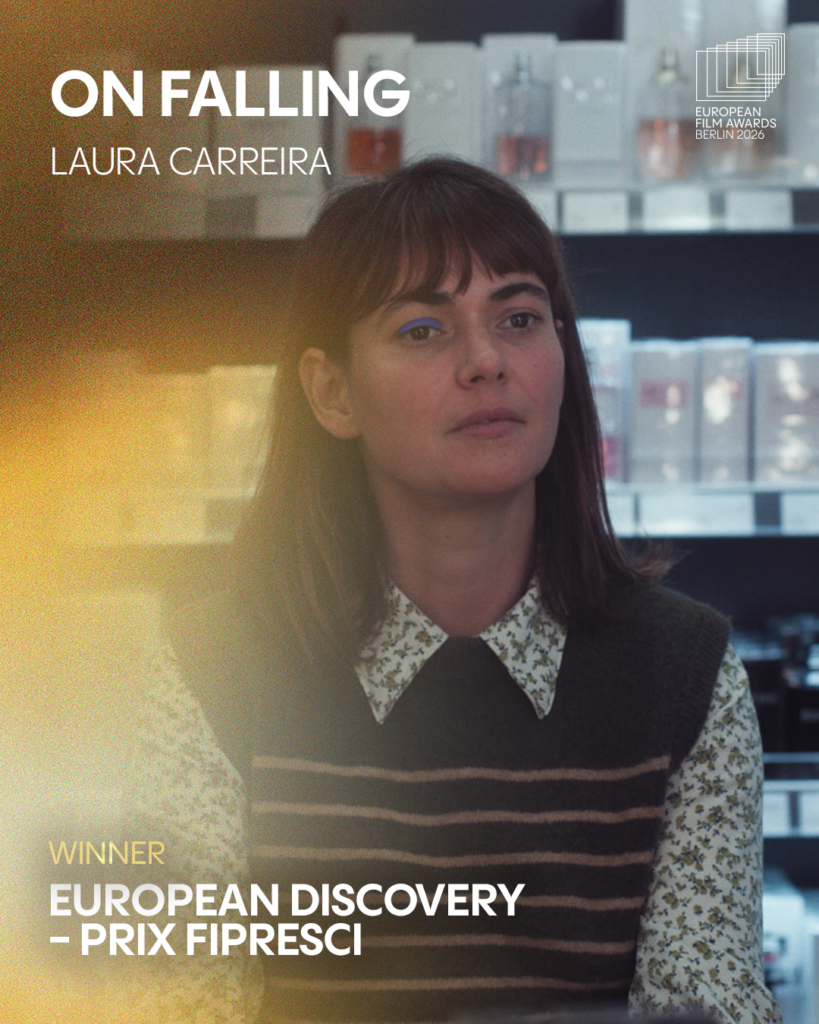
After receiving the prize, the director stated: “It is hard to take risks on the very first film of a director’s career,” before adding, “Winning this award will give me the strength to take further risks with my next feature.”
FIPRESCI Vice Presidents at the Ceremony
FIPRESCI Vice Presidents Paola Casella, from Italy, and Marina Kostova, from North Macedonia, were also at the award ceremony.
Paola Casella remarked: “Sentimental Value won all the artistic awards, Sirat all the technical ones…”
Marina Kostova also commended the ceremony’s innovative tone, noting the highlight of “Marlene Dietrich’s iconic hat from Shanghai Express and the 100-year-old animation panel from Lotte Reiniger’s The Adventures of Prince Ahmed.”
Looking Ahead: Athens 2027
Next year’s 39th edition of the European Film Awards will take place in Athens for the first time, in partnership with the European Film Academy and the Hellenic Film and Audiovisual Centre.
It will be held on Saturday 16th January 2027 at the Stavros Niarchos Foundation Cultural Center.
Steven Yates
© FIPRESCI 2026
References
The full list of winners for the 38th European Film Awards can be found here:
https://www.europeanfilmawards.eu/award-edition/awards-2026/?tab=winners
Further information on the LUX Audience Award 2026 can be found here:
https://lux-award.europarl.europa.eu/en