
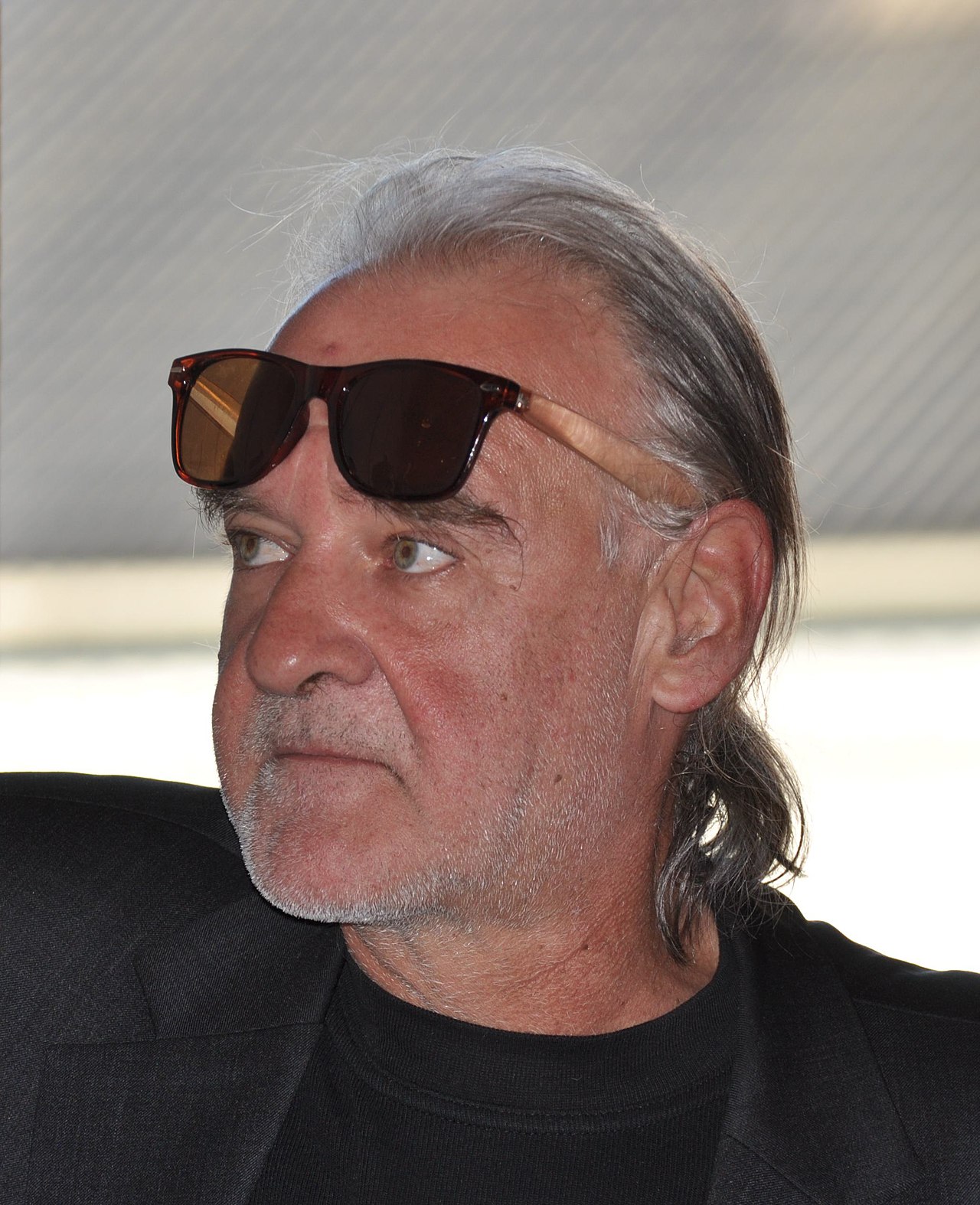
Hungarian film critic György Báron reflects on the life, legacy, and solitary grandeur of Béla Tarr, tracing the reverence surrounding the filmmaker across festivals, institutions, and audiences worldwide. Through fragments of memory and farewell, Báron considers what Tarr’s cinema meant—and what it leaves behind in a changed world.
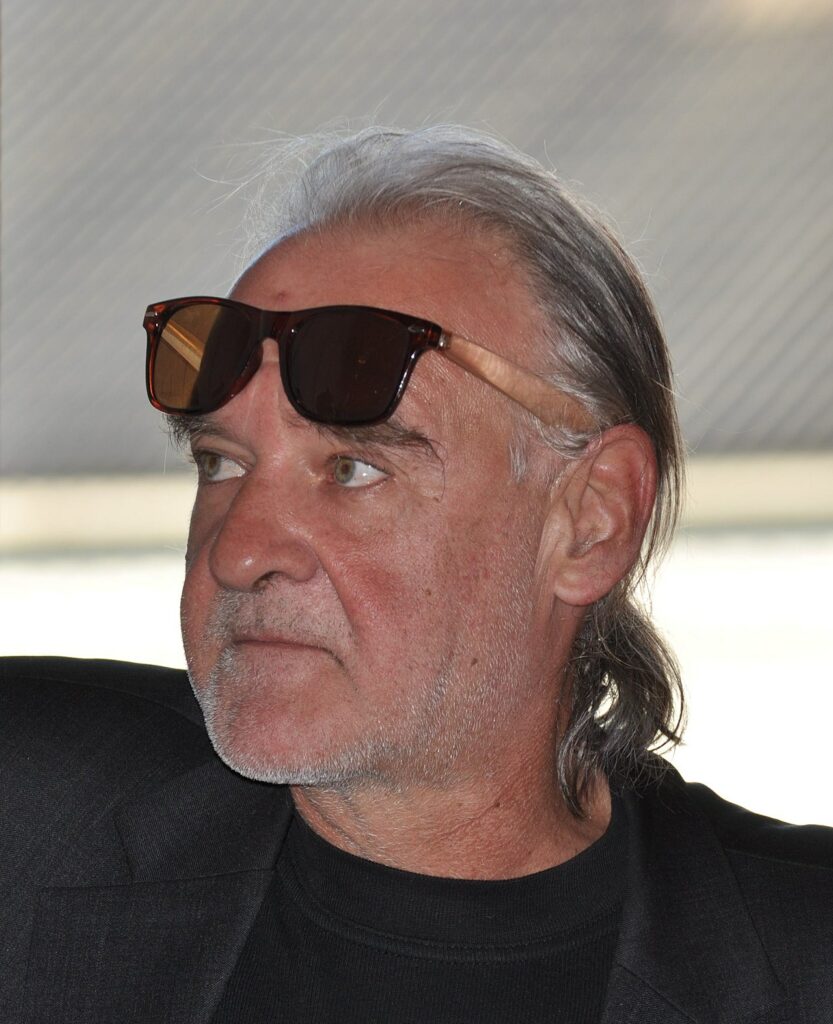
In recent years, he often quoted the cruel wisdom of the ancient Greeks: “No one has ever left here alive.” He sat on the banks of the Styx, stoically calm, even cheerfully scanning the water, looking across to the other side with insatiable curiosity. He fought a heroic, stubborn battle against his overwhelming illnesses, never complaining, mostly rejecting the help of friends. He did not want to be pitied, and he was not. He retained his cool, majestic solitude throughout.
“How are you?” I asked at the beginning of our conversations.
“Shitty,” he replied, as if to say, “Thanks, I’m fine,” stupid question.
During healthier periods, he set out into the world, gave master classes, attended screenings of his films, received lifetime achievement awards and honorary doctorates, and was celebrated in America, Europe, Asia, and the Far East. He saw that his works lived on, that his fan base was not diminishing but growing over time. I have never encountered such reverent admiration as that which surrounded Tarr around the world.
In 2011, Tilda Swinton received a lifetime achievement award in Abu Dhabi. Before that, they listed the world-famous directors she had worked with in a single long sentence, then paused and added: she also played alongside such an exceptional creator of contemporary cinema as Béla Tarr.
In 2023, the rather dull European Film Awards ceremony took place quietly at the Arena in Berlin, with notable artists such as Agnieszka Holland, Stellan Skarsgård, and Vanessa Redgrave taking the stage. Then the room darkened, somber images by Tarr flashed across the screen, accompanied by music by Mihály Víg, and when he stepped onto the stage, cane in hand, the elegant audience jumped to their feet, applauding and cheering, and the arena erupted.
In Amsterdam, a university lecturer kept the leaf as a relic, which had been blown by the wind onto his installation depicting the barbed wire fence erected on the border of Europe. That exhibition, To the End of the World, was about the scandal of our time, the ordeal of refugees.
Six years ago, his performance in the winter riding hall of the Royal Palace in Vienna was about another scandal, poverty and homelessness—at the end, the audience at the Burg also gave him a standing ovation. He did not come out to take a bow, because it was not the right moment. A little later, he sat down in the pub corner he had set up, was recognized, and people waited in long lines for his autograph. The title of the Viennese evening was Missing People.
Tarr was the poet of the saddened, the unaccounted for, the missing people. In his European vision (Visions of Europe), Robby Müller’s camera rolls for a long time alongside people queuing for food distribution, just as it does in a similar shot in Damnation, in front of a rain-soaked wall. In that five-minute haiku, the end credits take a minute and a half, listing hundreds of names, an integral part of the work: giving names to the nameless, the missing people.
All of his works—especially the later ones—are about redemption, faith, and failure, about the delayed salvation whose promise is mocked by false prophets who pocket profits in the muddy, foggy borderlands that are our homeland, both near and far: the Hungarian landscape of the Great Plain, small towns, and the desolate Beckettian world stage at the end of the game.
If the unmistakable sign of greatness is that we recognize a filmmaker’s signature within a few minutes, then Tarr belongs to the elite club of Ozu, Bresson, Tarkovsky, Bergman, Fellini, Godard, and Jancsó. I can only name older filmmakers—perhaps he is the last classic. A survivor of a bygone era of film history.
At the end of The Turin Horse, when the air runs out, the wind stops, the fire goes out, and the light fades, he not only closed his oeuvre with admirable awareness, but also—as he himself probably felt—an entire golden age of cinema history.
The motion picture had changed, and there was no longer a place for him in it. Instead, he taught and supported young filmmakers. He would have preferred to do this in his homeland, but he could not establish a film studio there, even though he only asked the government film commissioner for the budget of a single feature film, which could have been used to make ten low-budget films and launch the careers of newcomers. He did not get it, and I will not list who and how many have since… to the shame of his country.
Yet, if anyone saved the honor of Hungary, it was him: when our country was mentioned abroad, it was mainly thanks to him that it was not met with incomprehension and resentment, but with: Béla Tarr!
He was both a citizen of the world and a patriot in the true sense of the word, although he never boasted about it. When asked which city he felt at home in, he simply replied, “My washing machine is in Budapest.”
In the City Life Budapest chapter, The Last Boat, written by László Krasznahorkai, we see a city ravaged by violence and decay, and the camera follows the journey of a boat crowded with refugees: “One of us suddenly raised his head, struggled to his feet, went astern, pointed out to the pitch-dark forever disappearing countryside, and called out with bitter relief: People. That there was Hungary.”
He keenly felt the responsibility that came with fame. He rarely spoke out on public issues, but when he did, his words carried weight. He stood up for important causes. When state support for the Filmmakers’ Association was withdrawn, he took over the presidency from Miklós Jancsó; when the Hungarian Film Festival was shut down, he organized a low-budget film festival; and he was the long-time president of the Freeszfe, which was formed to replace the destroyed liberal University of Theatre and Film Arts (SZFE).
We invited him several times to teach at his alma mater, the old SZFE, but he never came because his creed was that art cannot be taught at university.
“No education—liberation!” he said.
Then, when the students began their freedom fight, he showed up, held workshops, and guarded the building, sitting on the parapet above the entrance. Because at that time, the university was not about education, but about liberation.
We talked at the time about whether the authorities would use violence against the peaceful students.
“If they try,” he said, “I’ll go and lie down in front of the gate.”
He was already ill, walking with a cane, but I have no doubt that he would have done so.
In the final episode of Jancsó’s film The Season of Monsters, he appears as Jesus Christ, dressed entirely in white. Reluctantly, he rises from the piano placed in the endless landscape to raise the dead. Then they stab him, and he is the only dead person who does not rise, because there is no one to resurrect him. A dull, gray fog hangs over the landscape, a stormy wind blows, birds fly frantically in the long carriage—just like in a Tarr film.
Memories and farewells to Tarr are pouring in from the internet, from home and from around the world. Is there anything new to say about him? About his long and yet taciturn films? About the fact that it is no longer possible to make films in the same way as before?
We have already said everything, perhaps even more than that. We should remain silent; that would be fitting. Future viewers will say what we can’t now.
György Báron
(Élet és Irodalom, 16 January 2026)