
Blue Heron: Life Between Memory and Uncertainty
The winner of the FIPRESCI award in Luxembourg, Blue Heron, is explored by Italian film critic Constant Carbonnelle, who finds a subtle and deeply moving portrait of a Hungarian family re-settled on Vancouver Island in the 1990s.
At the Luxembourg City Film Festival, Blue Heron quickly emerged as a frontrunner for the FIPRESCI Prize, capturing the jury’s attention from the start. Some films grow on you slowly, but this one impressed immediately with the precision of its vision and the emotional weight it carries. Canadian filmmaker Sophy Romvari’s feature is subtle but unrelenting, and that quiet authority is what makes it linger.
The film follows a Hungarian family relocating to Canada, settling into a new home on Vancouver Island in the 1990s. On the surface, the story is quite simple: unpacking, arranging rooms, adjusting to a new environment. But beneath these routines, tensions emerge. Jeremy (Edik Beddoes), the eldest son, struggles with mental health issues; his unpredictable behavior shapes daily life, creating uncertainty and forcing the family to adapt continuously. Parents, siblings, and the household as a whole negotiate the unknown, while the brother’s presence remains deeply affecting yet resistant to explanation.
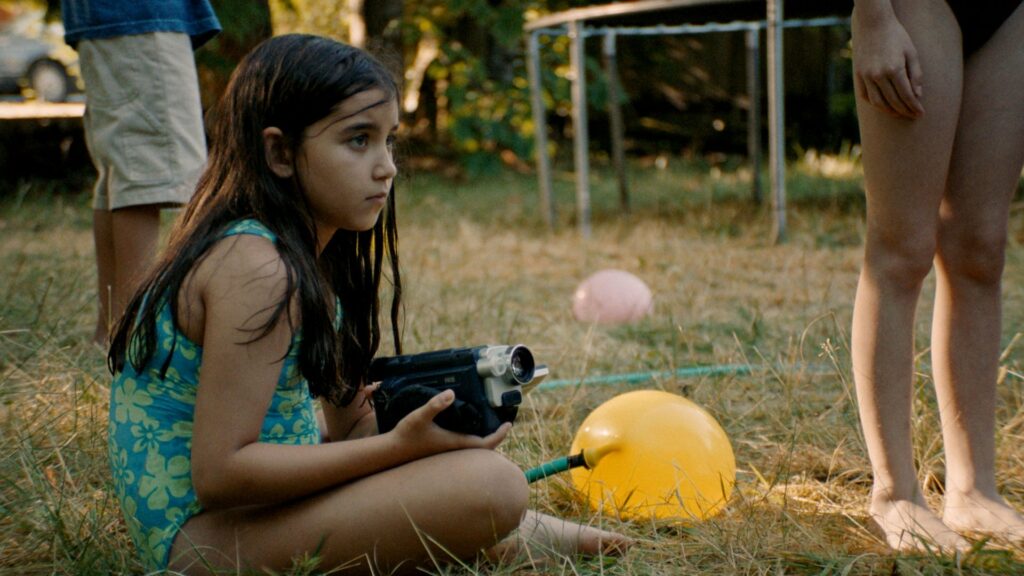
To explain this narrative, the filmmaker chooses to follow Sasha (Eylul Guven), the youngest child. She observes, absorbs, and later revisits these moments with the clarity of adulthood. And her perspective shapes the film’s non-linear rhythm: past and present collide, memories fragment and reconnect, and familiar scenes take on new meanings each time they appear. Through her eyes, we feel the weight of her brother’s unpredictability and the quiet tension it imposes on the family.
Romvari draws directly on her own life. After several short films, she makes her autobiographical feature debut, transforming memories into cinematic sequences that feel lived-in and intimate. The family’s home is realized with painstaking detail: furniture, objects, and lighting reflect the textures of everyday life. Re-enactments are interspersed with photographs and small staged moments, which occasionally offer alternative perspectives or subtle commentary, underscoring the difference between lived experience and recollection. The camera often lingers close to gestures, faces, and objects, sometimes partially obstructed, conveying that memory is always partial.
Also, Sasha’s viewpoint shapes the film’s emotional texture. While she follows daily routines, small joys and ordinary interactions are captured with acute sensitivity. Long lenses and careful framing allow attention to the family’s micro-behaviors while the eldest brother can remain partly shadowed, highlighting his inaccessibility. Through these techniques, Romvari transforms domestic life into a beautiful meditation on perception, adaptation, and memory.
And as Sasha grows older, the film introduces a reflective distance. Adult Sasha revisits her childhood through another lens, attempting to understand what could not be interpreted at the time. These passages shift perspective without clarifying or solving, emphasizing the persistence of uncertainty and the work of remembering.
Awarded the FIPRESCI Prize, Blue Heron therefore offers a nuanced and deeply moving portrait of a family, and of a young girl seeking to understand the world she experienced without fully grasping it.
Constant Carbonnelle
© FIPRESCI 2026