
In a report from the LuxFilmFest, Luxembourg-based critic Jeff Schinker pays special attention to four films that share a common theme despite their differences, including a couple of festival’s award winners.
Across the nine fiction features of the 16th LuxFilmFest, family, memory, and fragmented timelines weave a puzzling red thread that ties together movies as stylistically and geographically disparate as can be. Yet, what they all tell us is that family is just another fictional construct, cemented by memory and rendered coherent through our sense of narrative and, ultimately, imagination.
The most startling and frightening portrait of a family emerges throughout Gábor Holtai’s unsettling debut Feels Like Home (Itt érzem magam otthon) where a woman (Rozi Lovas) gets abducted only to wake up in what she’s supposed to accept as her new home. Progressively, she gets to learn how to slip into the role she’s supposed to play: she’s no longer Rita, but Szilvi Arpad, favorite daughter to a patriarch who’s less than pleased about her past runaways. Every time she denies being Szilvi, her abductor—one of her “siblings”—resets her conditioning process, at the end of which, like one of Pavlov’s dogs, she can finally be presented to the family as the new incarnation of the lost daughter miraculously returned. What Holtai humorously described as not a psycho-thriller, but a portrait of your average Hungarian family, turns out to be an asphyxiating portrait of autocracy at work. Since reality as we perceive it is nothing else but the consensus of what we deem things to be, a lie can turn into a reality if a majority chooses to believe the lie.
Mostly filmed as a juxtaposition of static shots, thus formally mimicking the inescapability of Rita’s fate, Feels Like Home can be read as a timeless and universal allegory about the abuse of power and autocracy, its cyclical ending a clear hint at how history repeats itself over and over again. At times reminiscent of philosopher Gilles Lipovetsky and his seminal essay L’ère du vide, Holtai points to the fascination autocracy holds for all those who find themselves in search of meaning in late neoliberalism, where individual freedom conceals a cold world populated by lonely souls.
Things get even more bizarre in Rose of Nevada. Set in a small fishing village, Mark Jenkin’s experimental movie begins with the unexpected reappearance of a fishing trawler lost at sea some thirty years ago. With the roof of his own home not only symbolically starting to leak—this might be a subtle nod to Il pleut dans la maison, which was featured in 2024’s competition—Nick (George MacKay) fills in for the missing third member of the crew, realizing the economic decline of his once prosperous hometown is linked to the disappearance of the vessel, and that he’s got no other choice than embarking on an adventure, despite many a sign warning him not to go, the only flag this rambunctious ghost ship could wave being a red one. Things start to get even stranger when the crew of three fisherman—apart from Nick, there’s a binge-drinking captain who (almost) never sleeps (an excellent Francis Magee), and Liam (Callum Turner), an unreliable drifter—get home after their first successful expedition: at some point, timelines must’ve gotten confused since the vessel, like a time machine in some sci-fi-movie, has brought them back some thirty years ago, to the period before the boat disappeared at sea, with Nick finding himself in the role of the child of his former neighbors and Liam dating a woman whose daughter he had started an affair with in the initial present tense of the movie. Oddly enough, Nick seems to be the only one who realizes that timelines and identities got confused. Picture Back to the Future without the sci-fi paraphernalia, add Jenkin’s truly breathtaking photography and a sometimes confusing but mostly rewarding storyline about the strange movements of time, and you’ll have the weirdest, but also one of the most interesting, feature films of this year’s LuxFilmFest. As in Holtai’s Feels Like Home, Jenkin plays with traditional family constellations, questioning the roles we play within our families while showing that if those parts we play are exchangeable, questionable, and fickle, what isn’t is time’s cyclical movement: where other sci-fi movies bet on multiple time lines to give us some hope with regards to time’s inescapability, here, the way time jumps back and forth in an incoherent way makes us grasp poetically what we already know: that we’re merely the toys of time.
Rose by Marcus Schleinzer stages a parody of the nuclear family, pushing the idea that family is both a fictional construct and, as Gilles Deleuze and Felix Guattari have shown us, a prison of heteronormativity. After having fraudulently settled on a farm meant to be inherited by a deceased soldier (met and befriended during war), the eponymous main character, brilliantly played by Sandra Hüller, turns out to not only have made up a fictitious family tree but to also have lied to everyone about her sex—Hüller convincingly incarnating a female usurper who pretended to be a man because there was “more freedom to be found in trousers.” When she gets forcefully married to one of the community leader’s girls and when her wife ends up getting pregnant, in one of those incongruous and zany turns that put some light into a rather grim tale, Schleinzer shows how this staged make-believe family allows for an alternative relationship between the two women to build, a relationship tinged with mutual respect and sorority, before its tragic finale summons the return of a society dictated by patriarchic rules of intolerance—a society that punishes anyone who tries to deviate from its heteronormative world view. If Rose gets punished, it is because, being a woman, she should’ve tolerated the injustices and inequalities of her sex and not have dared to try to embrace men’s freedom.
Even though filmed in black and white, set in a far-away town in 17th century Germany and told by a distant and almost humorous voiceover reminiscent of the narrating devices of the fairy tale, Rose is an utterly contemporary movie, showing how suffocating family can be when it reproduces exclusion and dictates social norms, thus marginalizing and ultimately punishing those who don’t fit in. Its beauty lies in the utopian vision of an alternative way of life it hesitantly drafts—an alternative, queer way of life crushed by the forces at work.
If other movies depict family put under the pressure of exile (Nina Roza), poverty and male toxicity (Mad Bills to Pay), alienation in a married couple and the challenges of a war at the door (How to Divorce During War), a pregnancy in a world estranged by late capitalism and crumbling under climate change and the multiplication of ecological crises (Human Resource), the FIPRESCI-awarded Blue Heron and the Grand-Prize-winning My Father’s Shadow most prominently explore what grief does to memory and the way it alters how we see ourselves within a family constellation.
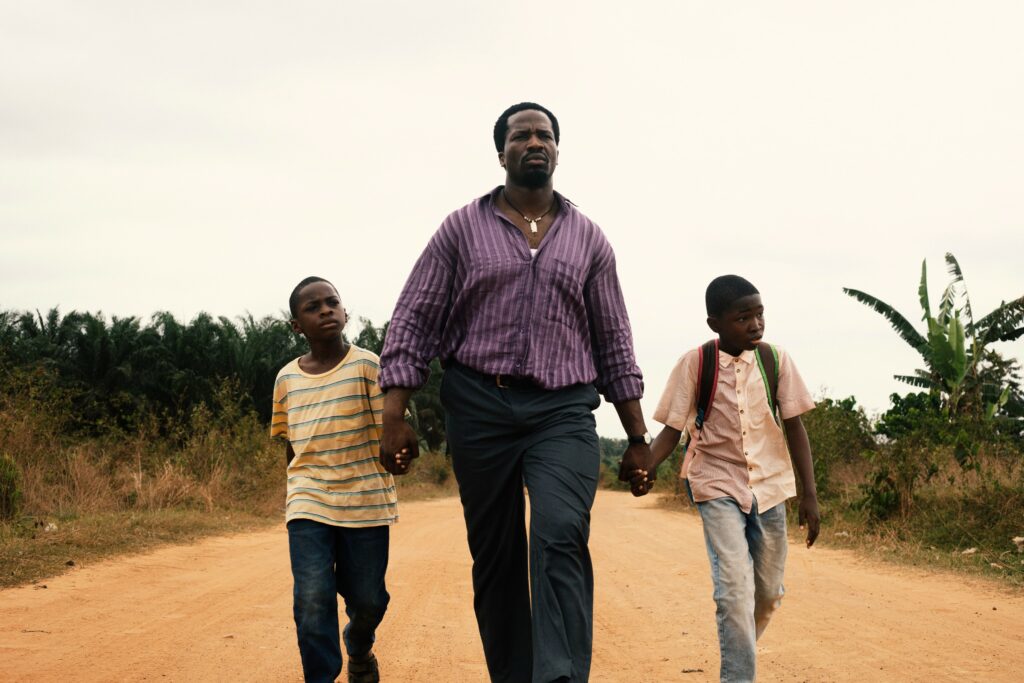
My Father’s Shadow by Akinola Davies Jr. retells the odyssey on which an estranged father takes his two boys after one of them complains that he works too much and never takes care of either his wife or his two sons. During a trip to and through a Lagos City rife with political and military unrest, Folarin (excellent: Sope Dirisu) shows his boys the hardships of Nigerian life and, in a refreshingly poetic and non-didactic way, teaches them what (little) he knows about life. After a plot twist reminiscent of The Sixth Sense, audiences will have to reread this comparatively straightforward, linear narrative as a tale less realistic and far more tinged with grief and mourning than one may have thought at first sight.
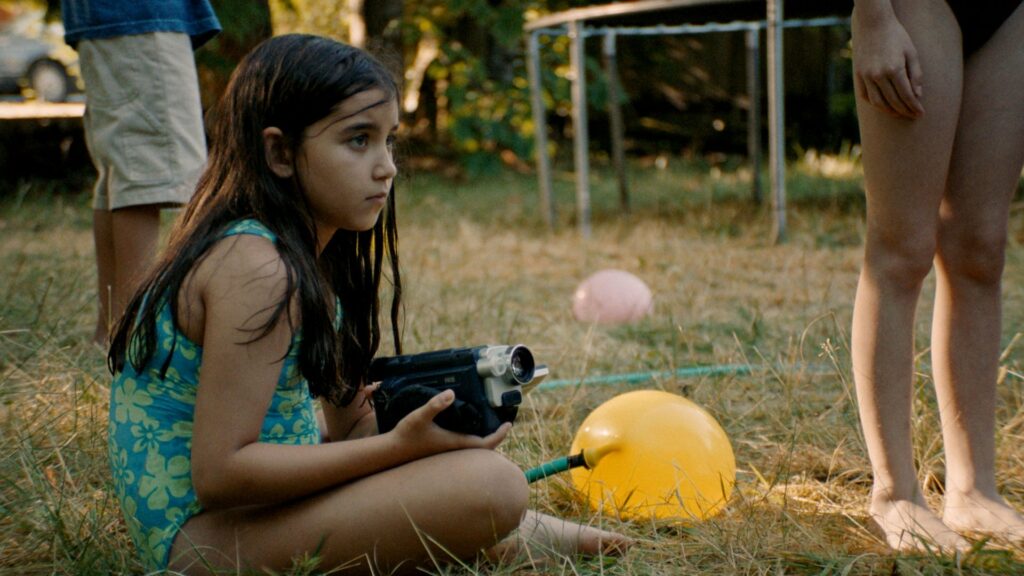
In Blue Heron, there’s a similarly disruptive moment when a grown-up woman reenacts a pivotal point in her family story, reliving through a fictional restaging the tragic moment when her mother, no longer able to handle the undiagnosed mental illness of her oldest son, decides to let go and let a social worker place him in another family. Here, the now adult daughter relives the tragic moment not from her perspective as an eight-year-old girl but embodies the social worker who then came to her idyllic home and took away her deranged but loving half-brother. And if she does so, she does so as if to give herself more agency over a crucial moment she experienced passively. In the closing scene of Sophy Romvari’s touching movie, the adult sister’s dead brother stands next to her, vanishing almost immediately after we learn of his passing. This scene echoes strongly with the ending of My Father’s Shadow, both movies ultimately being ghost stories. This poignant ending suggests what many of this competition’s selections hinted at: if in those movies, time isn’t linear, it is because we keep our dear and lost alive in the fictional realm of memory—a realm unbound by the tragedy of time’s arrow.
Jeff Schinker
© FIPRESCI 2026