
Stepping Away or Being Stuck in Personal Perspectives? - Examining The International Feature Films At Visions du Réel 2026
by Nil Kural
“When I taught creative writing at Princeton, [my students] had been told all of their lives to write what they knew. I always began the course by saying, ‘Don’t pay any attention to that.’ First, because you don’t know anything, and second, because I don’t want to hear about your true love and your mama and your papa and your friends.”[1]
This anecdotal advice from the great Toni Morrison urges writers to take distance from the personal and cultivate a wider curiosity toward the affairs of the world. It came to my mind frequently as I and other members of the FIPRESCI jury screened the selection of first feature documentaries in the International and Burning Lights competitions at the 2026 Visions du Réel. This year’s selection offered many examples of personal stories told from the filmmakers’ own perspectives.
The impulse to use the personal as a lens for documenting broader issues with the hope of touching something universal is understandable, especially in an era defined by social media and the constant usage of the first-person pronoun. Taking what you know best as a starting point especially at the beginning of your filmography is, in many ways, a straight-forward path. But the films that managed to resonate with us at this festival were those that succeeded in transcending the self entirely, turning private experiences outward until they genuinely connected with an audience that could inhabit these experiences.
We encountered feature productions that illustrated the full spectrum of what primary emphasis on the personal can achieve, including moments where said emphasis occasionally fell short. At its best, the “I” becomes a starting point reflecting personal experience into something larger than the filmmaker alone. At its weakest, it is a restricted narration, stunted by self-indulgence and leaving the audience alienated. Four films in particular opted for this approach, each with varying results.
The film with the most successful attempt at expanding a personal story into global resonance is Almourad Aldeeb’s If Only the Year Had 364 Days (Estahbes, 2026) . This German–Syrian co-production is based on the filmmaker’s time of torture and imprisonment in 2013 under the despotic Assad regime. The Syrian administration operated secret prisons replete with horrors that shocked the world when more information surfaced following the fall of the Assad regime at the end of 2024.
Aldeeb tells of his own experience via skillfully written voice-over and images documenting his personal ordeal and the scars that lingered after his escape to Germany. Through his prism, we witness his vivid account of events, which also includes the tragic fates of his friends as well as other inmates who were taken to prison in an attempt to crack down on a student movement decrying Assad’s dictatorial government. Aldeeb carefully makes his journey through personal memory without neglecting the stories of others, introducing us to the families of friends who did not make it out alive. This collage of creativity allows the audience to witness a monstrous regime in ways that had not previously been experienced . A notable achievement of Aldeeb’s work is the use of distance to show us the current state of these prisons: walls that bear cold witness to torture and killing, an ordinary building that holds dark memories without a documentary maker needing to spoonfeed their audience.
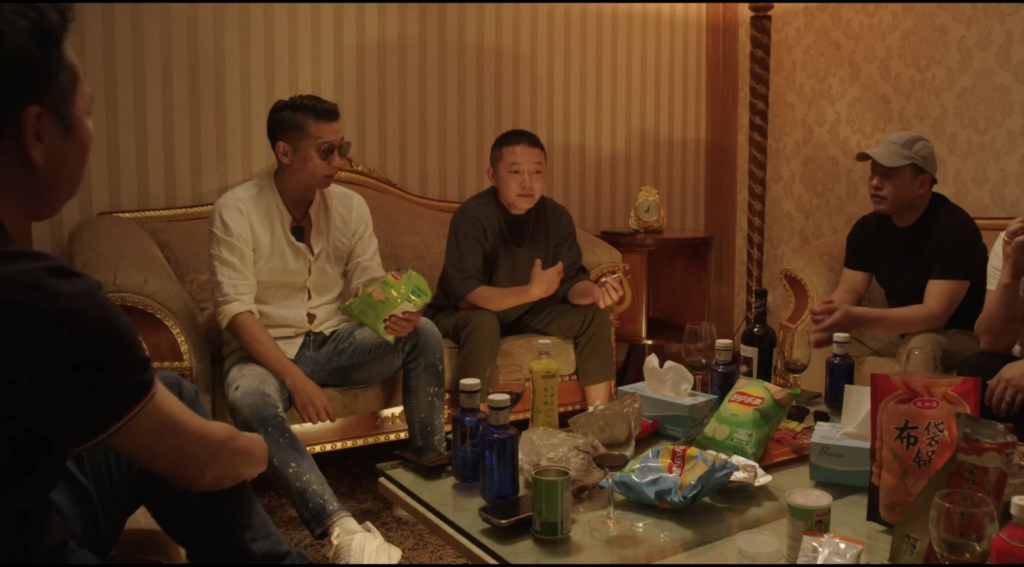
From Dawn to Dawn (La noche de la infancia, 2026), directed by Xisi Sofia Ye Chen and winner of the Grand Jury Prize at the International Competition, tells a smaller story of a Chinese immigrant family in Spain, yet manages to turn it into a universal story of not belonging and feeling lost in an unfamiliar culture. Chen focuses on her brother A Wen, his involvement with the Chinese mafia and his efforts toward redemption through hard work and a return to his roots in China, residing at a Buddhist monastery. The director’s poetic voice-over and dreamlike storytelling draw the audience into this personal story which is told with care and grace. At its core, it is the experience of one immigrant family, but the film finds a broader meaning in the global immigrant experience.
On the opposite end of the spectrum are two features that alienate us: Like a Fortress (Comme un château fort, 2026) by Lou Colpé and Fracture (2026) by Keren Kraizer. The former follows Colpé through a period of mourning after her boyfriend dies in an accident. Filmed in the style of a vlog or personal diary, it traces her journey through the stages of grief with flashes of humour that help with some narrative gloss, but are not enough to elevate the film to a memorable story. It attempts to conjure a montage of loss at its most universal element, but only ends up with a pastiche and, as if referencing its title, remains closed to the audience like a fortress.
The latter film focuses on Kraizer and documents her return to Israel after living in Europe for many years, amid her new relationship with a human rights activist. It generally unfolds as a diary about her experience of the ‘fracture’ in Israeli society before and after the events of 7th October 2023. The topic of the genocide in Gaza becomes a weight on the film that proves too heavy for its director to carry. The perspective of an Israeli filmmaker about these horrible times is worth seeing, but the film leans way too much on the personal. There are hints of a wider view with the family members and activists struggling before the war, but they are left underexplored, and as a result, the film is confined to a singularity that ends up in diegetic shallowness.
As Toni Morrison suggests, sometimes what you know is not enough to cover an interesting perspective, and a need to step outside is necessary to widen it, but maybe it is enough as a starting point to document a story worth telling, as these four films suggest.
By Nil Kural
Edited by Jerry Chiemeke
Copyright FIPRESCI 2026
[1] * www.arts.gov/stories/magazine/2014/4/art-failure-importance-risk-and-experimentation/toni-morrison