
Gondhal: When Content and Form Merge
Indian film critic Rekha Deshpande examines how Gondhal fuses narrative and ritual form, transforming a familiar story of power and violence into a culturally grounded cinematic experience rooted in Maharashtra’s folk traditions.
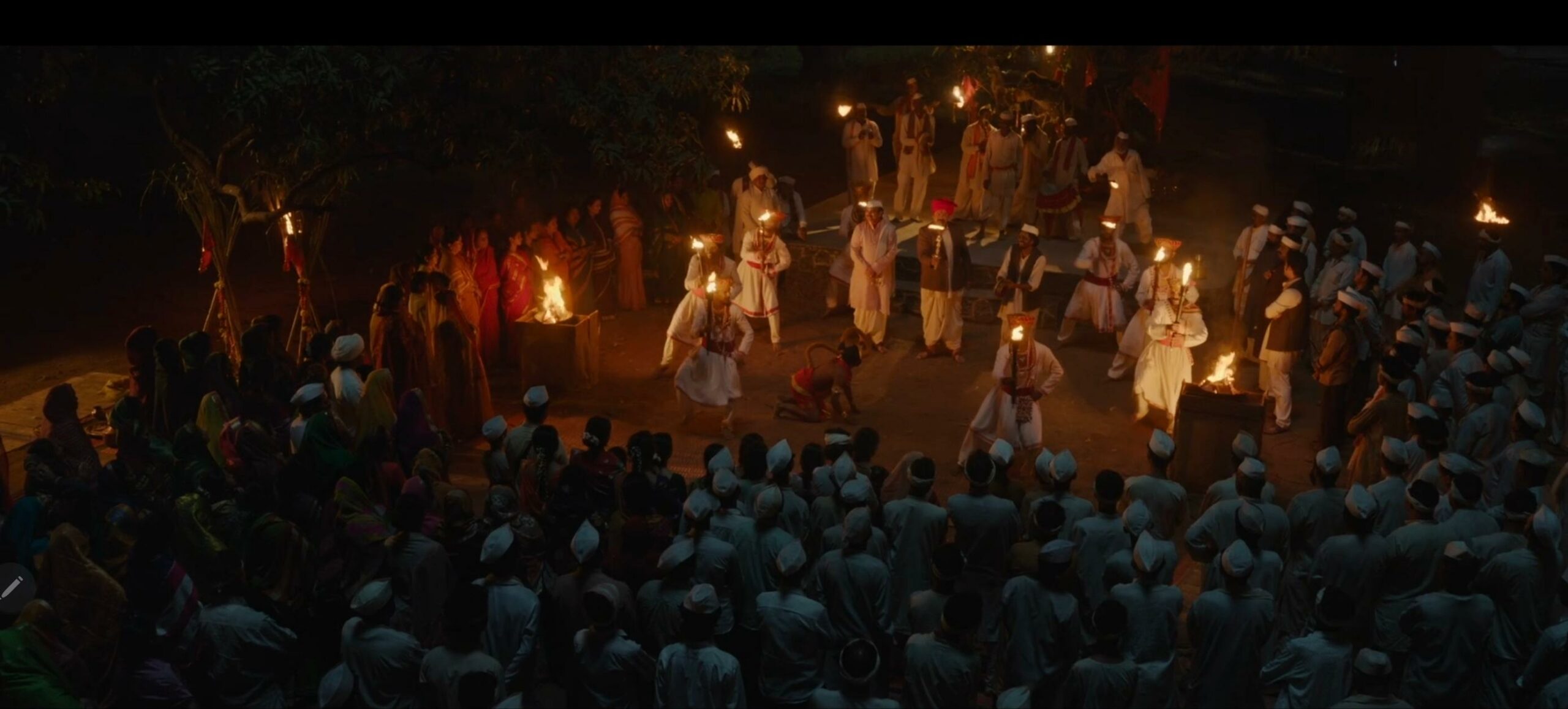
When content and form merge together, the story transcends mere narration and becomes an experience. Form becomes the content, shaping meaning through its very structure, rhythm, and cultural texture. What emerges is not just a tale being told, but a living expression rooted in its soil.
The story itself is familiar—one that has unfolded over generations. A story of power-hungry men and those who fall victim to them. Of human cunning. A story that could happen anywhere in the world, yet one that absorbs the colours and smells of the soil in which it takes place.
But the texture of a story depends on how it is told, on the form the storyteller chooses. An unusual narrative style weaves an unusual texture, and the story becomes new.
This is precisely what Gondhal, a Marathi film directed by Santosh Davakhar, winner of the FIPRESCI Award in the Indian Cinema (Chitrabharati) Competition section at the recently concluded 17th Bengaluru International Film Festival 2026, demonstrates.
The Ritual Performance
The literal meaning of the Marathi word gondhal is confusion, but here it refers to a specific religious folk tradition of the state of Maharashtra, India: an ancient ritual-performance devoted to the worship of goddess Durga Bhavani and the god Khandoba. On auspicious occasions such as weddings, members of the gondhali community are invited to the wedding house to perform this ritual-drama. Through all-night singing and dancing, the deities are invoked to descend, bless the newly married couple, and ward off impending misfortunes in their marital life. A man called Vaghya and a woman called Murali, both dedicated to the deity, dance as part of this ritual.
It is through this very ritual form that the film’s story takes shape. The seamless integration of form, narrative style, and subject matter becomes the film’s most distinctive feature. The story unfolds in rural Maharashtra, and its form emerges from the very soil of rural Maharashtra, lending deeper meaning to the non-duality of content and form.
The ritual song and dance performed at the wedding of Anandarao Patil, the bridegroom, and Suman, the bride, is not only part of the story but also acts as a catalyst that propels subsequent events.
Abasaheb Patil rules the village through fear. Intimidating poor tenants and farmers, sexually exploiting women, forcibly grabbing land, acquiring any woman who catches his eye, and treating village women as his personal property—this defines his character. Murdering relatives to seize village power is a legacy handed down through generations. People do not respect him; they fear him. He tells his young son Sarjerao that power must be sustained through terror.
Sarjerao is a rough, aggressive man, walking in his father’s footsteps. He desires Suman, but marriage negotiations collapse over the exorbitant dowry demanded by Abasaheb Patil. Eventually, through the mediation of Bhivba the gondhali, Suman is married into the Patils’ extended family—to Anandarao.
Both Abasaheb and Sarjerao will stoop to any level to get what they want. Blood relations, even the bond between father and son, hold no sanctity. Even during the ritual, Sarjerao relentlessly tries to claim Suman. Her beauty is the talk of the entire region; the village envies Anandarao’s good fortune.
Complex Characters
Suman is fully aware of the power of her beauty and possesses the cunning to wield it. She too is manipulative and ruthless when it comes to getting what she wants. On one hand, she despises her marriage to the shy, childlike Anandarao; on the other, she continues enticing Sarjerao even during the ceremony. Meanwhile, her lover arrives disguised as a murali dancer to perform in the gondhal.
The elderly Bhivba, the gondhali, is the master of the ceremony. The honour of holding the sacred oil lamp traditionally belongs to him. When Abasaheb Patil arrives, he snatches the oil lamp from Bhivba’s hands and takes the centre space. Once again, the gondhali is forced to swallow humiliation. Yet Bhivba does not relinquish his control over the ritual’s deeper workings.
In the film’s opening extended shot, we see Bhivba setting out for the wedding house in the dim light of a lantern. His grandson Vishnu accompanies him, eager to witness the gondhal. Much churns within Bhivba’s mind, visible on his face. Beneath his restrained words lies not just wounded pride, but a resolve that goes beyond helplessness.
Through songs performed during the gondhal, Bhivba’s fellow gondhalis provoke members of the Patil household, pointing out their moral corruption and nudging events forward. The audience of this ritual is the entire village—both spectators of the drama and mute victims of the atrocities as well.
Though young Vishnu does not fully grasp everything, he wonders why he is teased at school for being Abasaheb Patil’s son. As he watches the gondhal, understanding dawns upon him. Ultimately, it is his own participation—his request within the ritual—that ignites the spark leading to the final event.
Vishnu grows up. Similarly, Anandarao’s timidity dissolves in the wake of unexpected events, replaced by newfound confidence.
Rhythm and Intensity
The ritual itself builds in pace and intensity through the night, and this escalating energy perfectly complements the accelerating momentum of the film’s narrative. Performed at night by the blazing light of torches and oil lamps, the gondhal is deeply rooted in rural life. The film’s nocturnal lighting design creates an atmosphere charged with consequence.
The rhythm of songs, music, and the villagers’ responses merge into a unified force that amplifies the narrative impact. The large groups of villagers, their reactions as spectators, and extensive night-time exterior cinematography present significant challenges for the director-screenplay writer and his team—cinematographer, editor, and sound designer alike. These challenges are met with remarkable competence.
The FIPRESCI jury, comprising V. K. Joseph, Laurenţiu Brătan, and Rekha Deshpande, unanimously selected Gondhal for the FIPRESCI Award.
Rekha Deshpande
© FIPRESCI 2026