
Politics/Past/Family Problems: The Nigerian Challenges of Akinola Davies Jr.’s First Feature Film
The winner of the Grand Prix in Luxembourg, My Father’s Shadow, is analyzed by the Italian film critic Michela Manente, who finds in it a truly formative story deeply rooted in the Nigerian political situation, which represents a vivid and cultural portrait, poised between family memory and collective trauma, of a country back in the 90s.
1993 was a special year in Nigeria, the year of presidential elections canceled due to alleged fraud, which provoked an immediate reaction in the streets threatened by the army. Akinola Davies, Jr., the director of My Father’s Shadow (written with his brother Wale) was probably in Lagos when he saw, through a child’s eyes, the rapid militarization of a country already affected by poverty and corruption, worn down by many years of military dictatorship and again on the brink of a coup. An Anglo-Nigerian co-production and the first feature film by Davies (director of the short film Lizard, 2020), the winner of a Caméra d’Or special mention as a debut work at the 2025 Cannes Film Festival, the film won the Grand Prix at the 16th Luxembourg City Film Festival.
In short, My Father’s Shadow is a portrait of a historical event from June 1993, deeply rooted in Nigeria’s history, filtered through the vicissitudes of a family. Folarin (Sope Dirisu) is a father often absent from home due to business in the capital. One day, returning home to a suburban and rural area, he meets his two young children: Akin (Godwin Chiemerie Egbo) and Remi (Chibuike Marvellous Egbo), 8 and 11 years old—brothers in the film as in real life—spending the day playing and arguing in the absence of their mother. He decides to take them to the capital to try to recover his salary, which has not been paid for many months. The city, seen through the eyes of the two children, is particularly chaotic, so much so that the father will have to warn them about urban dangers but will also have to assert himself in his role as a father and try to explain some unspoken aspects of their family relationship. Starting from a small and peaceful countryside village to the crowded streets of a metropolis, we follow the hours before the journey and then the encounters of Remi and Akin.
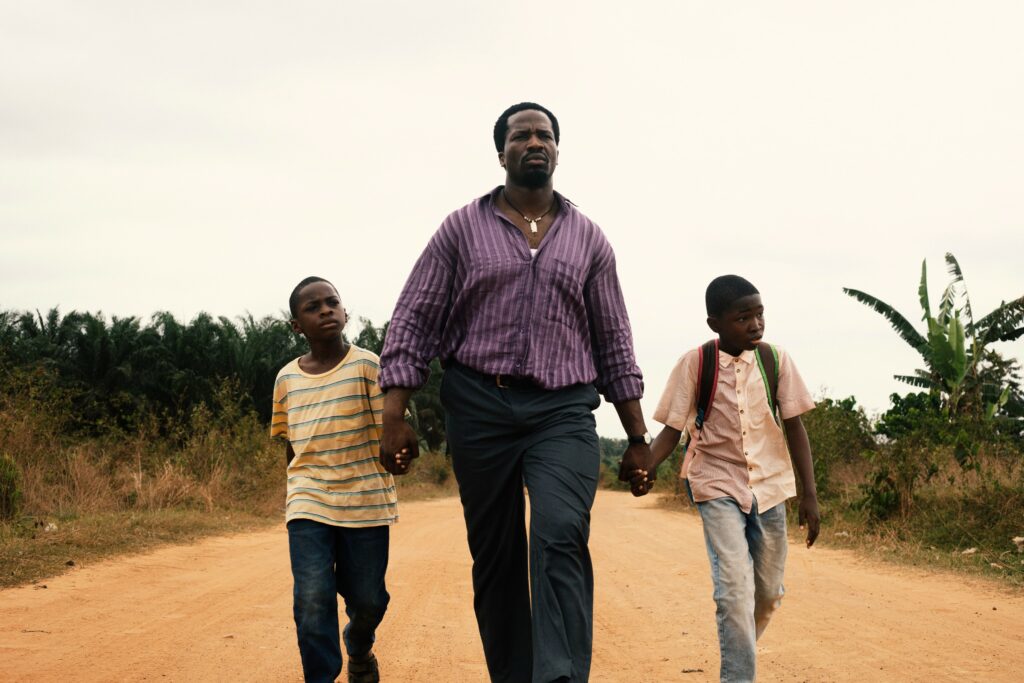
In addition to Nigeria, particularly the capital and the outskirts, the other major narrative focus is the family. In fact the political and economic difficulties of the country often force Folarin to move to Lagos for work for entire months, leaving his children in the native village with their mother. The choice to take them with him for a day is therefore a journey not only geographical but also familial, in search of an opportunity to mend the rift that distance has created, especially in the younger of the two children.
The story that unfolds here is one of great realism, made up of small urban scenes, of the faces of passersby and soldiers observed almost from the inside, of people eating, of confusion in the market as in the streets, of people hugging, of two children who still oscillate between the carefree frivolity of childhood and the premature maturity and awareness to which they are immediately called. Even the direction itself seems to oscillate. Amid long sequences in which the camera almost disappears, letting the images speak as if we were in a documentary, there are occasionally different choices inserted: the flash of a memory, the repetition of an image, a highly expressive close-up, all marked by a profoundly genuine character, which seems natural and lived in every moment. The actors certainly contribute to this as well. The two children are absolutely convincing both in their sibling quarrels and in their relationship with their father: they observe and react as children can. Also Sope Dirisu, in the role of this father figure—somewhat absent but very steadfast in his principles and in his love for his family—is believable and sincere.
The two major themes outlined, social/political conditions of Nigeria and family bonds, are closely integrated in this film of struggle: an investigation into how difficult it is to be truly a father and truly a son but, at the same time, an accusation and a protest against the military regime in power in the country. The abuses and violence of the army are never shown openly, but evoked: by an occasional radio, by the conversations among people in local bars, by newspaper pages, by the wary faces of soldiers on army trucks, by the concern on the faces of women, by the ideals of freedom and renewal that Folarin himself, cautious but convinced, speaks for, up to the accusation of him also being an anti-militarist revolutionary. Thus, this almost structural intertwining is maintained until the ending, the climax of both these narrative lines.
Viewing My Father’s Shadow is intense, vibrating with the bright colors, atmospheres, and contradictions of Lagos, living in the simplicity of its two young protagonists and the calculated yet caring and strong personality of their father, well know in Lagos with the nickname “Kapo.” The film appears true to the story it wants to tell the community and yet, at the same time, is interpreted in an expressive and personal way by director Akinola Davies, Jr. This film, shot in 16mm to relive the phantoms and the shadows of the father and of an entire nation, strongly wishes to communicate, while hiding behind the eyes of two children who are entering adulthood in Lagos.
Michela Manente
© FIPRESCI 2026