
Profession: Architect—In Memory of J.O.S.
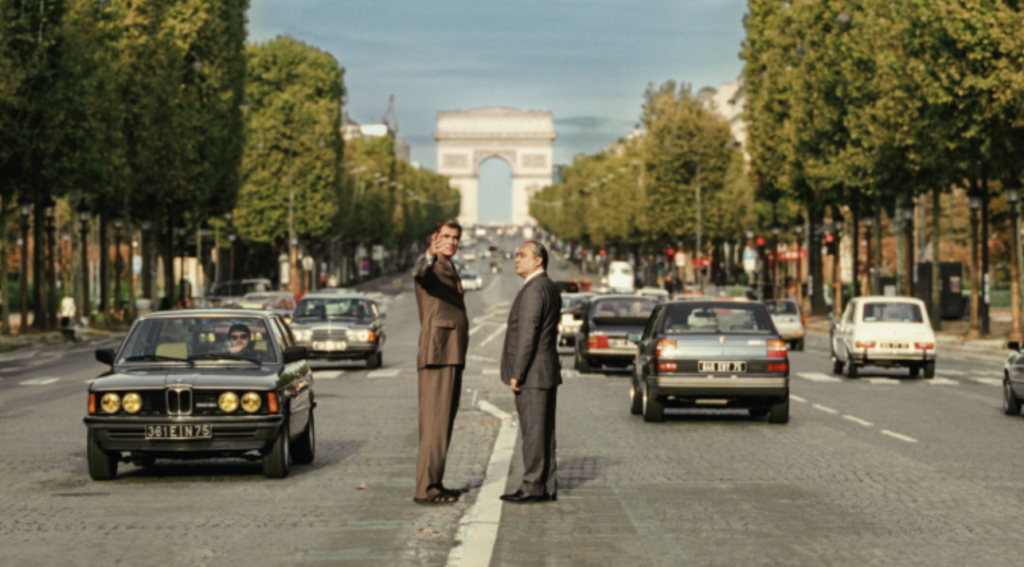
Filling a glaring gap in the cinematic repertory on architecture is Stéphane Demoustier’s “The Great Arch” (L’inconnu de la Grande Arche, 2025, Stéphane Demoustier, French filmmaker and director), which offers a welcome celebration of both art and artist. Based on the story of the previously unknown Danish architect Johann Otto von Spreckelsen, the film offers a memorable reflection on creative masterworks realized only posthumously, settling deeply into the viewer’s mind by its haunting end.
Although the history of cinema knows of geniuses who were trained as architects—Fritz Lang, for example, with Metropolis, or Sergei Eisenstein, whose films display a pronounced penchant for monumental composition —architects themselves and their art have rarely aroused sustained interest among filmmakers. A telling example of this relative neglect is The Belly of an Architect (1987, Peter Greenaway, Welsh-born British filmmaker and director), which focuses primarily on the stomach ailments and heart problems of its protagonist. A kind of compensation for this omission is offered by The Great Arch (2025, L’inconnu de la Grande Arche, 2025, Stéphane Demoustier, French filmmaker and director), which, in contrast, fully celebrates architecture as an art form and the architect as an artist.
It is worth noting the striking discrepancy between the film’s original title, L’inconnu de la Grande Arche, which accurately reflects its content by drawing attention to its central figure, and the English title, The Great Arch, which instead seems to promise a documentary devoted to an architectural monument. The difference between the two titles neatly encapsulates the film’s thematic core: the drama of an artist whose vision of a perfect work encounters various forms of resistance, resulting in a mutilated form that ultimately contributes to the creator’s death.
Demoustier’s film draws inspiration from historical events that had earlier provided the basis for Laurence Cossé’s novel La Grande Arche. This fascinating story truly took place more than forty years ago, and its characters are real people who appear in the film under their own names. The main protagonist is the previously unknown (the eponymous l’inconnu) Danish architect Johann Otto von Spreckelsen (1929-2987), whose design unexpectedly won an international competition announced in 1982 by the then-president of France, François Mitterrand. The award was for the construction of the Grande Arche de la Fraternité in the La Défense district, an architectural monument intended to commemorate the bicentenary of the great French Revolution.
The outcome of the competition was startling: the 53-year-old winner, unsupported by any major professional agency, possessed a remarkably modest portfolio. Apart from his own house, he had designed only two Catholic chapels and two Protestant churches. He also lectured on architecture at his alma mater, the Royal Danish Academy of Fine Arts in Copenhagen. His architectural style was characterised by a sophisticated simplicity grounded in the highly functional deployment of geometric shapes. President Mitterrand was persuaded by the “purity of form and power” of Spreckelsen’s proposal. It also integrated seamlessly into the historical urban fabric of Paris, closing the great axis (the Axe historique) formed by the Champs-Élysées, the Arc de Triomphe, and the Louvre. Moreover, the design was sensitive not only to the colors changing under the influence of light, but even the backdrop of the clouds.
This flawless artistic vision was nevertheless doomed to collide with a succession of bureaucratic, material, financial, and ultimately political barriers. The futile struggle of a perfectionist architect to realize his ideal project constitutes the narrative backbone of the film, which functions both as a tribute to the art of architecture and as a portrait of the uncompromising temperament of an artist faithful to his moral and creative principles. Danish actor Claes Bang—memorable for his leading role in The Square (2017, Ruben Östlund, Swedish filmmaker and director)—delivers an outstanding performance in the role of Spreckelsen. Michel Fau is equally evocative as François Mitterrand, the architect’s loyal patron and supporter. He is a president who, with a touch of monarchical majesty, attempts to shield him, yet who, after the advent of a right-wing government, loses the ability to intervene, thereby sealing the architect’s defeat. Spreckelsen, who died in 1987, did not live to witness the completion of his dream project, which was marked by numerous compromises, having previously resigned from its authorization.
The film’s bitter conclusion leaves a lasting impression: when two of the Dane’s French colleagues search in vain for his grave in a rain-soaked Copenhagen cemetery, the camera briefly settles on a round plaque bearing the inscription, “J.O.S.”
Tadeusz Szczepański
Edited by Olivia Popp
@FIPRESCI 2026