
White Lights of the Black Nights
The First Feature Competition of the 29th edition of the Tallinn Black Nights Film Festival (PÖFF), viewed by the FIPRESCI jury, included thirteen debut films from Europe, Asia and America: intimate character studies, genre-bending experiments, and works that incorporate documentary techniques into fiction.
The selection brought together not only young and relatively inexperienced directors but also well-established figures in cinema who either ventured behind the camera for the first time or shifted from documentary to fiction. Among them was the celebrated Mexican actor Daniel Giménez Cacho, who, after a distinguished acting career working with renowned filmmakers like Almodóvar, Weerasethakul, Martel, and the Three Amigos of Cinema, presented his directorial debut, Juana (Mexico). The film’s title character struggles to maintain her sanity in the horrific aftermath of a journalistic incident all while reliving a long-standing childhood trauma. Giménez Cacho reveals the inner world of a person burdened by multiple psychological scars, through the use of visual imagery—any reflection, whether in the rearview mirror, an elevator, or even at the bottom of a glass, threatens to turn into obsessive images from the past—paired with a soundscape of moans, rustles, and gasps. However, tying all the plot lines together becomes an impossible task, and the film gradually devolves into a kind of wandering soap opera.
Reflecting on trauma is also a central theme in Easy Girl (Germany): its protagonist is yet another fractured figure as if hesitantly pieced together by the screenwriter and director Hille Norden. While Juana uses visual and auditory techniques to immerse viewers into the protagonist’s inner demons, Easy Girl relies more on dialogue: long conversations and confessions about the past. But even here, everything is not so straightforward. The film’s most compelling device emerges when these tales begin to materialize, gradually intruding into the fabric of reality. Midway through the story, the protagonist quite literally splits: two versions of herself—past and present—occupy the same physical space. The third act is entirely built on the juxtaposition of dimensions: the characters exist simultaneously in the here and now and somewhere far in the past, creating the sensation of a continuous dialogue between layers of time.
A few vacation days on a quiet Bulgarian seashore culminate in the collapse of Lucia’s already fragile world. That is perhaps the most succinct way to describe Safe Place (Romania, Bulgaria) by Cecilia Ștefănescu. Here, reality exists solely in the immediacy of the present moment. This is characteristic of the Romanian New Wave: from the very first shots, a distinct tone is set, while the editing and cinematography steadily build tension even within the most ostensibly “peaceful” scenes. The key sequence, an endless village dinner captured in long takes, is a carefully crafted false idyll: the men get drunk, debating politics, money, and war, while the women remain silent, reduced to quietly serving them.
Woman’s experience emerges as one of the program’s central themes. Questions of self-identity set the tone of Elena’s Shift (Greece) by Stefanos Tsivopoulos, from its opening shot, a stark, minimalist interview with a Romanian woman applying for Greek citizenship. Filmed almost like a police interrogation, the scene foregrounds her uncertainty and vulnerability before a state that sees her only as a labor migrant rather than a full member of society; she repeats her pre-rehearsed answers with visible hesitation. Her daily life is a web of internal and external conflicts: raising a young son, a difficult relationship with her mother, uncertainty in her personal life, injustice at work, and fighting for her rights. Some narrative threads remain unresolved. For instance, her struggle for labor rights yields no concrete external victories. Yet it is precisely through this process that Elena begins to reassemble herself, reclaim her sense of dignity, and gradually adapt to a new society.
In My First Love (Norway), director Mari Storstein draws on her personal experience to address an important issue. Ella, born with a disability and using a wheelchair, dreams of moving into her own apartment for college. However, a denied assistance application forces her into a care facility, shattering her hopes for independence. Rather than delivering the expected heartbreaking social drama, Storstein creates a lighthearted teenage romance—far more Hughes than Dardennes—about college life, first relationships, the search for autonomy, and the joy of life despite all adversities. While not particularly original, it’s a feel-good movie that will resonate with many viewers, thanks in part to Marie Flaatten’s excellent performance in the lead role.
Dump of Untitled Pieces (Turkey) offers an ironic glimpse into the pretentious, insular world of contemporary art. A young woman cuts ties with her family and becomes obsessively determined to make it as a photographer. Driven by a kind of supernatural-frenzied rebellious impulse, she is capable of anything, including, for instance, casually smashing a stone through the window of an art gallery she “dislikes.” But every act of protest is immediately absorbed by the system: neatly packaged, monetized, and re-displayed as yet another exhibit for the amusement of the wealthy and the pseudo-aesthetes. Director Melik Kuru, in a fashion typical of many first-time directors, appears insatiable in his experimentation. He shoots in monochrome, sporadically breaks the fourth wall, and toys with form in every possible way; at one point, an entire sequence unfolds as a rolling strip of film. What stands out, however, is the director’s self-irony. In the finale, the seemingly settled protagonist, in a renewed surge of rebellion, flees all authority figures at once: both her father and the director himself, who once again intrudes into the film’s reality. It seems this is the only true form of protest: refusing to grow up and escaping “responsible life”.
A special focus of the program was on films that play with genre, or even anti-genre. In Backstage Madness (Kyrgyzstan), director Amanbek Azhymat whips up a hodgepodge, borrowing from the cookbooks of Takashi Miike, Mani Haghighi, and Adilkhan Yerzhanov. An elderly screenwriter, wearily bent over an old typewriter, hammers out vulgar, chaotic plots that “magically” materialize. A young woman showers while a four-eyed pervert sneaks up on her; the pervert then appears before his creator, the screenwriter, who, without hesitation, shoots this figment of his imagination with a toy shotgun. Moments later, Pennywise, Freddy Krueger, Genghis Khan, a mullah, a priest, and other figures whirl in a circle to nostalgic Kyrgyz pop. After such a flamboyant introduction, it becomes almost impossible to shock the viewer, even with a vibrator perched on the forehead of a gangster-philosopher. What was intended as an ironic yet important statement about authorship, art, and the all-consuming, fickle marketplace quickly slips into stale parody.
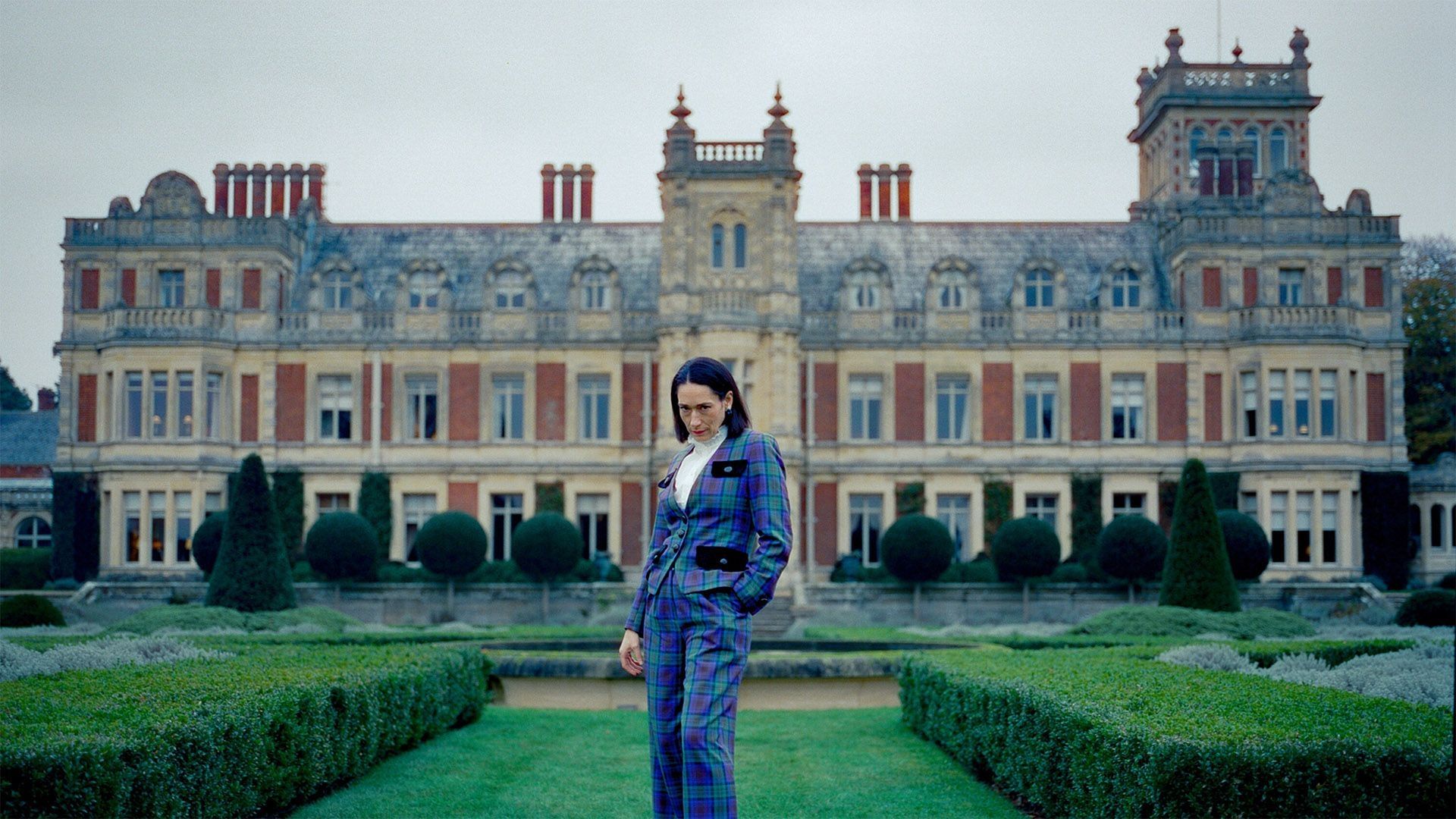
The comical continues with Samuel Abrahams’s Lady (UK), at first a sparkling mockumentary about Lady Isabella, an eccentric, somewhat scatterbrained aristocrat living in a remote manor, who commissions a BAFTA nominated director to make a documentary about her. By the end of the first act, it becomes clear that the story has little room to develop: the plot seems to loop back on itself. Abrahams is left to play (often quite successfully) with clichés of Gothic horror and reportage-style documentary. The result is still enjoyable, though one can’t help but feel that, as a short film or a series of sketches, the concept might have had real cult potential.
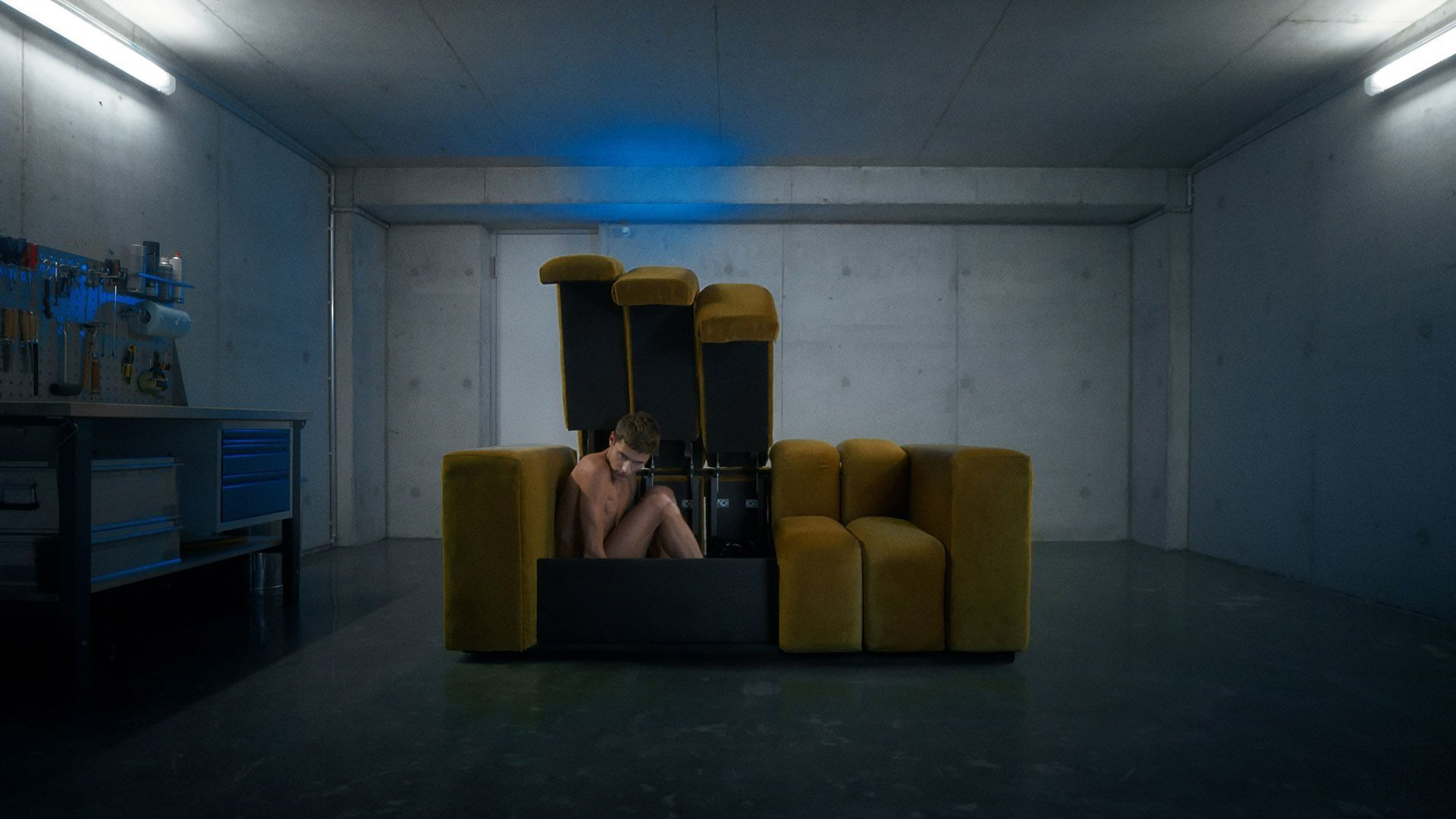
Kazimir, an odd trespasser from Pascal Schuh’s Interior (Germany), uses a sofa with a secret compartment to slip into people’s homes. He plants surveillance cameras and quietly records their most unguarded moments. The main rule is to remain unseen and not interfere with the natural course of events. The footage is then delivered to his mysterious master, Dr. Lieberman, who watches it from his icy abode. Schuh never lays all his cards on the table, leaving room for various interpretations: the film can be read as a metaphor for art, politics, or even religion. In terms of cinematic kinship, the voyeuristic horror elements immediately evoke Haneke’s work, from Funny Games to Benny’s Video. However, stepping beyond direct stylistic associations reveals another, more unexpected parallel: the project becomes the antithesis of perhaps the biggest German cinematic hit of all time, The Lives of Others.
A more straightforward genre exercise is This Is Not Happening (Poland). Artur Wyrzykowski’s film could be seen as a kind of Polish answer to Netflix’s Adolescence. After murdering his classmate, a desperate young man turns for help to his father, a seasoned political schemer used to controlling everything and everyone around him. But now he is faced with a challenge that neither his connections and experience, nor usual cold rationality can resolve. The film is an intimate, almost hermetic thriller: right up to the climax, the action remains confined to a single apartment. Despite noticeable flaws, it manages to captivate and hold attention in certain moments. Unfortunately, such striking episodes are far fewer than one might hope over its 75-minute runtime. Though its brevity is, incidentally, also one of its strengths.
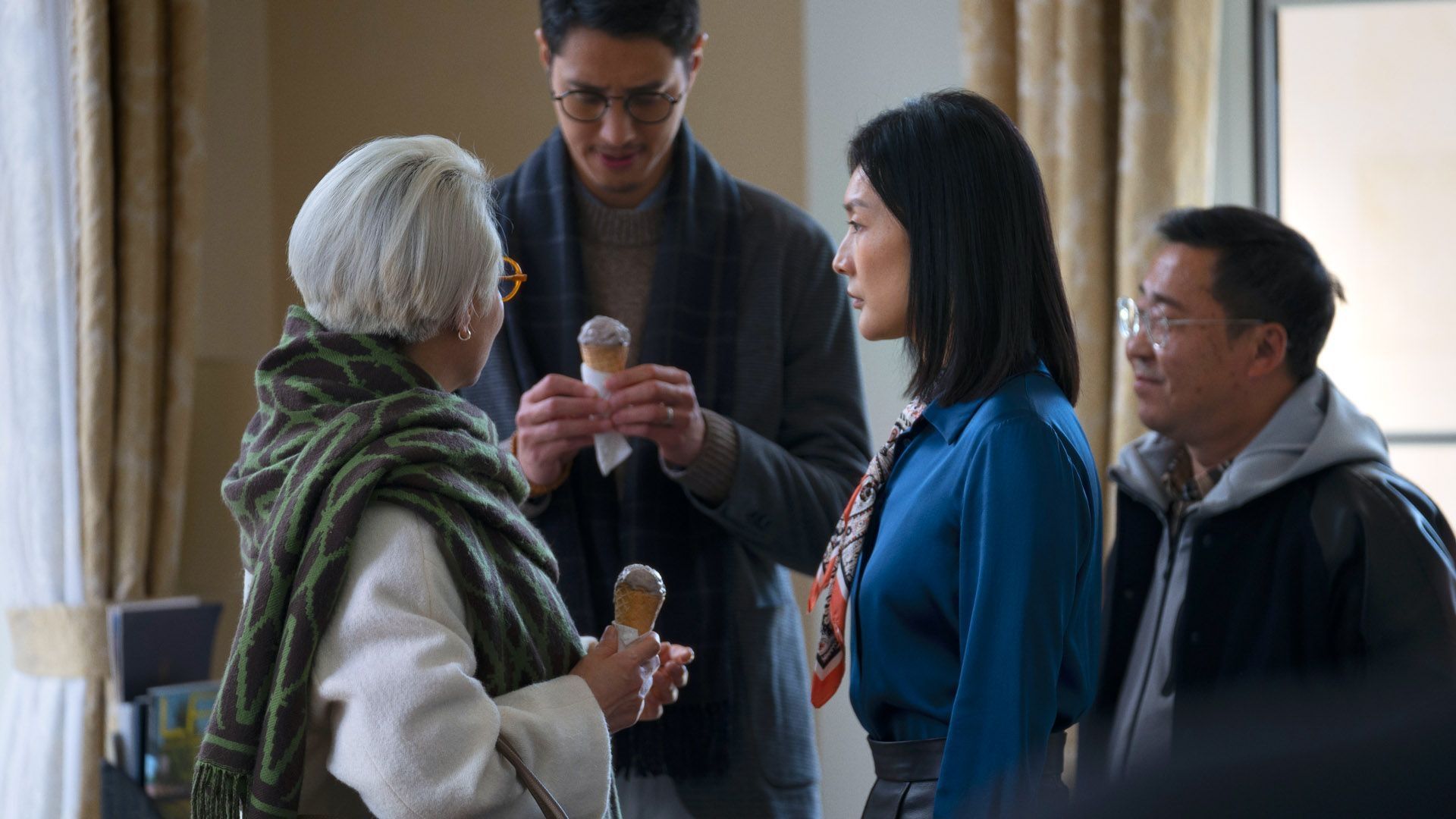
A stylistic and temporal antipodes to Wyrzykowski’s film is Admission (Taiwan) by Hsu Kun-Hua, another hermetic work about children and parents. Setting aside the prologue and a few brief flashbacks (interview scenes with the admissions committee, framed, again, as strange interrogations), this is a classicist play with temporal and spatial unity, captured with remarkable mastery. Long takes, impressive mise-en-scène, and minimalism. The rejection of their young son by a prestigious school threatens to tarnish the reputation of an upper-middle-class family, prompting the parents to consider unconventional measures. Maintaining a deliberate distance, the director examines the dynamics of the characters’ relationships: who manipulates whom, how, and why. Five people “trapped” in a hotel function as a microcosm of the modern society of achievement and fatigue.
The gaze of new auteurs frequently turns backward. Kat Steppe, the director of Sunday Ninth (Belgium, Netherlands), tells the story of two brothers: Horst, who suffers from Alzheimer’s and lives in a nursing home, and Franz, deeply in debt, who views his brother’s inheritance as the solution to his financial troubles. Following the precepts of Van Dormael’s Toto le héros, the film is constructed from at times unreliable flashbacks, that intertwine memories and dreams. Only toward the end do the disparate fragments of the brothers’ childhood and youth come together. A parallel narrative unfolds through the daily life of a real nursing home and its residents, one of whom communicates with the outside world almost exclusively using the two words from the film’s title. While the effort to combine documentary and fiction is commendable, the program included a far more successful example of this approach.
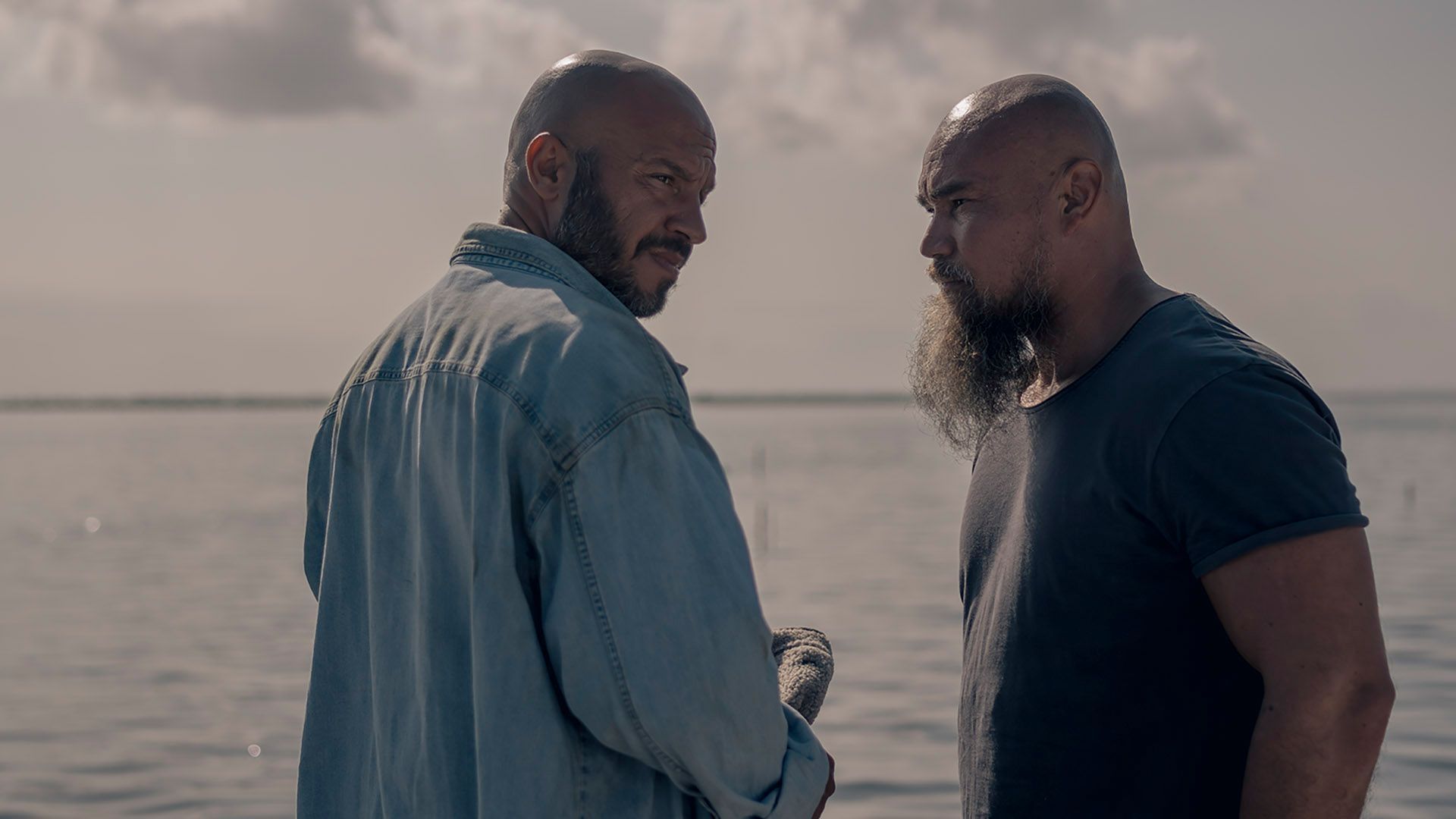
In Hercules Falling (Denmark), the protagonist Yusef, masterfully portrayed by Dar Salim, carries the heavy burden of war, inflicted in the mountains and deserts of Iraq and Afghanistan. Director Christian Bonke, whose film stands as the program’s most striking entry, asks the perpetual question: Can a soldier ever truly return to civilian life after what he has seen and done in war?
The film opens with a cozy yet inverted domestic scene. After an evening of watching TV together, a boy wakes his father, who, still half-asleep and on autopilot, suddenly attacks and begins to strangle him. The title and opening reference the myth of Heracles (or Seneca the Younger’s tragedy Hercules in Madness), in which the hero, in a fit of insanity, kills his own children and, upon regaining his senses, leaves his homeland in exile. Likewise, after a near-fatal incident, Yusef enters his own kind of exile: a rehabilitation center for veterans on a remote island—a closed community where men attempt to find inner peace.
This is where the bridge between fiction and documentary is crossed. The film depicts a real-life commune for veterans with post-traumatic stress disorder. The head of the center, Anne-Line Ussing, plays herself, as do many of the veterans undergoing rehabilitation. Bonke, with his extensive experience in documentary filmmaking, seamlessly integrates these elements into the film’s otherwise conventional narrative. As a result, the film moves like a train guided by an experienced engineer, arriving at every station precisely on time: it may not break new ground, but it fulfills its objectives admirably. And the documentary component adds another dimension, elevating the film to a new level.
Alexander Melyan
©FIPRESCI 2025