
Review: The Anatomy of Horses
The revolution failed. Only horses can be free.
What is the most compelling aspect of a film festival? Certainly, watching an outstanding film. The excitement intensifies after seeing several exceptional films. Then you realise the festival’s selection is consistently impressive, assuring you that cinema’s future is promising. Ultimately, the greatest reward is discovering a new voice—a debut filmmaker from a little-known national cinema—who displays remarkable maturity. All these elements converge in the film The Anatomy of Horses, directed and written by Peruvian filmmaker Daniel Vidal Tocha.
An exceptional film is evident from the opening scene. The remarkable prologue, presented in slow motion and underscored by evocative music, immerses us in a liminal world between reality and dream. Elements appear familiar, yet consistently elude our grasp, invoking Borges’ magical realism. The introduction is extended and introspective, layered with dream sequences, deathbed rituals, biblical imagery, and South American folklore that nearly converges with the Western. The revolution has faltered once more, the future remains as uncertain as ever, but the decision has been made with clear intent, leaving no possibility of return. It manifests as both a mindset and an ancestral inheritance.
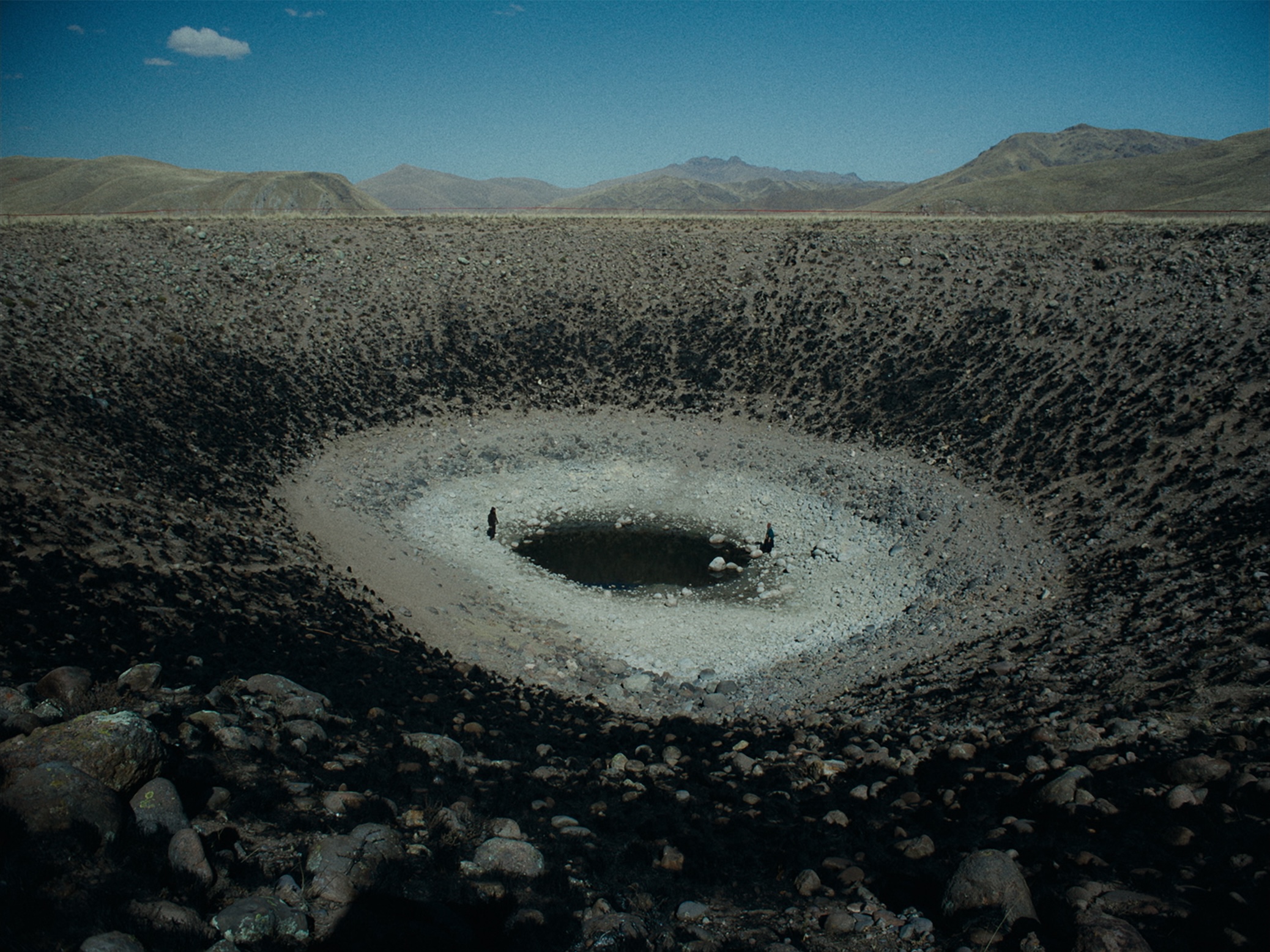
The revolutionary is gentle; he prays for the soul of the llama he must kill in order to survive in the vast desert. He knows that the revolution is a failed endeavour, and all he wants is to return home. And just when we, as viewers, think that we are attending one of those introverted films in which we follow the struggle of a man with himself, with the context in which he lives and with the whole world, a meteor falls from the sky! And it makes a huge hole in the ground. Oh, how I love that unexpected “switch” in stories, both in film and in literature, because it makes me feel alive, makes me think about life as a reasonable human being.
From a romantic view of the revolution, the film’s author catapults us into the harsh capitalist reality of the new millennium. “Bread and Games” is an ancient formula for satisfying the needs of ordinary people, those who still respect the rules of nature as a source of their own existence. In the picturesque landscapes of the Andes, the past is present everywhere, and it happens in the moment, as an unbearable lightness of existence for residents from different provinces. The dance in front of the mine of death is only a momentary expression of the joy of living, while problems pile up one on top of the other. But the locals are aware of the times they live in. Never underestimate ordinary people. They are the heart of planet Earth.
And again, another “switch” follows as a new qualitative layer in the film’s story. The sister is searching for her lost twin. Everyone doubts the meteorite, the stellar body that, without any particular intention, will manage to unite two kindred souls. And while the revolutionary still believes in radical transformation, she, the lost woman of his dreams, the symbol that connects past and future times, is certain that change is not possible. All this leads us to the ultimate, essential question: is revolution innate in us or is it just a construction that we constantly strive for!?
And that, the end (of the film, of life, of the world), implies a new beginning, which begins with a song about the dead sister. “Who are we, you and I? Just a cold, lonely wind.” And while the white men bring death to the cities, the children play with wooden guns, and the village madwoman repeats the prophecy endlessly: “Listen, traitor, you will go blind and sell your cause.” The circle is round, you put your dead friend on the horse, and again set off on the road to nowhere, like a fate from which there is no escape.
But consciousness is present all this time. You know that the future is behind you, and that is precisely why you must start all over again, because, simply, there is no other way. And the best place to do this is by the river, because water cleanses all sins. In doing so, quite naturally, you free the horse from the chains, because only horses can be free. Like that of the pioneer of moving images, Eadweard Muybridge. And you are once again engaging in history, moving backwards. Because, don’t forget, the future is behind us all.
The viewer in the darkened cinema temple finally becomes an integral part of the foretold Borgesian magical reality, through the view of the revolutionary’s telescope, like a kaleidoscopic mirror that projects incredible polysemies. The perception of the complex story becomes a pleasure that requires footnotes, from which you know in the end that a text full of metaphors will emerge. Like the film work itself.
The Anatomy of Horses is visual poetry that I haven’t seen on the silver screen in a long time!
Igor Angjelkov
©FIPRESCI 2025