
Thirteen Films, Two Conversations
Davide Abbatescianni assimilates the opinions of the main makers from this year’s program of International Feature Oscar contenders. What became apparent was the very different production values based on budget or as a necessity because of social or political pressure in certain countries.
Filmmakers behind this year’s Best International Feature contenders discussed a wide range of topics – from casting roosters and shooting on iPhones, to sound as trauma, the ethics of reenactment, and working under political pressure
On 7th January, the Palm Springs International Film Festival (2nd-12th January) hosted two Best International Feature Film panels at the Annenberg Theatre, offering a rare, concentrated look at how international contenders are made – practically, emotionally and politically.
The first session, moderated by The Hollywood Reporter’s Senior Entertainment Reporter Mia Galuppo, brought together directors Dolores Fonzi, Neeraj Ghaywan, Shih-Ching Tsou, Annemarie Jacir, Joachim Trier, Oliver Laxe and Hasan Hadi.
Session two, hosted by The Hollywood Reporter’s International News Editor Kevin Cassidy, welcomed Cherien Dabis, Jafar Panahi, Petra Volpe, Lee Sang-il , Kaouther Ben Hania and Mascha Schilinski.
Across both conversations, a set of shared questions emerged: how to protect truth without flattening it into ‘message’; how to craft performances that feel lived rather than performed; and how formal decisions – camera size, sound design, locations, rehearsal methods – become ethical decisions when cinema is made in the shadow of real violence, collective trauma or structural neglect.
Panel 1: Nerves, Logistics, and the ‘DNA’ of Place
Mia Galuppo opened by asking what, heading into production, made each filmmaker most nervous. Annemarie Jacir, director of Palestine 36 (فلسطين٣٦), answered in bluntly practical terms: “There were many things, but the biggest was staging large-scale military violence – handling extras, explosions, and action on a scale I hadn’t worked with before. That was intimidating.”
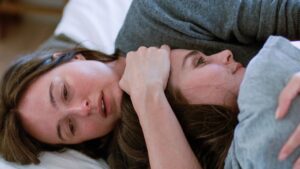
While making Sentimental Value (Affeksjonsverdi), Joachim Trier’s anxiety was both personal and structural: “On a personal level, it was my first film after becoming a father, and the film deals with a difficult father-daughter relationship. That resonated deeply. Professionally, it was about balancing tone across many characters. We aimed for a polyphonic structure – no villains, just people. Maintaining tonal unity across performances was something I remained nervous about throughout.”
Oliver Laxe, whose work leans toward the sensory and the spiritual, framed fear as part of Sirât’s meaning: “For me, it was the violent sequences. I was afraid of being misunderstood. My intention was to take care of the spectator – it’s a kind of shock therapy. Those scenes were difficult to write, shoot, and edit. We really suffered making them, but that’s part of art: moving forward despite fear.”
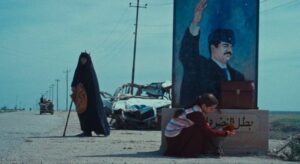
For The President’s Cake (مملكة القصب), Hasan Hadi’s nerves, by contrast, were tied to the most unpredictable of performers: “Many things – but especially casting the rooster. We tested many roosters to see if they were aggressive enough. We ended up with four brothers.” He then described a moment of near-impossible coordination – bird behavior, jet timing, and an improvised off-camera trick: “On the day, we used another rooster behind the camera to provoke him. He flapped, crowed, looked up – the jet passed. It was perfect.”
Shih-Ching Tsou, helmer of Left-Handed Girl (左撇子女孩), revealed that her production problems began with an animal, too – though one shaped by regulation and the pandemic: “Originally it was a monkey – I grew up with one. But Taiwan has strict rules, and pandemic quarantine made it impossible. So we switched to a meerkat. He had a great personality and could be trained using a cockroach inside a red ball. When he saw the ball, he’d run for it.”
Homebound director Neeraj Ghaywan returned to emotional calibration rather than mechanics, describing a climactic sequence whose tone had to land without tipping into easy effect: “The final sequence on the bridge was the hardest. It was emotionally delicate – I didn’t want melodrama, but I had to land the truth. I kept rewriting during production. We shot it last, and watching it unfold felt spiritual.”
Dolores Fonzi’s case was distinctive: she was building Belén from recent history and a living subject. She described the paradox of responsibility and creative freedom as “a gift”: “I became friends with her – she’s now my lawyer. She collaborated constantly via WhatsApp and lives where the events happened. We merged energies.” That relationship, and the openness to fiction within a real framework, allowed the film to move between the private experience of a woman and the broader social movement around her story.
A recurring theme of the first panel was how filmmakers create ‘reality’ not through a single technique, but through dozens of choices – casting, rehearsal, location, and the degree of control a director is willing (or able) to relinquish. Tsou’s approach to directing children was to avoid the safety net of formal rehearsal: “We avoided formal rehearsals to preserve tension. Everyone arrived prepared, and the performances felt very natural.” Hadi echoed that instinct with non-professional child performers: “We did workshops instead of rehearsals – rules, trust, familiarity. Kids are tricky; sometimes they direct you.”
When it came to building family dynamics, Laxe credited actor generosity and patient chemistry testing: “Sergi López was incredibly generous. He rehearsed with several children until the chemistry was obvious. From the beginning, they felt like a family – it was magic.” Trier, who avoids table reads, emphasized relationships as something grown in layers, and direction as proximity rather than distance: “I sit next to the camera during shooting. I believe in emotional transference. Actors need trust, not distance.”
The panel’s most expansive stretch concerned place – how location carries identity, history and meaning. Jacir outlined a year-long act of world-building in order to reconstruct a period without studio resources: “We restored an entire village using traditional methods, planted crops, built period vehicles, tanks, buses. We prepared for over a year. We lived there. We pretended there were no obstacles.” The attention to detail was not aesthetic fussiness but historical insistence: “Even a typewriter from the wrong decade was unacceptable – even if barely visible. We weren’t just making a film – we were creating an archive.”
Meanwhile, Ghaywan framed realism as responsibility, tied to whose lives Indian cinema chooses to acknowledge: “Most of India lives in villages, yet cinema ignores them. Realism is my responsibility.” He described immersing actors in village life and “stripp(ing) away privilege,” positioning authenticity as a structural choice rather than a surface texture.
Hadi’s explanation of why The President’s Cake had to be shot in Iraq became a manifesto about cinema’s relationship to national self-representation and industrial possibility: “Because stories have DNA. This story belongs to Iraq. Shooting elsewhere would have stripped it of its identity.” He expanded: “If foreign filmmakers don’t make films in Iraq, and Iraqi filmmakers can’t make films in Iraq, how are we supposed to inspire people or help build an industry?” Even the logistics – sourcing basic equipment, moving between Baghdad, Chibayish and Nasiriyah – were part of the argument that “the identity is in the faces, too.”
Laxe then connected landscape to interiority, describing the desert as a place that refuses distraction and forces self-confrontation: “The desert is also a place where you can’t hide… You stop scrolling, and you listen.” His articulation of what he wanted the film to do—“With Sirât, we wanted the spectator to ‘die’ while watching the film” – positioned formal extremity as a kind of spiritual exercise rather than provocation for its own sake.
Tsou’s account of building a living night market environment supplied a different kind of realism: one based on integration, patience and invisibility. “Yes – we shot in a real night market, and we didn’t control anything,” she said, describing how she spent two months simply showing up to persuade a vendor to rent his noodle stand, and how stories heard there entered the script. The decision to shoot on iPhone became a strategy of non-interference: “In Taiwan, if people see a camera, they come closer – you can’t get them to leave. So we reduced the crew to five or six people.”
Finally, Fonzi spoke about moving beyond courtroom confines to capture collective action, and how the film’s core drama lies in what happens after the sentence – how a case becomes a mobilization. She described the unsettling power of interpretation: “It was the same file. No new evidence.” The shift in attention, she argued, becomes a life-saving act – both within the narrative and as a wider political lesson.
Panel 2: First Images, Sound as Truth, and Doubt as a Working Method
Kevin Cassidy began the second session with a note of candor – “I’m emotionally wrung out” – and then asked when each filmmaker knew they had to make their film. Cherien Dabis answered with the kind of origin story that functions as both memory and structure: “For me, the moment I know I have to make a film is when I get the first strong image.” For All That’s Left of You (اللي باقي منك), that image was a protest, a cut to an old woman’s face, and the realization that the Nakba “never really ended,” requiring a multi-generational narrative.
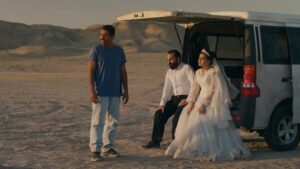
Jafar Panahi, when asked how he executed the opening shot of Palme d’Or winner It Was Just an Accident (یک تصادف ساده ), answered with deadpan simplicity that underscored his working conditions: “It was very simple. We moved the car with our hands.” He expanded the logic of minimalism as survival: “When you make underground films, you have to work with the fewest people and the least resources. If the crew grows, you draw attention, and you’ll be arrested.” Even the choice to use a studio – “for the first time in my life” – was framed as necessity, and post-production had to happen abroad.
Petra Volpe’s Late Shift (Heldin) shifted the conversation toward systemic invisibility. She described nursing as “crassly undervalued” and “invisible work,” and explained her desire “to make a love declaration to this profession.” The film’s craft challenge – compressing an eight-hour shift into ninety minutes – was about making the experience “almost physical,” with detail as a form of respect: “It’s millilitres and precision, not just ‘handing someone a pill.”
Kaouther Ben Hania’s entry point was neither image nor plot, but voice: “When I heard the voice – on June 7.” She described encountering the audio online and feeling compelled to build a film that could “honour her voice,” contrasting the internet’s disposability with cinema’s attention: “For me, the Internet is not a place to remember – it’s a place to forget. Cinema can offer attention and memory.” Her explanation of The Voice of Hind Rajab‘s (صوت هند رجب ) reenactment was grounded in ethics – “to make an impactful film, but also a respectful one” – and in a formal strategy that forces an audience to feel the collision between performance and reality: “So we begin with reenactment, but at a certain point the actors can’t ‘act’ anymore. They stop acting, and they start listening to the real recordings from the people they’re portraying.”
Mascha Schilinski then offered one of the day’s most precise articulations of sound as structure. “While writing Sound of Falling (In die Sonne schauen), I always had a sound in my mind – this crackling that gets louder and louder,” she said, describing how sound can anticipate trauma before an image “align(s) – until they do.” Working with her sound collaborators, she pursued near-impossible questions – “what does a black hole sound like?” – treating sound as the film’s score and a conduit for trans-generational memory.
When Kevin Cassidy steered the conversation toward rehearsal versus improvisation, Cherien Dabis described a process of discovery that often involves subtraction: “Usually it turns out the scene is overwritten – too much said. So we cut, tweak a line, and suddenly it works. Actors almost always know what needs to change.” Petra Volpe, in turn, described the paradox of precision and performance in depicting labor: her script accounted for “every movement, every drawer opened,” supported by nurse consultants, while the lead performance had to become “almost a movement piece.”
Lee Sang-il’s contribution underscored a different kind of preparation: casting film actors rather than Kabuki performers for Kokuho, then training them “for about a year and a half,” a long time for cinema, a short time for Kabuki.
The panel’s emotional apex arrived when Cassidy returned to Jafar Panahi’s personal risk and asked about his plan to return to Iran. Panahi’s answer – quiet, insistent – reframed exile as a kind of permanent tourism: “I’m not the kind of person who can live anywhere besides my own country… That is the soil I know. That is the kind of breathing I know.” He continued: “Everywhere else has been a tourist experience. So, for my own sake, I have to go back.” Upon his return, Panahi risks facing at least one year of detention following charges brought by the Iranian government.
A Shortlist as a Snapshot of Cinema’s Current Pressures
Taken together, the two Palm Springs panels did more than present films as “contenders.” They exposed the working realities behind international cinema in 2026: little room for escapism and productions reshaped by censorship and danger; aesthetic decisions dictated by the need not to be seen; realism pursued not as style but as duty; and sound, location and performance treated as moral technologies – ways of paying attention when attention is the rarest currency.
All in all, the day’s recurring message was that cinema survives by adapting its methods without surrendering its purpose. And, as several filmmakers suggested in different registers, purpose is not something you add later, during the campaign – it is embedded, from the first image, the first voice, the first decision about where (and how) a story can truthfully exist.
Davide Abbatescianni
Edited by Steven Yates
© FIPRESCI 2026