
Testament of Youth
This year the Oscar submissions from around the world were driven by child actors and family dynamics. According to Pat Mullen, the young talents behind the camera put trust in the emotional intelligence of their actors, which was mutual, and also their audiences.
A popular adage in Hollywood advises against working with children and animals. However, filmmakers around the world seem to firmly challenge that recommendation, as noted by the extraordinary range of stories about families and young people among this year’s Oscar submissions for Best International Feature. Watching forty-four of these selections in consideration for the FIPRESCI prize for this year’s Palm Springs International Film Festival – admittedly having caught some at previous festivals and watching others for general coverage – there’s a clear theme about the films in competition this year: youth.
The international submissions boast an extraordinary range of young perspectives on both sides of the camera, from child performers wiser than their years to filmmakers who trust the emotional intelligence of both their actors and their audiences. These include several films that have already been drawing accolades since Cannes – Norway’s Sentimental Value, Chile’s The Mysterious Gaze of the Flamingo, Germany’s Sound of Falling, and Iraq’s The President’s Cake – as well as some standouts from the circuit that deserve more attention.
For starters, there’s no better discovery among the Oscar submissions at Palm Springs than Egypt’s Happy Birthday, directed by Sarah Goher. The film, which won the FIPRESCI Prize for Best International First Feature, really sneaks up on a viewer as Goher envelops audiences in the plight of eight-year-old Toha (Doha Ramadan). Happy Birthday subtly unfolds a touching parable about class and labour as Toha wakes a few minutes before Nelly (Khadija Ahmed), who seems to be around her age. Toha happily lays out Nelly’s clothes for the day and helps her clean up her nighttime accident so that her mom won’t know she wet the bed. These two girls could be sisters as Toha endeavors to get Nelly’s birthday off to a good start. But as Toha makes breakfast for Nelly, her mother, and grandmother, the latter makes a comment that throws a viewer for a loop as they discuss plans for Nelly’s birthday: “The three of us will have such a nice day,” grandma says.
Toha’s place in the family becomes increasingly clear: She’s not Nelly’s sister. She’s the maid. Yet Happy Birthday unfolds the drama of a single day as Toha doesn’t quite understand why she can do all the work to throw her friend a party, but not attend as a guest. Goher smartly meets her young protagonist at eye level and creates a heartfelt drama about child labour and economic determinism that is accessible yet mature. The filmmaker confidently allows the weight of the drama to rest on the shoulders of her young star, and Ramadan offers an extraordinary turn. This is one of the best child performances ever to grace the screen. She’s sweet when the moment demands, but Ramadan conveys an eroding of Toha’s innocence the more she pieces together her place in both the family and society. Happy Birthday will break your heart.
A strong intergenerational dynamic, meanwhile, fuels Taiwan’s submission Left-Handed Girl. The drama by Shih-Ching Tsou won the FIPRESCI Prize for Best Actress in an International Feature, jointly awarded to stars Nina Ye, Janel Tsai, Shih-Yuan Ma. It features a revelatory performance by young newcomer Nina Ye in the titular role. Her turn as innocent five-year-old I-Jing, who simply doesn’t understand the cultural taboo associated with her dominant hand, makes for an instantly endearing character study. Her mother Shu-Fen (Tsai) and older sister I-Ann (Ma) do their best to contain superstitions while encouraging I-Jing’s self-expression, but there’s only so much they can do to control the little monkey’s paw.
Tsou deftly connects I-Jing’s coming of age with the pulse of the city as she runs free through night markets and becomes a local fixture at her mom’s noodle stand and her sister’s smoke shop. Much like Tsou’s work with frequent collaborator Sean Baker, who serves as co-writer here, Left-Handed Girl bracingly reflects the youthful energy of its young star. But more striking is the harmony that Tsou creates between her three leads. Each woman young and old complements the other. Their performances blend with remarkable naturalism to create a cohesive family unit that makes the drama so tender.
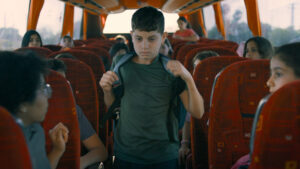
Alternatively, the distance between a father and son fuels Israel’s submission The Sea, directed by Shai Carmeli Pollak. Twelve-year-old Mohammad Ghazawi stars as Khaled, a Palestinian boy who gets left behind at a checkpoint during a class trip to Tel Aviv. He lacks the papers that will allow him to accompany his class to the beach. Like a rebellious Antoine Doinel, Khaled embarks on an adventure towards the sandy shores that call him. The Sea unfolds as a neorealist fable about the politics of mobility while living under occupation as Khaled navigates public spaces on the other side of the border wall and finds his way to Tel Aviv. At the same time, his father (Khalifa Natour) traces his path with hopes of catching the runaway before the army does. He, too, nimbly negotiates the spaces as a visibly Arab man in a Jewish community.
However, Pollak explores the reality of life in Israel as Khaled’s father gets help from some Israelis who want to live peacefully with their neighbors, while, like Khaled, he recognizes shifts in language and non-verbal cues to avoid detection. This nuanced slice of life film offers a deeply sympathetic portrait where the freedom to move depends on a man-made wall. Moreover, The Sea presents a critical eye of the army that dictates mobility, particularly in one arrest scene that unfolds while patrons at a Tel Aviv patio look on while sipping their lattes. The film’s inclusion at Palm Springs reflects the politics of mobility for cinema as well, as The Sea faces an industry boycott against Israel film institutions, which, while rooted in obvious merits, has unfortunate collateral damage. The Sea, made by a mixed Jewish and Arabic crew, and shot on location on both sides of the separation wall, offers a moving story about the plight of Palestinians who deserve the world’s attention. Unfortunately, this portrait of Palestinian life seems exactly like the kind of effective activist cinema that anyone fighting for the freedom of Palestine would want to be told.
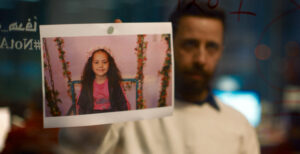
The urgency of the situation in Palestine, moreover, receives a riveting treatment in Tunisia’s submission The Voice of Hind Rajab. This exceptionally compelling film marks a unique counterpoint to the theme of youth among the submissions, as its power comes in the physical absence of a child. Director Kaouther Ben Hania continues her exploration of the space between fiction and non-fiction by using the real audio tapes from the Palestinian Red Crescent call center on 29th January 2024. The voice of six-year-old Hind provides a gripping and emotionally exhausting account of her hours spent trapped in a car after the Israel Defense Forces opened fire on her family.
Ben Hania deftly blends these audio tapes with dramatic reinterpretations with actors Motaz Malhees and Saja Kilani playing Red Crescent volunteers Omar and Raja, who reassure Hind and rally to save her. The film draws upon the real characters’ subjective memories of the events to script their dialogue, while remaining faithful to the child’s voice that captured the world’s attention. As the screen cuts to black and audio waves convey the tremors in Hind’s voice, there’s immediacy to the archival material that no dramatic take could convey as effectively. As Omar asks in the film, “If a little girl can’t inspire empathy, what can?” The world might have failed Hind Rajab, but this film ensures that her voice will be forever seared into your memory.
The absence of a child makes Slovakia’s submission Father (Otec) equally memorable. This film from director Tereza Nvotová begins with what seems like an ordinary, if busy, day for publishing executive Michal, played by Milan Ondrík, who won the FIPRESCI Prize for Best Actor in an International Feature. Michal drops his daughter off at daycare while juggling phone calls, emails, and items on his to-do list. However, a disturbing phone call from his wife asks if their daughter is at work with him, as the daycare says that she never arrived. Ondrík shatters the father’s calm and poised demeanor as he races from his office to the parking lot on what the radio refers to as the hottest day of the year. Father tragically invites audiences to bear witness to the reality of forgotten baby syndrome, as the distractions that occupied Michal’s morning have tragic consequences. As Michal wrestles with his guilt and faces trial for his actions, Father proves an extremely moving consideration of contemporary workaholics and the costs of doing away with work/life balance for the sake of a company’s bottom line. It’s a poignant reminder of the things that really matter in life.
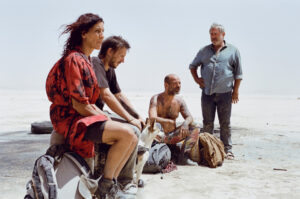
So too is the jury’s winner for Best International Feature, Sirāt. Spain’s Oscar submission directed by Oliver Laxe may be the most explosively original film of the year with its haunting study of families, both biological and chosen. The masterfully tense film inspires edge-of-your-seat viewing as a Spanish father, Luis (Sergi Lopez), winds up in the Moroccan desert searching for his missing daughter. His quest leads him and his son, Esteban (Bruno Núñez Arjona), to a group that throws massive raves in the desert. They’re like a techno oasis where lost souls find themselves absorbed and immersed in the hypnotic techno beats.
While one must navigate a minefield of spoiler alerts to preserve the dramatic twists that propel Luis through a Job-like odyssey through the desert of human frailty, a devastating loss provides another bracing reminder of how the ones we love can be lost in the flash. Luis soon finds himself more reliant on the nomadic ravers whom he initially sees as a band of ruffians who tempted his daughter into their alternate lifestyle; the ravers’ weathered faces complement the foreboding desert landscape that Sirāt traverses. The more time that Luis spends with them, the more they defy the preconceived notions he brings regarding their lifestyle, especially when their survivalist instincts keep him alive as the situation escalates. Sirāt brings us close to the souls of these characters as the hypnotic rhythm immerses us in their world. Just wait for the moment when the bass line of the soundtrack becomes practically indistinguishable from one’s own heartbeat. It’s a life force of its own, drawn from the pulse of these dancers in the desert.
By Pat Mullen
Edited by Steven Yates
© FIPRESCI 2026