
European Shooting Stars 2026 Interviews
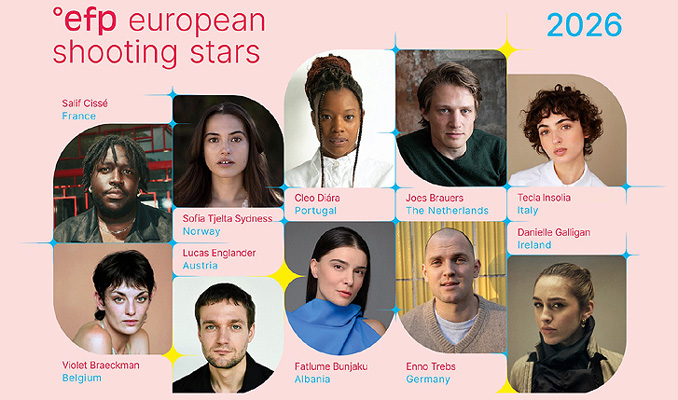
In collaboration with European Film Promotion, the Berlinale welcomed ten European talents for the annual Shooting Stars event, chosen from thirty-seven EFP member organizations, each of whom nominates one candidate. A five-person jury of industry professionals selected the final ten to be this year’s Shooting Stars, and four of them were interviewed by FIPRESCI as part of the Berlinale press promotion.
With its Shooting Stars program, European Film Promotion (EFP) brings ten promising newcomers to the Berlin International Film Festival each year. The goal is to help them raise their profile within the international press and among audiences, thereby building a network in the global film industry.
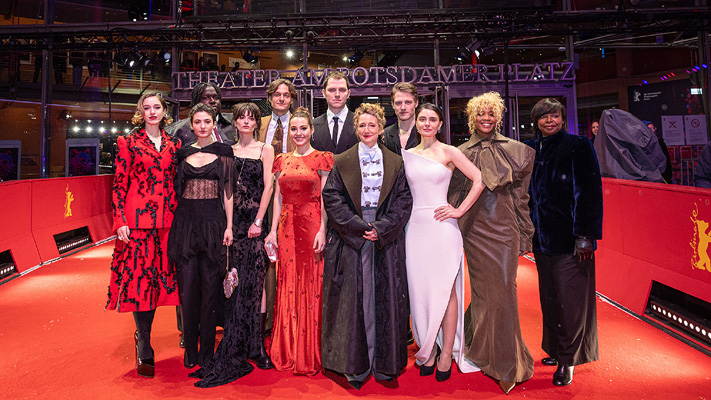
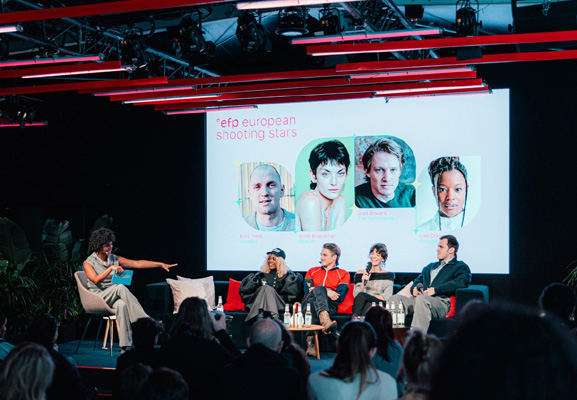
The Berlinale Hub, prominently placed in front of the Berlinale Palast and its red carpet, hosted lively events for a limited audience who arrived on a first-come, first-served basis. On 16th February, the Berlinale Hub welcomed the ten actors selected for European Shooting Stars 2026. Moderation was by Aminata Belli, a renowned German TV presenter, influencer, and fashion journalist, who led the conversations alongside film clips and audience interaction. Later that evening, a Shooting Stars gala event took place at the Berlinale Palast, where all ten of this year’s chosen talents received their awards.
Over four high-profile days encompassing the festival’s first weekend, the participants also fulfilled the expected press activities. FIPRESCI was fortunate to speak with four of the Shooting Stars 2026 talents.
Fatlume Bunjaku Interview
Fatlume Bunjaku is a Kosovan-Albanian actress who combines her on-screen talent with a meaningful academic background and a career in music. She began acting in 2013 and her ability was recognized immediately, winning the Best Actress award at the Nine Eleven Film Festival in Pristina. After a number of impressive credits, she recently made a strong impression in Hana (2025) for director Ujkan Hysaj.
Q1. You are from Kosovo-Albania but which country were you born in?
Fatlume Bunjaku: I was born and raised in Kosovo but when I started to do acting my first role in a feature film was in Albania. After three years I got an Albanian passport and from this time I have always been represented and nominated from Albania. However, I can still say that I represent both countries because I am from Kosovo.
Q2. You have an academic background and also in music so how did you progress into acting?
FB: Actually, I was always into acting and I always wanted to be an actor because I always loved acting. However, I started in high school. I was in music school and, to be honest, I had some friends who were actors. They told me that acting was very difficult and that you cannot earn money so easily. At this point I started to study music and I completed it but during my studies I was all the time thinking about acting and all the time attending auditions.
Q3. In 2013 you won Best Actress at the Nine Eleven Film Festival. Where was that festival and what film was the award for?
FB: The Nine Eleven Film Festival was also in Pristina but it only played as a ten-year festival project and it was supported by the American Embassy in Kosovo. The film was called Dawn (Agonia, Director: Esat Fejza) and is a story about a ballerina who decided to abandon her career and family because she fell in love with someone. After she becomes pregnant he started to cheat on her and then the relationship started to have a lot of issues.
Q4. What is Hana about and what character do you play?
FB: The film is about a woman who is a survivor of the Kosovo war, and from sexual violence. The film concerns survivors who are used as a form of healing. In an art center there are a lot of women who are survivors and they try to heal themselves. My character Mrika was one of those who wanted to heal and so decided to tell her sad story. For me it was the most difficult role in my life, in my career. Even though it was a leading role, it was a supporting role, but it was emotionally very intense.
Enno Trebs Interview
Enno Trebs began his career under the guidance of Michael Haneke, appearing in the Palme d’Or-winning drama The White Ribbon (2009). Since then, he has collaborated with Christian Petzold, appearing in Undine (2020), Afire (2023), and most recently Miroirs No. 3 (2025). He will next take a leading role in Echo of Tomorrow’s War (2026) for director Nicolas Ehret.
Q1. What was it like working with a renowned director like Michael Haneke so early in your career?
Enno Trebs: It was not really early in my career as I was a child, I was eleven years old. It was still amazing but it was through the eyes of a child. I was still naive about the job and I just did as I was told. I remember during this time when I was not acting and was with my fellow child actors and there were about forty of us so it had a summer camp vibe about it. It was only in later years that I realized the scope of the project but Michael was such a professional that he made it all seem so easy. We were all well-directed and there was no fiddling around and it was a very safe space.
Q2. You have also worked with Christian Petzold on a few occasions. What was the progressive experience like and were there any surprises?
ET: The first film I worked with Christian on was Undine and I only had a very small part in that one where I was entering a room and was very angry. However, Christian thought that we should work together again and it surprised me as I thought I couldn’t show in such a small part what I was capable of. However, it seemed to have stuck with him and he asked me to come back and we did the film Afire. In Afire we have this scene that I love as it is well-written and I tell this whole story. Christian is a very anecdotal director and I remember that in the morning he just sat with us and talked about the scene, then always managed to connect it to something that happened to him or a friend of his.
Q3. Next up for you is Nicolas Ehret’s Echo of Tomorrow’s War. Has this already been filmed?
ET: The film Echo of Tomorrow’s War (Morgen war Krieg) has already finished shooting and is scheduled to come out later this year. I play a character called Jonas, one of the main protagonists of the film.
Q4. What does being in Shooting Stars mean to you?
ET: I felt that I really went slow and steady and only did one or two movies a year maximum. Therefore, I went step by step and I think I really improved and took my time. I said no to film roles a lot as well as I had that privilege because I was working a lot in theatre at the same time. Financially I was not pressured to work a lot and so I could really decide and curate what I was doing. Therefore, I think it is the perfect time to be in Shooting Stars.
Joes Brauers Interview
Joes Brauers began acting at eight years old and later developed his craft at the Maastricht Institute of Performative Arts. Since graduating he has featured in the Oscar-nominated Quo Vadis, Aida? (2020), as well as Do Not Hesitate (2021). His performance in the short film Fuck-a-Fan (2024) was rewarded with a Golden Calf. Director Sander Burger’s Youri (2026) will be his next role.
Q1. You began acting at eight years old. What was that for?
Joes Brauers: It was a role in a musical called Ciske the Rat (Ciske de Rat), which is a Dutch story…
Q2. What was it like working on Quo Vadis, Aida? and Do Not Hesitate?
JB: First of all, it amazed me! Luckily, the terrors of war are far away from me until now…
Q3. More recent roles include Hardcore Never Dies and Fuck-a-Fan. Tell us more.
JB: These are more harsh film roles. Hardcore Never Dies is about someone who actually goes down the drain…
Q4. What are your long-term plans and ambitions?
JB: I hope that I will have a European career in the future and that I will write and direct my own films.
Salif Cissé Interview
Salif Cissé discovered his passion for acting at eighteen. Since his debut in All Hands on Deck (2020), which earned him a César nomination, he has appeared in Filmlovers! (2024), Guess Who Is Calling (2025), and the Netflix series Lupin (2023). More recently he captivated audiences in Meteors (2025) after its screening in Cannes.
Q1. What made you realize at eighteen that you wanted to act?
Salif Cissé: It was more about the feeling I had the first time that I went on stage and saying words that were not mine…
Q2. What was the experience of your debut and César nomination like?
SC: I never thought I would be acting in cinema until after I had done theatre so it was a really thrilling experience…
Q3. Tell us about your comedy roles in Filmlovers! and Guess Who’s Calling!
SC: Despite them being comedy roles, as the character playing them it doesn’t feel like a comedy…
Q4. How does acting for a TV series compare to film roles?
SC: I don’t want to be the kind of actor that is trying to be above the medium…
Steven Yates
©FIPRESCI 2026