
From Hong Kong, the Croatian film critic Sara Simić considers the winner of the FIPRESCI award, Linka Linka, and finds not only an insightful and original depiction of new youth in Tibet but the compelling introduction of a young filmmaker.
At the 50th edition of the Hong Kong International Film Festival—one of the oldest and most important festivals of East Asian cinema—Kangdrun’s Linka Linka (一個夜晚與三個夏天, 2025) emerged as a truly high-quality film, claiming both the Firebird Award in the Young Cinema Competition (Chinese Language) and the FIPRESCI prize. Such recognition would be notable under any circumstances; here, it feels especially significant. Kangdrun began developing the film while still a university student, and that origin lends the work an added layer of immediacy and creative urgency. Far from feeling tentative, Linka Linka displays a remarkable assurance of voice and thematic clarity, marking its director as a filmmaker of uncommon sensitivity and vision. That a project conceived in an academic setting has gone on to achieve such international acclaim only underscores the strength of Kangdrun’s feature debut, and suggests the arrival of a compelling new presence in contemporary cinema.
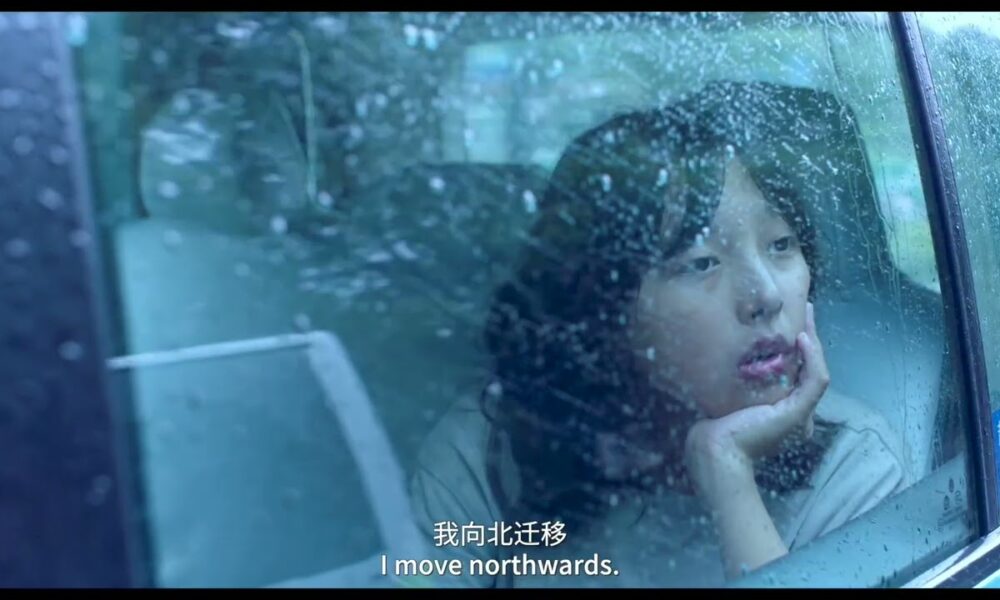
In an era defined by global connectivity, a large number of national and regional cinemas remain largely invisible to international audiences. This absence often fosters the mistaken impression not of neglect, but of nonexistence—as though certain cultures simply do not produce cinema at all. Such assumptions are decisively challenged by emerging voices like Tibetan filmmaker Kangdrun, whose work reveals a cinematic landscape rich with nuance, introspection, and emotional depth. Her film follows Samgyi, who returns to Lhasa with the intention of making a documentary about the lingering, unresolved memories of a childhood friend. What begins as an intimate and delicately observed portrait of familial and personal relationships—anchored in a formative childhood conflict that led to estrangement—gradually unfolds into something more expansive. The narrative shifts its focus from the specificity of two individuals to a broader meditation on time, memory, and the layered nature of personal histories.
Kangdrun’s direction is marked by an attentiveness to the details and quietness of the protagonist’s environment, allowing the past and present to coexist in a state of gentle tension. As the protagonists—shaped by years of separation, divergent life paths, and the pull of different cities—slowly reconnect, the film resists melodrama in favor of subtle emotional resonance. Their reunion becomes less an act of closure than an exploration of how memory itself evolves—how distance reframes experience, and how reconciliation often emerges not from resolution, but from recognition.
Underlying this personal narrative is a wider socio-cultural context. Samgyi’s journey mirrors that of many young Tibetans who leave their homeland to pursue education and professional success in major urban centers in China, such as Beijing or Shanghai—spaces often perceived as gateways to opportunity and upward mobility. This trajectory reflects a persistent tension between center and periphery, between the promise of advancement and the emotional cost of departure. Kangdrun deftly situates her characters within this dichotomy, illuminating the complex interplay between aspiration, displacement, and belonging. Also, as the protagonist struggles to find her authentic artistic voice in filmmaking—resulting in endless fights with her father who wishes for her to have a stable job and finally start a career and “proper” life—the director portrays the very prominent generational struggles of young Tibetan youth who are constantly struggling to make peace with parents who have trouble understanding many of the current ways of life and the ever-changing world in which their children and grandchildren live.
The film’s narrative is constructed in a deliberately multilayered manner, at times elusive, even faintly disorienting in its progression. Yet this structural complexity proves to be one of its defining strengths. What may initially seem opaque gradually reveals itself as a carefully calibrated approach to storytelling, one that mirrors the fragmentary and often unreliable nature of memory itself. Kangdrun resists linear clarity in favor of emotional and temporal depth, crafting a work that invites active engagement rather than passive consumption. By the film’s conclusion, these shifting temporal strands—spanning moments of Samgyi’s past in Lhasa and Beijing, alongside her present-day return to Lhasa—are drawn together with quiet precision. The result is a narrative that feels both intellectually rigorous and emotionally coherent, its seemingly disparate elements resolving into a unified whole. In this synthesis, the film achieves not only structural elegance but a profound sense of closure, affirming its status as a thoughtfully constructed and deeply resonant work.
Ultimately, the film offers a deep reflection on return—not merely as a physical act, but also in an emotional and evocative way. It is a work that quietly insists on the vitality of Tibetan cinema, challenging its marginalization while affirming its capacity to engage with universal themes through a distinctly localized point of view.
Sara Simić
© FIPRESCI 2026