
Between the Living and the Dead: Growing Up in Ester Ivakič’s Yugoslavia
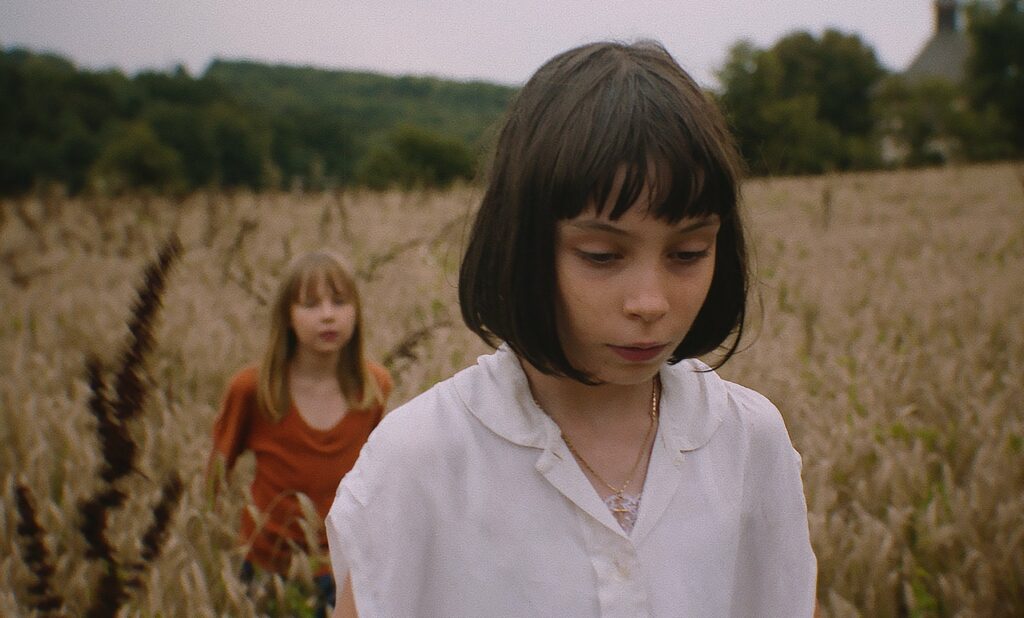
Ester Ivakič’s feature debut, Ida Who Sang So Badly Even the Dead Rose Up and Joined Her in Song (Ida, ki je pela tako grdo, da so se mrtvi vstali od mrtvih in zapeli z njo) is set in 1970s Yugoslavia and follows Ida (Lana Maric), a dreamy, introverted girl on the threshold of adolescence. Bullied at school, along with her only friend Terezka (Liza Mursic), and openly disliked by a strict, authoritarian teacher—a near-archetypal figure of the socialist educational system—Ida exists on the margins of her class, inhabiting a fragile inner world shaped by faith, superstition, and quiet longing.
From its very first scene, the film establishes a connection with the realm of the dead: Ida imagines her grandmother lying lifeless in a field, an image that will echo throughout the film as a recurring motif. Death, spirits, and the afterlife are not treated as sources of fear, but as part of the everyday texture of this rural Yugoslav environment. Ida’s mother (Judita Franković) communicates with her deceased sisters—women who likely perished in a fire, hinted at but never explicitly shown—a habit that irritates Ida’s pragmatic, emotionally restrained father (Matej Puc), a working-class man in overalls, firmly rooted in the material world. Their uneven marital relationship, full of silent tensions and misunderstandings, forms the emotional background against which Ida’s coming of age unfolds.
Ivakič populates this world with archetypal yet strangely tender figures. Among them is a charismatic local vagrant with a bloodied torso, whose past remains ambiguous and whose presence feels symbolic rather than realistic. He becomes an unlikely source of warmth and guidance for Ida, gently nudging her back toward her family and grounding her fragile sensitivity. These characters seem to exist somewhere between reality and myth, reinforcing the film’s liminal quality.
Convinced that singing has the power to awaken the dead and save her grandmother, Ida joins the school choir—despite being completely tone-deaf. When the time comes for a public performance during a local celebration, the choir teacher coldly informs Ida and another child that they will merely open their mouths onstage, pretending to sing. Faced with this enforced performance and emotional dishonesty, Ida makes a decisive choice: instead of participating in the spectacle, she leaves to bid farewell to her grandmother and the dead. The gesture can be read as a quiet act of resistance—a refusal to fake what she does not feel—and as a deeply personal moment of truth.
Ida Who Sang So Badly… is less concerned with narrative clarity than with mood and sensation. Ivakič crafts an evocative portrait of socialist and post-socialist childhood, one that will resonate deeply with audiences who remember summers spent at their grandparents’ countryside homes, walking through fields with dogs, learning to ride bicycles, or sitting at long family tables with homemade spirits and fruit picked straight from the garden. The film is soaked in warm sunlight, rustling trees, and wind that seems to carry a song—perhaps one rising from beneath a gravestone.
Whether the dead truly rise and join the living in song is left deliberately unanswered. Ivakič does not offer closure, only atmosphere. What remains is a poetic, melancholic meditation on growing up, loss and kindness—a film that understands childhood not as innocence, but as an early encounter with the invisible weight of the adult world.
Diana Martirosyan
© FIPRESCI 2025