
Shared Time: Kopal Joshy on We Are Two Abysses
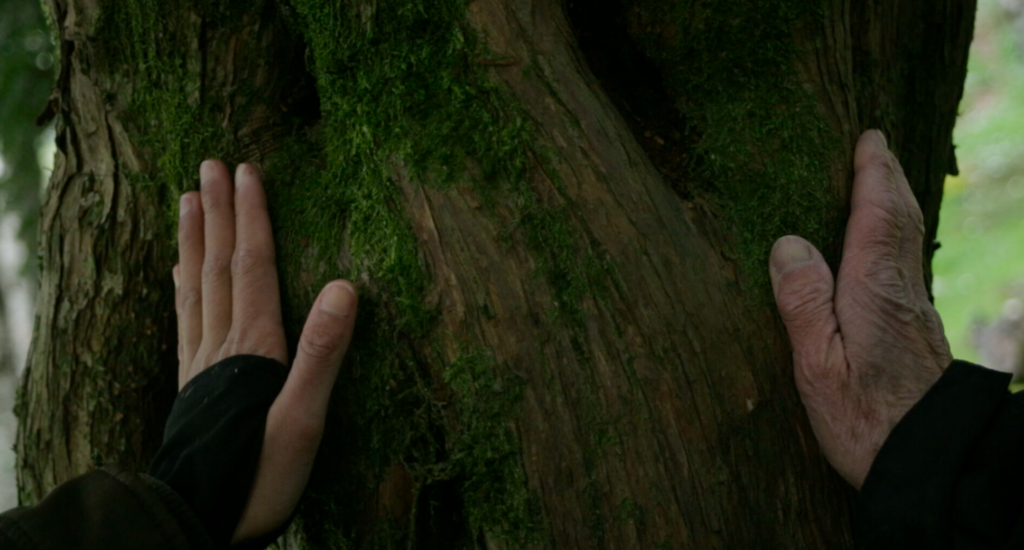
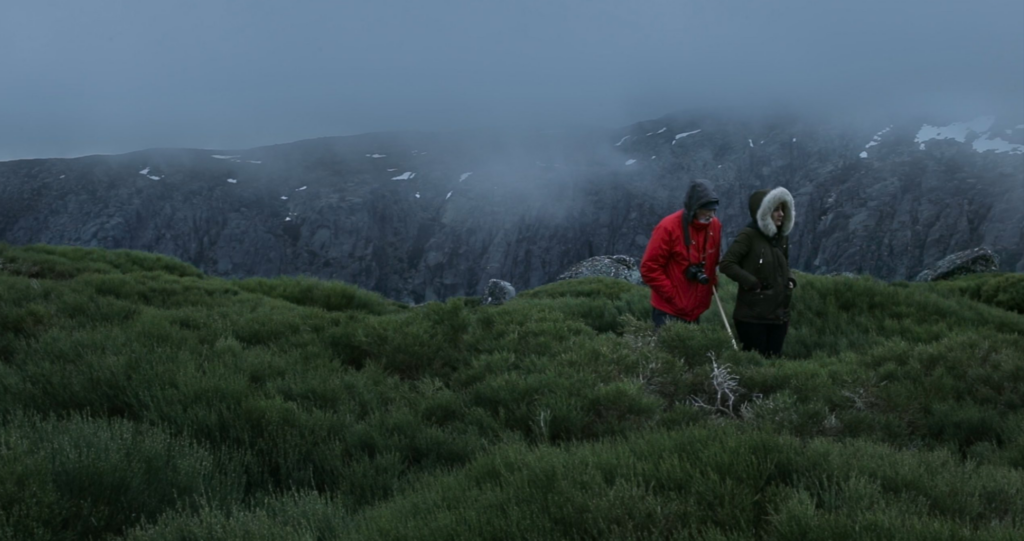
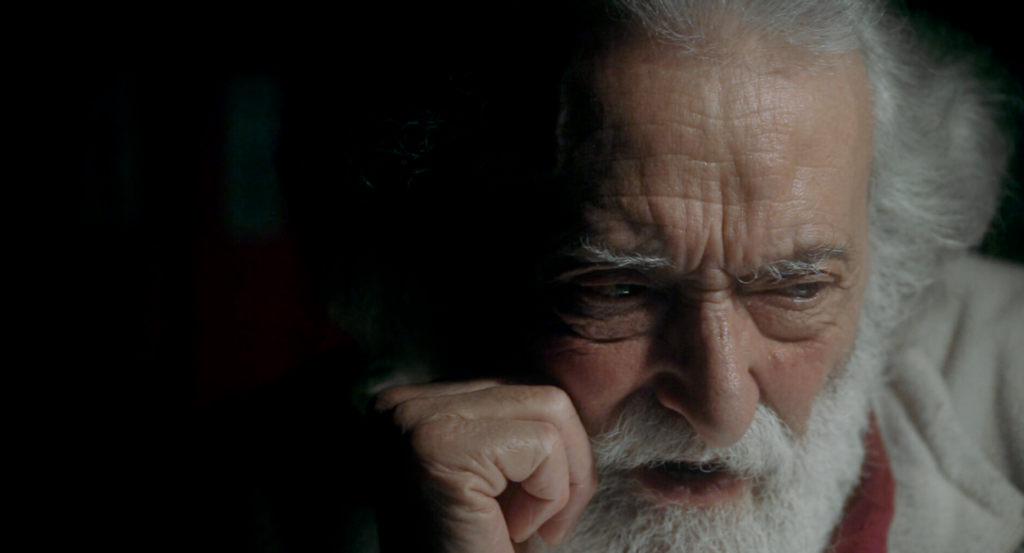
Kopal Joshy’s feature debut was prompted by her discovery of a photograph of a lake in Portugal. The lake is surrounded by mountains, while at its center is a mysterious void. She traveled to find this lake. In a nearby village she sought out an old man who, she was told, knew the path to get there. This man, Carlos, whose voluptuous mane is as white as the snow that blankets the aforementioned mountains, invited Joshy to stay in his house, first for days, then for weeks. A precious friendship bloomed. A precious film bloomed.
In We Are Two Abysses (Somos Dois Abismos), Joshy’s storytelling most often inhabits a hushed, chiaroscuro space, weaving hauntingly beautiful impressions of alpine landscapes with Carlos’ readings of letters to his beloved Trudi, who had died some time before, as well as images of Carlos’ photo albums crafted in homage to Trudi, and scenes of Carlos and Joshy undertaking quotidian tasks, such as roasting food on an open fire or hanging socks on a line. At the time when most of the film was being shot, Joshy spoke little Portuguese, and Carlos’ English was rusty, but this language barrier makes this already immensely moving film only more poignant: each are forced to reach to communicate, and that reaching, across age and experience, across language and culture, across approaches to grief, fortifies their bond. Their stumbling communication imbues this film with a tenderness and an air of ephemerality, enhancing its handmade quality, that I found tremendously moving when I had the opportunity to see it at the 31st Caminhos Cinema Português in Coimbra, where it instantly became a personal favourite amidst the films in competition.
It was some weeks later when I was finally able to speak with Joshy online about the wending process of sculpting We Are Two Abysses. I was at my home in Toronto. Joshy was at her mother’s house in Bhopal. Though she’s forged her film work in Europe, India is Joshy’s home country. A military brat, she moved several times during her childhood, a fact that, as she’ll explain, contributed something essential to her sensibility.
José Teodoro: How did you find yourself studying film in Portugal?
Kopal Joshy: I was 22. I’d come from an arts background. Drawing, painting, illustration. I thought I was going to illustrate and write children’s books. But I also found my way to photography, and my direction shifted. I was not traditionally schooled in cinema. I wasn’t really a cinephile. But some months after finishing my undergraduate degree, I decided I would make films. I realized quickly that the scene in India was not something I wanted to subject myself to. Here, you chase Bollywood or go towards Mumbai, this big city, start as a clapper girl, do the most more menial things on set. That’s not how I approached film. I knew of others who were studying cinema in Europe, and I came across this Erasmus Mundus master’s program, Doc Nomads, run by a consortium of three universities, one in Lisbon, one in Budapest, one in Brussels. There was a scholarship that would fund both the education and travel. It seemed a perfect match for someone like me, still fresh in the world of cinema, still young to the ideas this medium was presenting. Lisbon was the first city I ended up in.
JT: I’m interested in this transition from fine arts into filmmaking. One huge difference between these fields is that you can have a fine arts practice that largely consists of working in solitude. Whereas filmmaking, generally speaking, is about engaging with and directing others, sometimes many others. How do you feel about working with people around, seeking your guidance, asking you questions?
KJ: I think this part came easily for me. As someone who is well travelled within the context of India, being a military brat, I feel comfortable interacting with different sorts of people, people I don’t share a language with, because in India there are multiple languages. For me, this was never a roadblock, being able to reach out, to understand something alien, because I was never around a single, homogeneous space where everything matched my language, personality, or culture. For me, the most exciting part of filmmaking is shared time. An encounter, an acceptance of another’s presence in a common space, a shared time that inevitably leads to transformation: that’s where a film is born.
JT: You’re comfortable in a space of not knowing.
KJ: Yes. When you don’t know, all you have is curiosity. I think curiosity is the germ from which things happen. Especially for an artist.
JT: Tell me about discovering the image that prompted We Are Two Abysses.
KJ: I am someone who gravitates towards mountains in any region. Wherever I go, I figure out where the highest mountain is, to know where I have that vantage point. So sitting in Lisbon, I got curious about the highlands of Portugal. I ran these Google searches, came across the Serra de Estrella, and was suddenly confronted by this image of this particular lake, my muse, eventually. It’s a strange image—it became the first image of the film—the snow-covered mountains, this lake in the middle, partially frozen. You can almost feel this glacier water slowly melting, arriving to form this lake. And in that lake was a giant circular hole, a black hole, where you cannot see the details of nature. It immediately provoked an emotional reaction. I couldn’t put my finger on why it made me feel a certain way, but the questions I immediately asked were: How does it feel to face an abyss? What happens in this complete darkness? Does time pass? What is this feeling of absence? So I went to this region to look for this lake, thinking there would be an answer there.
JT: Where were you in your studies at this point?
KJ: I had been living in Lisbon for five months. Then I moved to Budapest for my second semester and immediately became nostalgic about Portugal. One of my mentors, who later became one of my producers, was visiting Budapest, and we had a meeting, and I brought the image along for him to see. I told him, “I don’t know what the future holds, but I would come back to Portugal just to make a film about this place. And I would love for you to mentor me through it.” He agreed. So after that semester in Budapest and another in Brussels, I went back to Portugal for my final semester.
JT: Though it was finished several years later, and though the discoveries you made along the way completely transformed the outcome, your film retains this feeling of following an idea without any promise of an outcome, of traveling blind, trusting in a profound impulse.
KJ: Perhaps it’s the privilege of an amateur, this idea that everything is possible, without the larger structure that determines how most films are made.
JT: Were you prepared to start shooting during that first trip to Serra de Estrella? Did you own a good camera or audio equipment?
KJ: I had this 6D Canon. It’s obsolete now, but back in the day it served my purposes. I’ve never been obsessed with technology so much. I’m a very DIY person. There are moments in the film where things are blurry, because I was using analogue lenses and I’d blow mist onto the lens just to have this effect of a halo or of softness. I wasn’t looking for this crispy image. If I’d had a Handicam, this film would have been a Handicam film. Most of the sound was done with lavalier microphones because I couldn’t really be the director, and the cameraman, and also sometimes be in frame, while also operating a directional mic or boom. That would have been physically impossible.
JT: So you went to Serra de Estrella with this DSLR camera and the desire to find this place. But I guess you found Carlos first, right?
KJ: One of my colleagues from the master’s program had spent some time in Manteigas, this village near the lake in the photo. He’d stayed in an Airbnb—and the person taking care of this Airbnb was Carlos. My friend said, “Look, I know you’re going to seek out this lake, so you should take this contact. I just feel like he’d be someone of use to you.” He said this partly because Carlos knew the region. Meanwhile, some other friends from my master’s program had this plan. None of them had an idea for their thesis films yet, but one of them had a caravan. So these four boys decided to travel the length and breadth of Portugal in this caravan and find their films. I saw my chance. I asked them to take me along and just drop me at this pin near Manteigas. Once we arrived, I made a call to Carlos, not knowing whether this conversation would happen because I wasn’t sure if he spoke English. It turns out he had some English, but he was hard of hearing. I quickly realized he wasn’t getting half the things I was saying. So he just said, “Look, I don’t know what you’re saying. We will meet at the gas station at the beginning of the town.” So I went there, he looked at me, and at this caravan full of young people of all nationalities—there was someone from Ireland, someone from the U.S., someone from Ukraine, and another Indian—and he was a bit confused. But we sat down in the gas station, had a coffee, and he asked, “What do you plan to do?” I said, “I don’t know, but I want to know the region. Can you lead me to a place where I could stay?” He said, “I live alone. If you don’t mind, you could stay at my house.” I said yes. The first night the others stayed too, then left the following morning. Then it was just me and Carlos.
JT: Your Portuguese was not strong at this point in time, I guess.
KJ: Correct.
JT: So you meet Carlos. He’s hard of hearing. He’s older. His first language is Portuguese. His English is somewhat rudimentary. But you felt you two could communicate?
KJ: I’m very patient as a person. I’m used to trying to find words or gestures to explain myself to people with whom I might not share a vocabulary. I knew that his English was just warming up, but he could express himself. For me, this is communication, when two people can understand each other through whatever forms of language they have at their disposal. In the initial days, he didn’t really understand what I was doing. I couldn’t really express this grand idea that I had about following this lake or whatever. I had to break it down into smaller things. Even for me, it was not clear what I was doing there. I was only on the cusp of understanding my purpose. But I felt him inviting me into his space with a grand gesture that I appreciated. I trusted him.
JT: And, clearly, he trusted you. Enough that he felt comfortable asking you to stay. You two felt a connection. You felt certain he wasn’t a weirdo?
KJ: I mean, the Carlos you meet in the film: he is that person. He has no malice. He’s very genuine, very transparent. Even to others in the village, he’d say the most honest things, including things which were socially unacceptable. He was a kind of clown and really didn’t care about anybody’s opinions.
JT: At what point did he begin to talk about Trudi?
KJ: When I entered his space, the absence of this person was very present. As Carlos says in his letters to Trudi, “Your absence is so present that it hurts.” In his house, there were images of this woman from all stages of her life, though later I discovered that they only met relatively late in their lives. They were in their 50s. At one point in the film, there is this image of a collage Carlos made with these little portraits of Trudi, images he inherited of her as a child, an adolescent, a young woman. He’d created this collage of her ageing. He had also photographed her a lot over their years together, evidence of which was on the walls of his home. He was also a person who collected mementos, and he had many stones and various objects that were imprinted with their time together. This place was clearly a shrine to her, while he barely had a single image of himself anywhere in the house. It was all about this woman. Meanwhile, I lacked this social barrier—there was nothing that I wouldn’t approach. So early on, I asked about this woman. And it was like I scratched his itch. He had a lot to say. Every story led to another question and, inevitably, Trudi was all we were speaking about. This all happened without the camera being turned on. I still thought I was going to make a spiritual film about the landscape and the sublime and whatever else, and that this was a transitory space. But I remember this feeling that Trudi was very much present, that she entered the conversation, that this became a conversation of three people, because she was always present in anything we spoke about. Of course, all this time Carlos was very curious about what I, this Indian girl, was doing there, in his house in the middle of nowhere. He was curious about my path, and we gradually learned that we had things in common. I discovered that he had a life outside of this small town, outside Portugal. He’d moved abroad very young. I felt that he probably had a youth like mine, you know? I knew that he understood me. We both were people who looked beyond their comfort, beyond their cultural contexts, and wanted to explore the world. Each saw something familiar in the other.
JT: At what point did he take you to the lake?
KJ: We couldn’t even approach the lake during that first visit, because it was deep winter and we were not equipped to be in that much snow, which would have been up to our heads.
JT: Which is very funny, because the whole point was to go to that lake. So that first trip, in light of your original intention, was a fiasco!
KJ: Completely! I’d had some experience mountaineering. As a child, I was sent every summer to the national mountaineering Institute in India for two months. That’s why I naturally gravitate towards mountains and looking for paths. But I forgot the basics. Even with the best tools, someone has to clear the way for you to walk. Nevertheless, this is a very special region and there’s more than just this lake. Carlos, from the first day, would take out his car and show me places, and the lake receded as we shared time together. It was only upon returning to Lisbon after this fortnight spent with Carlos that I spoke with my mentor, Tiago, and the project changed. I kept speaking about Carlos, only about Carlos, and Tiago looked at me and stated the obvious fact that I was much more moved by this person than by anything that could have happened if I’d gone to the lake.
JT: So Tiago was the one that made you realize that your encounter with Carlos would be the subject your film?
KJ: Pretty much. Carlos was the manifestation of these questions I had about the abyss. Which were really questions about loss. Toward the end of that first trip, Carlos said to me, “I have to tell you that I write letters to her.” I left not really understanding what that meant. I think I consciously tried to not understand it, because I knew the gravity of him telling me that. I think he hadn’t had a new friendship in a very long time, a friendship that that made inquiries, with a person that wanted to know a lot about someone who had lived a long and precious life. He was telling me a secret.
JT: And you went back some weeks later?
KJ: Yes. I thought I’d film this region, try to capture its atmosphere, with Carlos as my guide. Something I kept thinking about throughout this process was when to film and when not to. How do you decide? Because there’s this sensation that you’re losing something all the time in such situations. At the start of this second visit I was only filming landscapes. I wasn’t yet pointing the camera at Carlos, even though our relationship was evolving. Then the first letters to Trudi were revealed to me one evening after dinner. I told him if he was ready for it, I would like to hear something. He could choose what to read. He wanted to read the very first letter, which he wrote during the strongest moment of his grief—the moment of her departure. He read it in Portuguese. I could sense the room. I could sense his body. I could sense his face, his eyes. I understood some of the words, and they were strong. I asked if I could film before we started, but the camera was very frivolously placed—I really didn’t know how to film this moment at all. As he read the first letter, of course, it provoked a lot of emotions, from him and also from me, even without the words being completely understood. His gaze was directed toward me and the camera. He said to me, “I see that you’re suffering. This is not your pain to take. This is not your grief. I’m just glad that you’re here for it.” I think just the fact that I sat with this first sharing, with the camera there recording, opened the door to the process we arrived at together.
JT: No one joined you on this second trip?
KJ: No.
JT: Did anyone join you on any of your visits to Carlos, to help with technical work?
KJ: I knew from the very beginning that I wouldn’t have a traditional crew. I knew this was something that would involve a maximum of three people in a room. Eventually, I asked a friend of mine, a Portuguese sound engineer named José, to come along. I wasn’t sure how Carlos would react to this, and communication between us was a bit difficult when we were apart. Because he didn’t hear well on the phone, we used Facebook Messenger. I said to José, “I would like for you to be there, but let me go ahead of you, spend a few days with Carlos to prepare him.” So I showed up and told Carlos, “Look, there will be someone who will help with the sound.” He said, “If it’s someone you trust, I accept.” But things didn’t go as planned. I think Carlos was uncomfortable with a third person’s presence. There was a lot of friction between Carlos and José.
JT: So you got to see a different side of Carlos when you brought in another person?
KJ: I got to see a very different side of Carlos. He had a possessive attitude towards me, and anyone who entered this space was not accepted, because he was entering a space that was only for me.
JT: For you and your camera.
KJ: Yes, my camera was completely accepted from the beginning. Carlos said anything he had to say to me could exist on camera. He saw the camera as an extension of me. During the process, I showed him what I was filming. Raw footage, because I wanted him to understand that there is a temporality to a single session. And I wanted him to understand the focus of the film. He thought I was still making a film about the lake, whereas all the material that I was gathering was about him. I felt that discovering himself in the footage liberated him from the unknowing of what his image might look like. And maybe that allowed him to do or say things that he would normally not have. It also made him an actor. It made him perform some the things that he really thought needed to exist in the film.
JT: Was that a positive development? Or did you feel like you were getting something less honest?
KJ: On the contrary. I don’t think this is universal, but in this particular case, it helped us have a level ground. He needed to be aware of his image being recorded over a long period of time because he was giving me everything unfiltered. Then it was up to my conscience to make narrative from it, to develop my perspective, which was always about his grief, as well as our relationship. By having this awareness early in the process, he soon arrived at a place where he wasn’t aware of the camera. He trusted me. I just wanted to return his trust by letting him know what this device was doing.
JT: Then you have you have a deeper layer of complicity on his part.
KJ: Exactly. A common question put to young filmmakers is, “Are you the right person to make this film?” But there’s another question, about your protagonist choosing you. You arrive at the point where you realize that you’ve been chosen to make the film. Carlos would often say that some things might be difficult for him to share, but he wanted to share them for the sake of the film. Because it was part of his story, but also part of this film.
JT: Did anyone else come with you after José? Or was that the only time you brought another person?
KJ: I had stopped filming with Carlos for a few years, and we just became friends who would meet every few months. During those years, Carlos came to know most of my friends, one of whom filmed a few things toward the end of the process, when I needed to not worry about the camera so much. But even then, I could tell that Carlos didn’t have the same level of comfort with another person around. He just preferred me behind the camera.
JT: I think this transmits in your film. It’s part of the reason I was so moved. He’s a person who is invested in intimacy, right? He felt a connection to you and this was how that connection worked. The moment in the film where he becomes quite emotional and talks about feeling like maybe he’d lost you, just as he’d lost Trudi—was that something that happened after this period where you didn’t film for a few years?
KJ: This film began as my master’s thesis, with the idea that I was making a short. When my master’s was ending, I wasn’t sure what the future was. I was thinking to move to Belgium. I knew Carlos well enough to know that neither of us were the kind of people to make promises, and we had to accept that I might take a path that might not allow me to find my way back to him. So a sense of loss emerged when he thought the filming was over. To my surprise, and to his, I came back to Portugal. The course of my life changed. And when I came back, I slowly went through all the material I’d gathered and realized that the duration of a short film was far too limited for the story I was telling. I knew there were more doors that were opened with Carlos that needed to be passed through. That prompted the second phase of filming.
JT: We talked about the moment of discovering what your film was about. When did you know it was finished?
KJ: This film is the result of a slow process. Eventually, I was graduating, I was re-entering my life in Lisbon, living as this lone wolf, figuring out the rest of my life. I was also coming out of a very long relationship. I was with a huge cloud of things. I would visit Carlos every few months and choose to shoot or not shoot. The film took the pace of life. It was not a very conscious thing until like there were deadlines and various things to apply to. I had a very tough time understanding the end of this film. I couldn’t fathom the conclusion in reality, so how could I conclude it on an editing table? Eventually it felt natural to stop filming because Carlos and I found a way to exist outside the project. The more we existed outside of the project, the less I felt a need to film. As I said, there was a moment where I went back for certain images, but I had a bank of lived experiences large enough to know where we could go for a certain image.
JT: At what point in the process did Carlos die?
KJ: We had finished editing, more or less, around the time I lost my father, in October of 2023. At that point, I took a long break from the film. When I came back and looked at what was left to do, I decided that in one month I would be done. During this month, Carlos had a fall and ended up in hospital. I went to see him in March 2024. We hadn’t started post production, so these were the last moments of questioning the order of things. Carlos caught glimpses of the film in this unpolished form. I don’t know how much he understood from watching it, but he was entertained. I think the only thing that was added during this time was the very last part of the film, which contains the first images I ever shot of Carlos in the snow, to which we added the Schubert that he mentions in the film, the music that he and Trudi loved so much. Suddenly the end of the film became this unexpected homage. We never thought that we would be presenting the film as a posthumous work.
JT: It’s remarkable that as a friend he left you far too soon, but as a subject he was in your life for the exact amount of time needed to complete this project, the product of your shared time.
KJ: I always spoke to Carlos about the afterlife of the film, how we would travel with it, and so forth. I remember the moment I received news of his passing. I felt very guilty that he never got to experience this thing we made together. Later, I realized something. There is this point in the film where he talks about his fear of losing memories. He wants the memory of Trudi to endure, but he doesn’t know how to make it so. In some peculiar way, this film made that possible. In this film, he found a house to hold a little of the memory of Trudi. I think that was his intention. Part of the reason he was an accomplice to this process was because he knew that the film—and with it, this memory—would exist beyond his time.
JT: It makes me think about how art, the process of making and sharing art, can give us two seemingly contradictory things at once. On one hand, the work that you’ve made is about grief and accepting the fact that all these things we cherish are going to tumble into the abyss. But the film also says, “Here are a handful of precious moments, evidence of a full life, of a fervent love, that for however long this film exists, we can keep alive.” So it’s funny how a film can hold these two truths at once.
KJ: The last time I met Carlos was either the day after or the day before my father’s birthday—his first birthday after dying. So I baked a cake. I arrived at the hospital with this cake and candles, singing “Happy Birthday.” I arrived in a mood to make Carlos happy because he was alone in a hospital bed. But when I saw his face, I realized that he had suddenly become an old man. I’d never seen age on his face this way, because he had a spirit that was younger than his physical age. On that particular day, a day that I might have grieved alone, I wanted to turn my father’s absence into something shared with my friend. I thought I had it so well planned, that I would be a goof and we would feel good, but I looked at Carlos and instantly wanted to cry because he looked old, frail, at the end of his time. I wasn’t ready to accept that. I didn’t want to cry. But I kept looking at him, and he was so happy to see me, and the flood gates opened. I had no way to explain to him what this feeling was. So we spoke of other things, like the destiny of his letters to Trudi. He started telling me things that needed to be taken care of. I was the only one who knew what he wanted. He said, “Look, I don’t want to be buried. I want to be cremated. I want our ashes, mine and Trudi’s, to be mixed and I want them to go in the mountains.” There was confusion about who inherits what, who looks after what. “I want you to go into the house,” he said. “You have to take all the albums of photographs that belonged to Trudi.” He gave me precise instructions, and they felt to me like an alarm, a vision of what was coming. It slowly became clear to me, that day, that something was drawing to an end. It was a heavy feeling. At the same time, I found myself walking from the hospital to the bus station and thinking to myself, “How in the world did I find myself here, in this small town in Portugal, visiting this funny, beautiful man I’ve known for the past six years, feeling the way I feel?” The world sort of narrowed into this reality and it felt absurd to have lived this experience and seen my way toward the end of it. Earlier that day, I still thought Carlos was going to move from the hospital to a centre where he would get physiotherapy and start walking again. I thought I would start filming him walking again. At that moment, I knew this would never happen. But also, at that moment, I felt almost lifted, buoyed by the knowledge that I was given a gift, a friend, an encounter that changed the paths of two lives. And I had a film to complete.
By José Teodoro