
Size Does Matter: On Pedro Pinho’s I Only Rest in the Storm
This year’s selection for the Portuguese cinema competition in Coimbra was very diverse. Animated films, documentaries, feature films, and short films: anything was possible. And then there was one long film. A very long film, in fact.
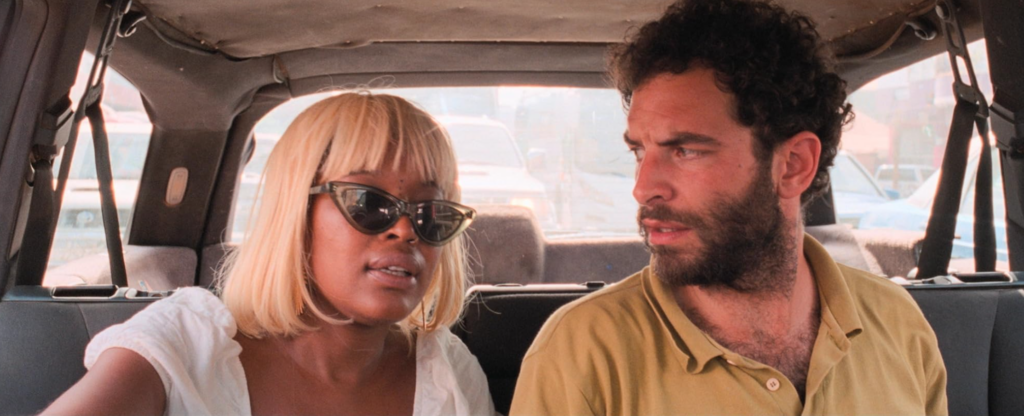
I Only Rest in the Storm (O Riso e a Faca), directed by Portuguese filmmaker Pedro Pinho, premiered at Cannes this year with a running time of three and a half hours. But the director had even more in mind: the version shown in Coimbra lasted five and a half hours (!) and was interrupted only by a short break. 330 minutes – the length alone is enough to make you afraid before entering the cinema. But the experience was incredible: I Only Rest in the Storm is such an intelligent, tense, and meandering film, with great scenes, great actors (especially Cleo Diára, who wore a different hairstyle in every scene, and Jonathan Guilherme, who wore a different outfit in every scene), and great editing (which took two years). So many ideas, so many themes, so many discussions, so many detours – fascinating.
The story centres on Sérgio (Sérgio Coragem), a white environmental engineer from Portugal who has come to Guinea-Bissau, a former Portuguese colony, to supervise the construction of a road crossing the country between the desert and the city of Bissau. He has been sent by an unnamed NGO, and the responsibility and expectations are high—perhaps too high, because Sérgio’s predecessor vanished before he could file a report. Some citizens are in favour of the project, perhaps because it will benefit the economy, but most of them are against it – they simply consider it unnecessary. As a spectator, one wonders whether Sérgio is the right man for the job. He is a very introverted, shy, and insecure man who is well intentioned but not very energetic.
In a nightclub in Bissau, he meets the vivacious and beautiful bar owner Diara (Cleo Diára), who occasionally wears a blonde wig. Sérgio cannot decide whether he wants to fall in love with her or not. Through Diara, Sérgio also meets Gui (Jonathan Guilherme), a gay Brazilian who is searching for his identity in a country that is not his home. Sérgio also meets other people – citizens on the street who are worried about the quality of drinking water, local politicians who dislike Guinea-Bissau’s dependence on foreign aid, fellow workers who start a big quarrel during a small barbecue party. Not to mention the discussion between Sérgio and a black prostitute who lectures him on colonialism.
This scene with the prostitute marks a slight lull in the film. At times, Pinho overstates his point. The audience has already understood what the director wants to say. But Pinho keeps going a little longer. He takes his time; he has made a slow film. However, this does not change the fact that this is also a very thoughtful, very provocative film, with great images such as the one at the beginning of the film in which Sérgio drives his car through the windy desert. It’s just a shame that, due to its extraordinary length, the film will hardly find a distributor. Only few people will watch it.
Interesting: Several films in the Coimbra competition dealt with either dictatorship or colonialism. Our Father – The Last Days of a Dictator (Pai Nosso – Os Últimos Dias de Salazar), directed by José Filipe Costa, as the title suggests, dealt with the slow dying of the dictator Salazar – a very problematic film because the audience might feel sorry for him. Bulakna, directed by Leonor Noivo, was a very strong film about forced migration and labour inequality in a post-colonial world. The Scent of Things Remembered (A Memória do Cheiro das Coisas), directed by António Ferreira, was a compelling film about dying and the generation that fought in the Angolan War.
And then there was Catarina Alves Costa’s documentary Orlando Pantera, about the eponymous famous musician who lived and died on the island of Cape Verde, which, like Angola, is also a former Portuguese colony that gained independence in 1975. Through its artists and filmmakers, Portuguese society is coming to terms with Portugal’s past, and that was the most interesting discovery in the 31st Caminhos do Cinema Português.
by Michael Ranze
Edited by José Teodoro
FIPRESCI@2025