
The Birds Who Stayed: On Tamara Kotevska's The Tale of Silyan
The FIPRESCI prizewinner at Krakow is the latest film from the Oscar-nominated director of Honeyland. Polish critic Łukasz Knap finds that the film’s roots in a Macedonian folk tale ably combine with a study in economics, and remarkable footage of storks—no AI used here.
Once upon a time a young man told his father he wanted to leave the village. The father heard it as a betrayal and cursed him, and the boy was turned into a white stork, banished to the air above a home he could no longer enter. Tamara Kotevska threads this old Macedonian fable through her film in voiceover, over footage of real storks. It begins as a children’s tale and ends as the most accurate thing in the film.
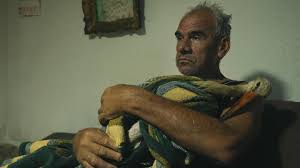
Nikola Conev is a real farmer, not an actor, and the camera never lets you forget it. Decades of sun and labour are written into his face, line by line, and he moves through his own fields with an ease no performance could imitate. He lives in Češinovo, a village said to have the largest white stork population in North Macedonia, with nests heaped on rooftops, church towers, and power poles. He has worked the family land his whole life, alongside his wife Jana, their daughter Ana, and Ana’s husband.
Then the economics give way. The market pays less than it costs to grow anything, the tobacco is rejected as substandard, and tons of produce are left to rot while a farmers’ road blockade changes nothing. One by one the young leave for Germany: first Nikola’s eldest son, then Ana and her children, then Jana, summoned abroad to raise a granddaughter the family otherwise cannot afford to mind. Nikola stays behind, alone, on land that no one will buy.
What keeps the film from being a straightforward lament is the way it slides between registers. It is, at once, a nature film, a study of economic collapse, and a folk tale, and Kotevska refuses to keep the three apart. Jean Dakar’s camera, which spent years earning the storks’ indifference, films the birds as residents rather than scenery. Kotevska went to Češinovo because of them in the first place: drawn to the dumps, many of the storks had stopped migrating, picking through rubbish instead of flying south. As the village empties, birds and men end up scavenging the same landfill, and the footage from that place is the hardest the film has to offer—white storks dead in the refuse, and the ageing men who, having outlived the value of their own labour, now drive bulldozers across it. So the injured stork that Nikola eventually takes home doubles for the fable’s exile: the son who left, but also the bird too broken to leave at all. None of this is stated outright.
This marriage of myth and observation is Kotevska’s signature. In Honeyland, the documentary that earned her two Academy Award nominations, she read a beekeeper’s collapsing livelihood through the life of a hive. The craft here is even surer. Dakar’s luminous widescreen images are matched by brisk, unobtrusive editing, and the closing credits carry a defiant line of plain text: “No AI was used in the making of the film”—no small thing in a year when text-to-video tools had begun turning out convincing birds. The score, built on Macedonian folk instruments like the kaval and the ocarina, is beautiful on its own terms. It is also where the film’s discipline wavers. In the stork passages above all, the music swells to instruct us how to feel, and now and then it tips over into the sentimental, pushing an emotion the images have already won. For a film this restrained, those moments are a small betrayal of its own confidence.
That wavering points to the strongest objection one can raise. Kotevska shoots a documentary as if it were fiction, and the seams sometimes show; you can come away feeling the real Conev family has been quietly fitted to the shape of a legend, their hardship eased by the consolations of myth. The hopeful ending—Nikola back at the plough, Jana home again, Silyan paired off—invites that suspicion most of all. It is genuinely moving, and Kotevska has been open about offering hope on purpose, refusing to send an audience away with despair alone. Whether that hope feels earned or merely soothing is, to my mind, the honest argument the film starts and then declines to settle.
I watched The Tale of Silyan at the 66th Kraków Film Festival, in a competition oddly crowded with people sealing themselves off from the world. Around Paradise (Im Umkreis des Paradieses) follows Europeans wealthy enough to opt out of modernity, who build a gated colony called El Paraíso Verde in one of the poorest corners of Paraguay to wait out vaccines, taxes, the next war, and the coming climate disaster. Tristan Forever tracks a Paris doctor who goes back to Tristan da Cunha, the loneliest inhabited rock on the planet, determined this time to stay for good, until the romance of exile runs up against what it actually costs to live there. Silent Flood sits with a community on the Dniester that had quietly opted out of modern history, until the Russian invasion arrived to ask what a pacifist does when the trenches reach the edge of the village. Set among these, Silyan plays as their negative image. Those films are about people who choose their seclusion, or have it forced on them by belief or by war; Nikola’s seclusion is the work of economics, and his refusal to leave is not a retreat from reality but a stubborn determination to stay inside it. The stork that will not migrate is the figure for that choice.
And this, in the end, is what the film is for. It explains almost nothing. It offers no statistics and summons no economists; it simply watches a family scatter and a man dig in. Why has farming here become impossible to live on? What does it say that a European country still outside the EU now exports its young and receives, in return, only their absence? How much of this is particular to Macedonia, and how much is the same story across the rest of rural Europe and beyond, wherever the market has ruled that the people who feed us are worth less than what they grow? You walk out wanting the figures the film keeps from you. The storks come back to the same nests every spring; whether anyone will still be farming the ground beneath them is the question Kotevska hands, unanswered, to her audience.
Łukasz Knap
© FIPRESCI 2026