
Magic Hour: The Curse of Success
Magic Hour, a documentary about celebrated cinematographer Piotr Sobociński that screened in the International Documentary Competition at the 66th Krakow Film Festival, received the festival’s recommendation for the European Film Award in the documentary category. German critic Kira Taszman reflects on the film and the remarkable legacy of the Sobociński family.
There are dynasties in cinema that everybody knows: the Fondas, the Coppolas, the Redgraves, and the Skarsgårds, to name just a few. Most of the time, these families seem to pass on their acting and directing talents from one generation to the next. Less familiar are the dynasties that have shaped cinema from behind the camera, particularly outside Hollywood. One such family stands at the centre of Marcin Borchardt’s documentary Magic Hour: the Polish cinematographic dynasty of the Sobocińskis.
Witold Sobociński (1929–2018) was one of Poland’s most celebrated cinematographers, collaborating with the country’s greatest filmmakers, including Andrzej Wajda, Jerzy Skolimowski, Wojciech Jerzy Has, Krzysztof Zanussi, and Jerzy Kawalerowicz. He was also known for his larger-than-life personality. At the heart of the documentary is his son, the more introverted yet equally gifted Piotr Sobociński (1958–2001), whose work included Krzysztof Kieślowski’s Decalogue III, Decalogue IX, and the acclaimed Three Colours: Red, which earned him an Academy Award nomination for Best Cinematography in 1995.
Following that success, Sobociński became one of the most sought-after cinematographers in Hollywood. Offers poured in from major directors across the United States, transforming not only his career but also his personal life. A devoted husband and father who had previously balanced work and family in Poland, he gradually found himself living out of suitcases, moving from one production to another. The relentless pace of the Hollywood system, with its constant pressure and little room for rest, ultimately took its toll. After approximately six years in the United States, Sobociński died of a heart attack in March 2001 while shooting Luis Mandoki’s Trapped in Vancouver.
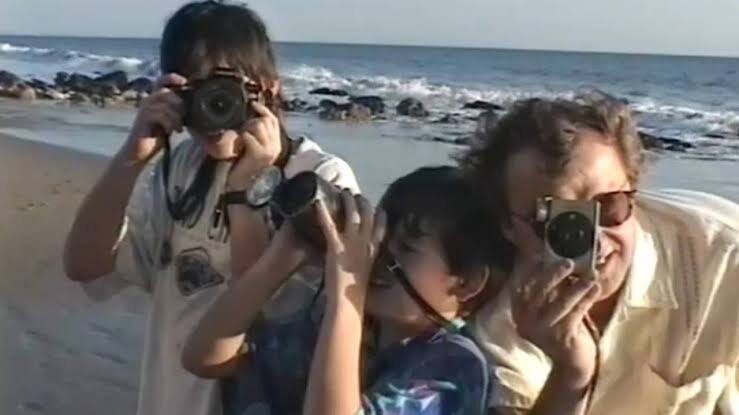
Today, Piotr Sobociński’s children have continued the family’s cinematic legacy. His sons, Piotr Jr. and Michał, became cinematographers, while his daughter Maria pursued a successful acting career. They appear throughout Borchardt’s film, though not in the conventional talking-head format. Instead, we first encounter them as young children walking with their father along a beach in Los Angeles during the so-called “magic hour.” In cinematography, this is the brief period after sunrise or before sunset when natural light achieves its most luminous and cinematic quality. The title thus functions not only as a technical reference but also as a metaphor for creative fulfilment and for a life lived with extraordinary intensity over too short a span.
These images come from Sobociński’s own private video archive, which forms the documentary’s greatest strength. Rather than relying primarily on interviews or retrospective commentary, Borchardt builds the film almost entirely from approximately 250 hours of family footage that Sobociński recorded over several decades. As the director has explained, the archive consisted of numerous formats: 8 mm, 16 mm, VHS, multiple digital video systems, and HDV tapes recorded in both European and American standards.
Here lies one of the film’s most original insights. Unlike acting or directing dynasties, cinematographers spend their lives observing the world through a lens. Sobociński constantly documented his surroundings. His camera accompanies him everywhere: on film sets, at family gatherings, in apartments in Poland, in California homes, and in anonymous hotel rooms. Sometimes members of the film crew even operate the camera themselves. On the set of a Robert Benton film, we watch Sobociński working alongside Paul Newman, who openly admires his professionalism. Yet the footage also reveals how difficult Sobociński found the unwritten rules of the Hollywood industry. The creative partnership and mutual understanding he had shared with Kieślowski proved impossible to replicate while working with directors such as Ron Howard, Scott Hicks, Robert Benton, or Luis Mandoki, despite collaborating with stars including Meryl Streep, Diane Keaton, Leonardo DiCaprio, Anthony Hopkins, and Paul Newman.
The camera records not only professional triumphs but also intimate domestic moments. We watch Sobociński excitedly unpack a new handheld camera, discuss lenses and equipment with his father, and capture everyday family life with infectious enthusiasm. At the same time, the film gradually reveals the complicated relationship between father and son. Witold Sobociński remained the dominant patriarch, seemingly uncomfortable with sharing the spotlight. Even after both men received awards at the International Film Festival Camerimage in 1994, genuine pride remained difficult to express.
Magic Hour therefore becomes not only a portrait of artistic achievement but also an exploration of family dynamics. Although Piotr eventually established his own visual identity—above all through his collaboration with Kieślowski—he never entirely escaped his father’s shadow.
His wife, actress Hanna Mikuć, affectionately known as Marysia, abandoned much of her own acting career to support both her husband and their family. Yet she recalls that filmmaking effectively meant losing him for twenty hours each day, even after they relocated to California. One of their sons remarks during their first stay in America, “Poland is better than America.” Indeed, the family appears happiest in the Masurian Lake District rather than beneath the Californian sun. Snow-covered Polish landscapes convey warmth and togetherness, whereas Malibu increasingly resembles an illusion of happiness. Paradise, the film quietly suggests, can become a trap. This interpretation is reinforced by the restrained narration, delivered by Piotr Sobociński Jr.
Running beneath the family story is another narrative: Poland’s own transformation after the fall of communism. Sobociński’s home movies inadvertently document the country’s political, social, and cultural evolution as it gradually opens to the West. At the same time, Western filmmakers increasingly recognised the extraordinary craftsmanship of Polish film crews. Sobociński emerges as both an exceptionally gifted cinematographer and a man unable to reconcile artistic ambition with family life. Even in the playful self-portraits he films, an undercurrent of exhaustion remains visible.
Ultimately, Magic Hour dismantles the mythology of professional success while offering a deeply human portrait of artistic ambition. By shaping this remarkable archive into an intimate family chronicle, Marcin Borchardt exposes the personal cost of talent, legacy, and the relentless pursuit of creative excellence.
Kira Taszman
Edited by Robert Horton
© FIPRESCI 2026