
Out of the peat rises a shrivelled, mummified boy. His skin has gone amber-brown and leathery, his small limbs pulled tight as rope. The bog that drowned him has kept him whole, and now the little Latvian town begins to shake loose its buried secrets. Bogs have always been cruel archivists. Peat’s acidic, oxygen-starved water halts decay, returning centuries of the dead, even world war soldiers, barely changed. Now one has surrendered a child. In Latvian director Reinis Kalviņš’s crime drama The Bog, the dead refuse to stay buried.
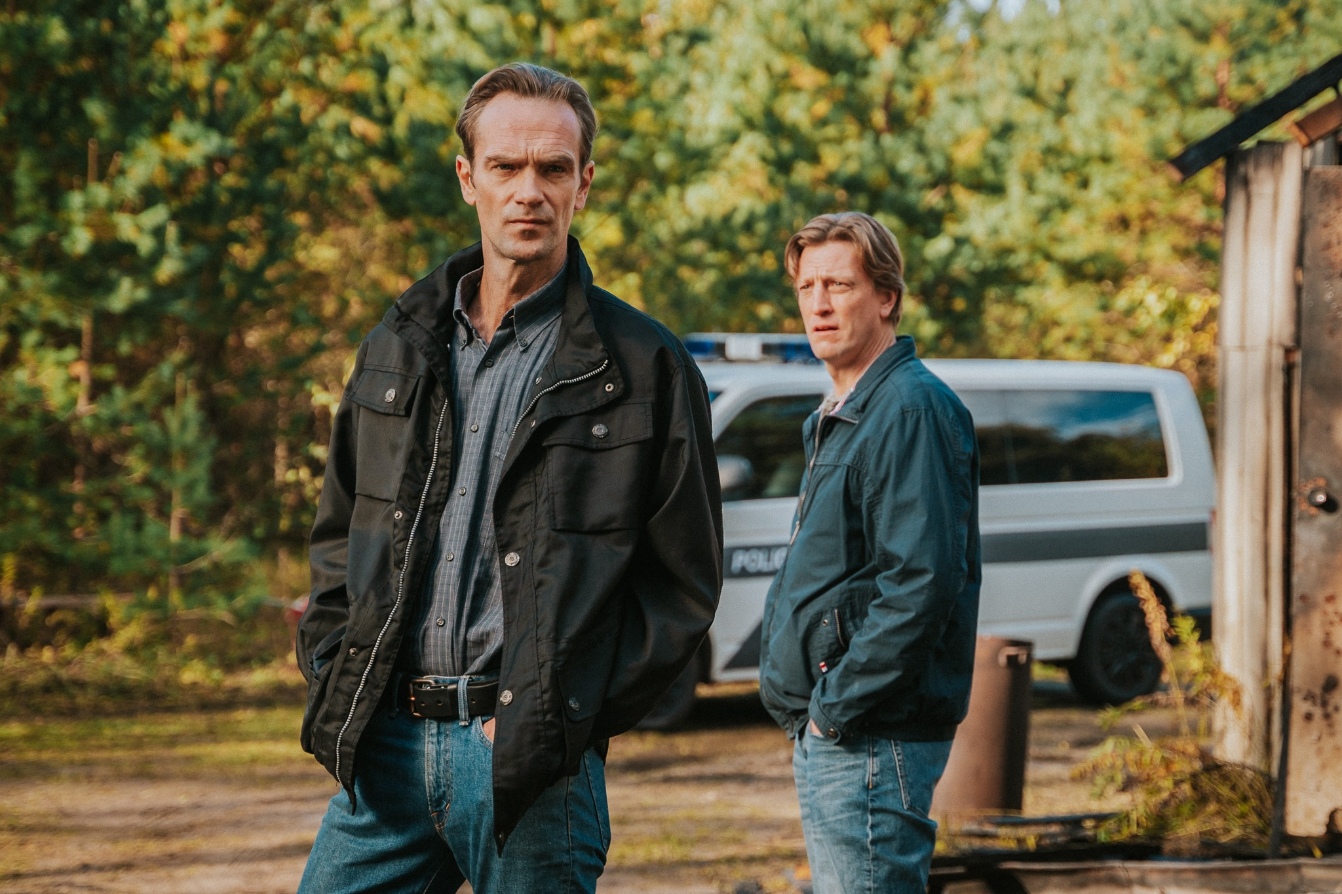
Local policeman and hunting enthusiast Brože (Kaspars Zvīgulis) uncovers the body of a boy missing some thirty years, or so everyone assumes. The case reaches into his own childhood, a past he would rather keep submerged, yet it drags him toward the people sharing those memories. When colleague Keziks (Armands Berģis) tells the prosecutor the truth, Brože rushes to have the death declared an accident. Every hurried step makes us doubt the man holding the file.
At home, Brože and Ilona (Svetlana Stoļarova), are raising son Sandis (Jānis Pīgožnis), who spends his days with friends, tearing along dusty forest tracks on his BMX and plunging into the hidden pond. It is classic Latvian country adolescence, bare feet on warm planks, sunburnt shoulders, the smell of the forest. Yet the lake holds a dark secret that was never supposed to emerge.
Jimmy Gimferrer’s cinematography gives the landscape room to breathe. Vast peat workings interrupt lush greens, beautifully complemented by accents of yellow. Yet the compositions are controlling, two people share a frame, one facing us, the other turned away, deciding whose expression we can read and whose remains inaccessible. Vivid flashbacks tighten that grip. The camera shakes as unknown hands push a drowning boy underwater, encouraging us to mistake a partial view for the whole story.
In the first act, the puzzle pieces fit together too easily; even the exposed peat workings announce what awaits. Surely that cannot be all? With so little for curiosity to feed on, suspicion sours into impatience. Then Brože drives alone in his battered Toyota jeep, and the film stirs to life. Small shifts drift across Zvīgulis’s face, loosening the hard exterior of this policeman and hunter, and his quiet, finely judged performance lends Brože a depth and complexity the material rarely offers. That makes the dialogue even more frustrating. Both the writing and its delivery often feel stiff, making the exchanges hard to believe, especially after watching how much Zvīgulis can convey without saying a word. Yet low, drawn-out strings keep scraping at the nerves, leaving us waiting and braced for impact.
Instead, the ending arrives and the pressure leaks away. After all that insistence, the lack of emotional force irritates more than the predictable mystery, it feels like ragebait. The film has kept us braced for a revelation whose weight never quite reaches us in our seats. It prepares you to dive headfirst into deep water, then leaves you face down in a puddle.
Director: Reinis Kalviņš
Writers: Reinis Kalviņš, Livia Ulman, Andris Feldmanis
Cast: Kaspars Zvīgulis, Edgars Ozoliņš, Armands Berģis, Svetlana Stoļarova, Lauris Dzelzītis, Jānis Pīgožnis.
Running Time: 104 minutes
Country: Latvia, Estonia, Germany
Year: 2026
Rating: 2.5
Elizabete Didža
©FIPRESCI 2026