
Beyond Good Intentions: The Search for Cinematic Vision

Now in its ninth edition, Egypt’s El Gouna Film Festival has established itself as an important meeting point for Arab, African and international cinema, combining film screenings with industry initiatives designed to support emerging filmmakers. Its competitive programme encompasses fiction, documentary and short films, while its CineGouna platform provides opportunities for projects in development and post-production.
This year, film critics were presented with a specially assembled selection of films from the narrative and documentary competitions, brought together under the festival’s overarching motto, Cinema for Humanity. Although promising in intention, the concept remained rather vague when subjected to critical assessment, raising a more fundamental question: does the relevance of a film’s subject necessarily translate into its artistic merit?
Let’s break it down.
Despite several films addressing pressing contemporary issues, not least the ongoing conflict in Gaza, what united much of the selection was not so much a distinctive humanistic vision as a striking lack of cinematic innovation. Instead of searching for new forms capable of expressing the complexities of contemporary life, filmmakers repeatedly retreated into conventional storytelling, often reducing it to its most elementary devices.
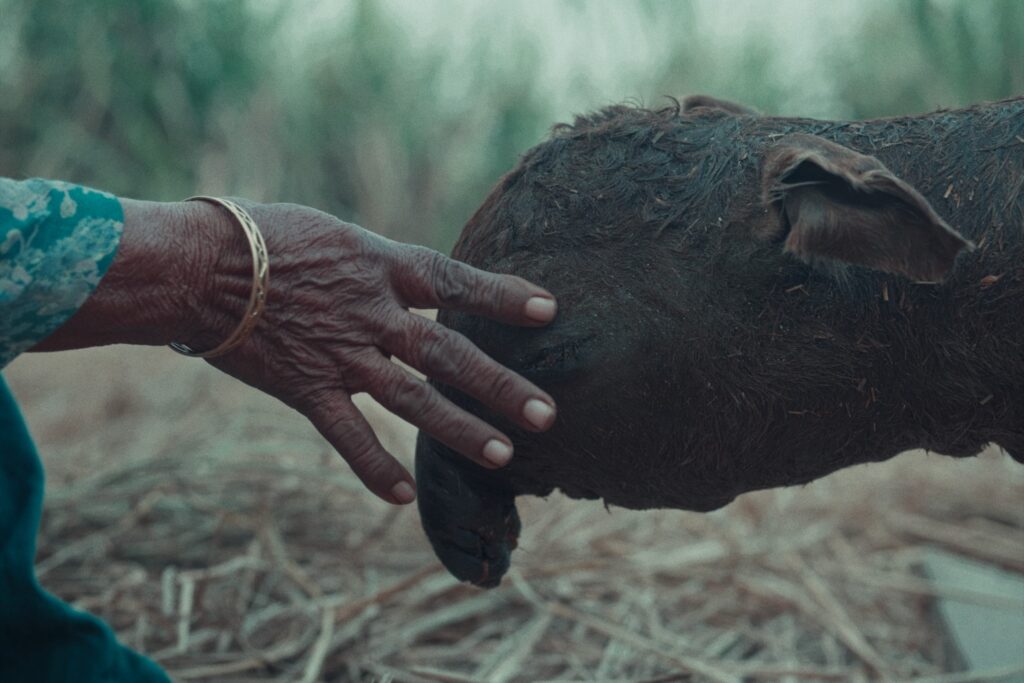
In The Calf Doll by Ankur Hooda (India) and Yesterday the Eye Didn’t Sleep by Rakan Mayasi (Palestine), an unnecessarily slow pace, perhaps intended to create an immersive experience, stretched relatively modest narratives into feature-length films without offering sufficient compensation in either cinematic vision or narrative originality. Prolonged static shots, with little to sustain attention through composition, production design or performance, suggested limitations not only of resources but also of imagination.
What was particularly frustrating was the filmmakers’ persistent reliance on established cinematic conventions. Their stories seemed suspended in an indeterminate past, with little acknowledgment of the contemporary world surrounding their characters.
Occasionally, however, that world broke through. A fleeting encounter with TikTok in rural India, or a sudden disruption of the fictional narrative by a behind-the-scenes exchange in which actors question why the filmmakers insist on shooting in their rural community instead of going to Bombay, exposed the absurdity and complexity of contemporary existence: the struggles of an agricultural society unfolding alongside the mechanisms of global cultural production and digital consumption.
This collision recalls Alvin Toffler’s theory of successive civilisational waves, developed in The Third Wave (1980 – almost half century ago). Agricultural, industrial and information societies do not simply succeed one another in neat historical sequence. They coexist, interact and collide, often within the same geographical and social space. A farmer struggling to preserve a traditional livelihood may simultaneously inhabit — or suffer from — a world shaped by algorithms, global communication and digital aspirations.
There is, of course, nothing inherently outdated about portraying traditional societies, nor does every story set in such an environment need to address technological progress. Yet the struggles of rural communities, the weight of tradition, generational conflicts and the confrontation between individuals and established social structures have occupied literature for centuries and cinema for more than a hundred years. Returning to these subjects is entirely legitimate, but what new perspectives, narrative approaches or cinematic forms do contemporary filmmakers bring to them?
The problem is not that these films portray ways of life rooted in the past, but that they frequently approach them through equally familiar artistic conventions, without offering a fresh interpretation or a distinctive cinematic vision. Meanwhile, the coexistence of different historical realities — so vividly illustrated by that brief intrusion of TikTok into rural life — opens up possibilities that remain largely unexplored. The filmmakers need not abandon traditional stories to engage with the present; they might simply discover new ways of seeing them.
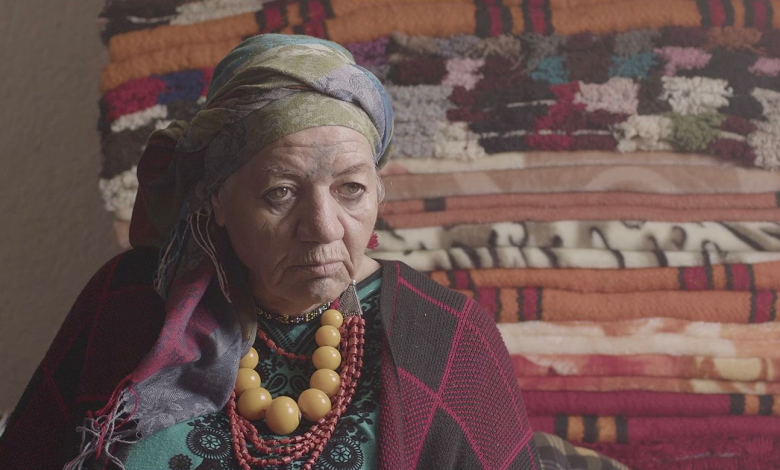
A different approach emerges in Halima, a film associated with the CineGouna development ecosystem. Here, rural Morocco is not presented as an untouched world removed from modernity, but as a place continuously penetrated by external forces. Drug smuggling, migration across the Mediterranean, modern technologies operating within traditional agricultural spaces, and a smuggler dreaming of YouTube stardom all coexist within the same environment.
The material is rich with possibilities. Yet the film struggles to transform its promising premise into mature cinematic expression. Its dialogue frequently serves an overly explicit expository function, explaining character motivations rather than revealing them through behaviour, conflict or dramatic development. When Halima asks a smuggler what he is doing there, he conveniently announces his ambition to make a music video and attract a million YouTube views (later, with the explicit dramaturgic naivety, the radio host breaks to us he made it). The information is relevant, but its delivery feels less like an organic exchange within characters’ universe than a message addressed directly to the audience.
Such moments betray a lack of confidence in the expressive possibilities of cinema itself. Rather than trusting the viewer to interpret contradictions, the filmmaker insists on articulating them.
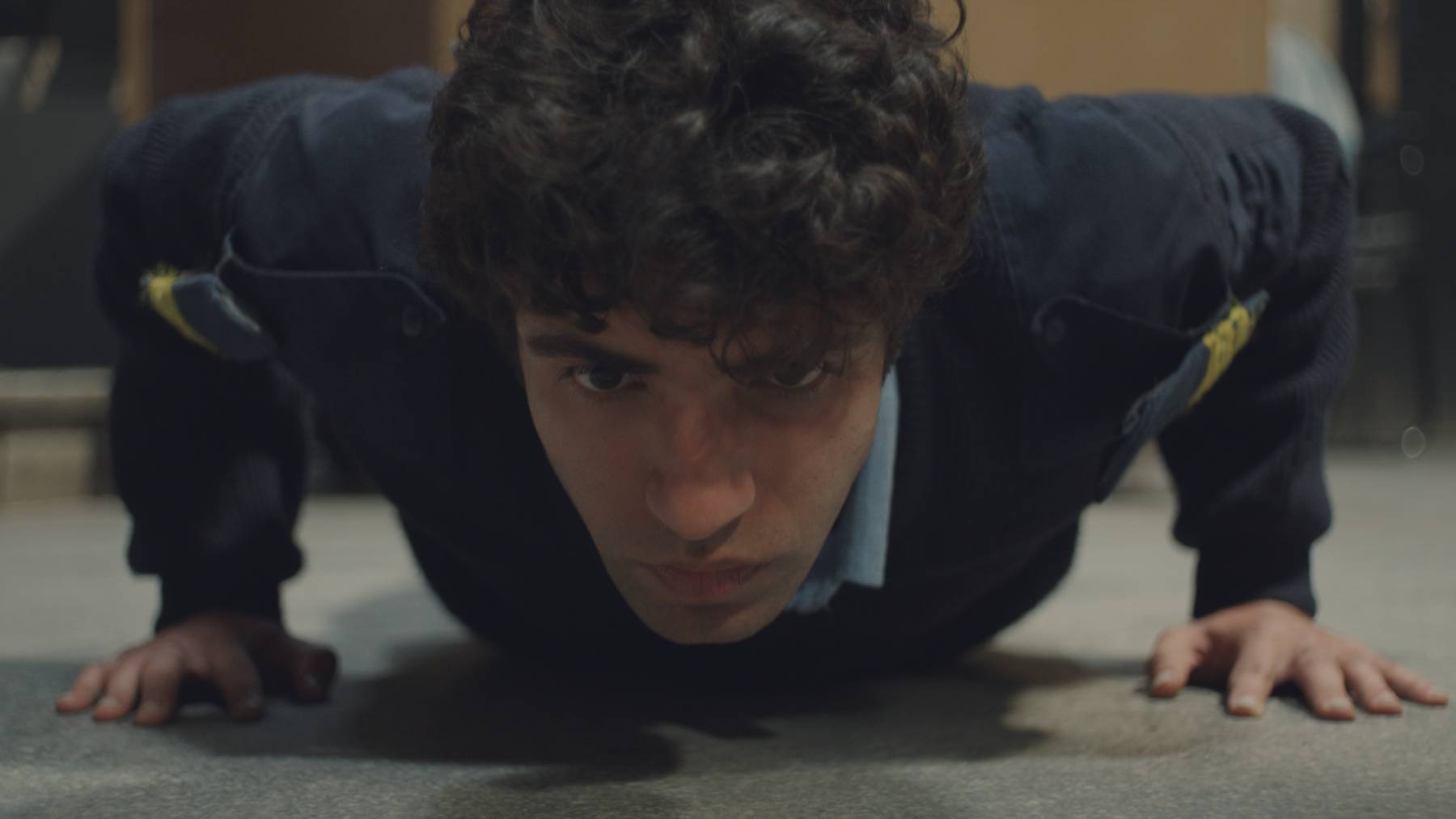
A comparable disconnection from contemporary reality appears in Safe Exit by Mohammed Hammad (Egypt). Its protagonist repeatedly carries what appears to be the manuscript of his novel, as though he were still living in the literary world of Jack London’s Martin Eden. Yet publishing, authorship and access to readers have undergone profound transformations. Digital publishing, online promotion and self-publishing have fundamentally altered the relationship between writers and literary institutions, including in countries where traditional publishing remains difficult to access. The film’s reliance on an almost century-old image of the aspiring writer processing his trauma raises questions about whether this apparent anachronism is a deliberate character choice or simply an unexamined narrative convention.
At the opposite extreme stood films seemingly afraid of saying too little. The Return of Captain Kabonga by Amir El-Shenawy (Egypt) and Boomah by Zaid Abu Hamdan (Jordan) both approach the two-hour mark, accumulating dramatic developments and multiple apparent climaxes until their central narratives begin to lose focus.
Their problem is not necessarily a lack of material, but an inability to establish a hierarchy within it. Every dramatic turn appears to demand its own culmination. Instead of enriching the films, this accumulation gradually dilutes their impact. The viewer is left with the peculiar sensation of watching a story that has ended several times but continues nonetheless.
Another recurring weakness was visible from the very beginning of certain films: the apparent uncertainty about how to enter a story, establish its characters or define the relationship between filmmaker and subject.

Big Boys Don’t Cry by Muhammad Mustapha (Egypt) and A War on Women by Raha Shirazi (Italy) explore distinct worlds of men and women, both shaped by patriarchal structures and expectations. Their protagonists are compelling, their experiences dramatic, and the underlying conflicts offer considerable potential for documentary exploration.
Yet instead of allowing these characters and their relationships to carry the films, both directors resort to conspicuous behind-the-scenes material, inserting sequences that foreground the filmmaking process itself.
Reflexivity in documentary cinema can be an extraordinarily powerful device. Revealing the presence of the camera, the filmmaker’s interventions or the negotiations between subject and observer may illuminate questions of ethics, representation and power, as demonstrated by Nathan Grossman’s Amazomania (2026), which had its world premiere at CPH:DOX, won the festival’s inaugural FIPRESCI Prize and sparked debate over the ownership of images, the colonial gaze and the filmmaker’s right to tell someone else’s story. But such an approach needs a purpose.
Here, the self-referential interruptions rarely seem to deepen our understanding of the protagonists or challenge the documentary’s own authority. Instead, they divert attention from the stories, as though the filmmakers felt compelled to remind audiences that a film crew was present to enhance the significance of what we observe. What might have become an exploration of masculinity, vulnerability and the consequences of patriarchal structures is repeatedly interrupted by the mechanics of its own production.
It is particularly regrettable because both films contain the essential ingredients of something far more accomplished.
Indeed, this might be the most frustrating impression left by the selection as a whole. Most of the films had worthwhile subjects, compelling characters, socially relevant conflicts or potentially fascinating environments. What they frequently lacked was the artistic discipline required to transform this material into cinema.
The problem was not simply limited budgets. Financial constraints undoubtedly influence production values and creative possibilities, but they cannot fully explain redundant (or awkward) dialogue, unnecessary scenes or an inability to recognise when a film has reached its natural conclusion.
Sometimes the most important decision a director can make is to say: Cut.
This raises a question that extends far beyond El Gouna and its CineGouna industry platform. Over recent decades, an increasingly elaborate infrastructure of development laboratories, funding schemes, pitching forums and mentorship programmes has emerged to support filmmakers, particularly those working outside established film industries. These initiatives have undoubtedly opened doors, facilitated international collaborations and brought otherwise marginalised stories to the screen.
Yet the films discussed here invite a less comfortable question: Has the contemporary film industry become better at identifying important stories than at cultivating distinctive cinematic voices?
Funding applications increasingly require filmmakers to articulate the social relevance of their projects, define their target audiences and demonstrate their potential impact. But how much attention is paid to the cinematic language through which these intentions will eventually be expressed? And might the emphasis on clearly formulated messages, recognisable themes and demonstrable social value inadvertently encourage the very predictability that cinema, as an art form, ought to resist?
The issue is not whether development programmes are necessary, but what kind of development they prioritise. More sustained dramaturgical consultation, script doctoring and structural editing could help promising projects realise their potential. Yet even these interventions would be insufficient if they merely polished conventional narratives rather than encouraged filmmakers to challenge them.
The selection at El Gouna offers no definitive answer, nor should it be taken as representative of an entire generation of filmmakers. But it does expose a contradiction worth examining: at a time when cinema has unprecedented opportunities to address urgent social questions, its formal imagination can appear surprisingly constrained.
Ultimately, Cinema for Humanity is a valuable aspiration, but humanity alone cannot constitute an artistic criterion. Social relevance does not automatically produce meaningful cinema, just as good intentions cannot compensate for the absence of form.
Perhaps the question we should be asking is no longer simply which stories deserve to be told, but what kind of cinema we are encouraging filmmakers to create.
Elena Rubashevska
©FIPRESCI 2026