
Beyond Borders: When a Conceptual Theme and a Physical Location Coincide
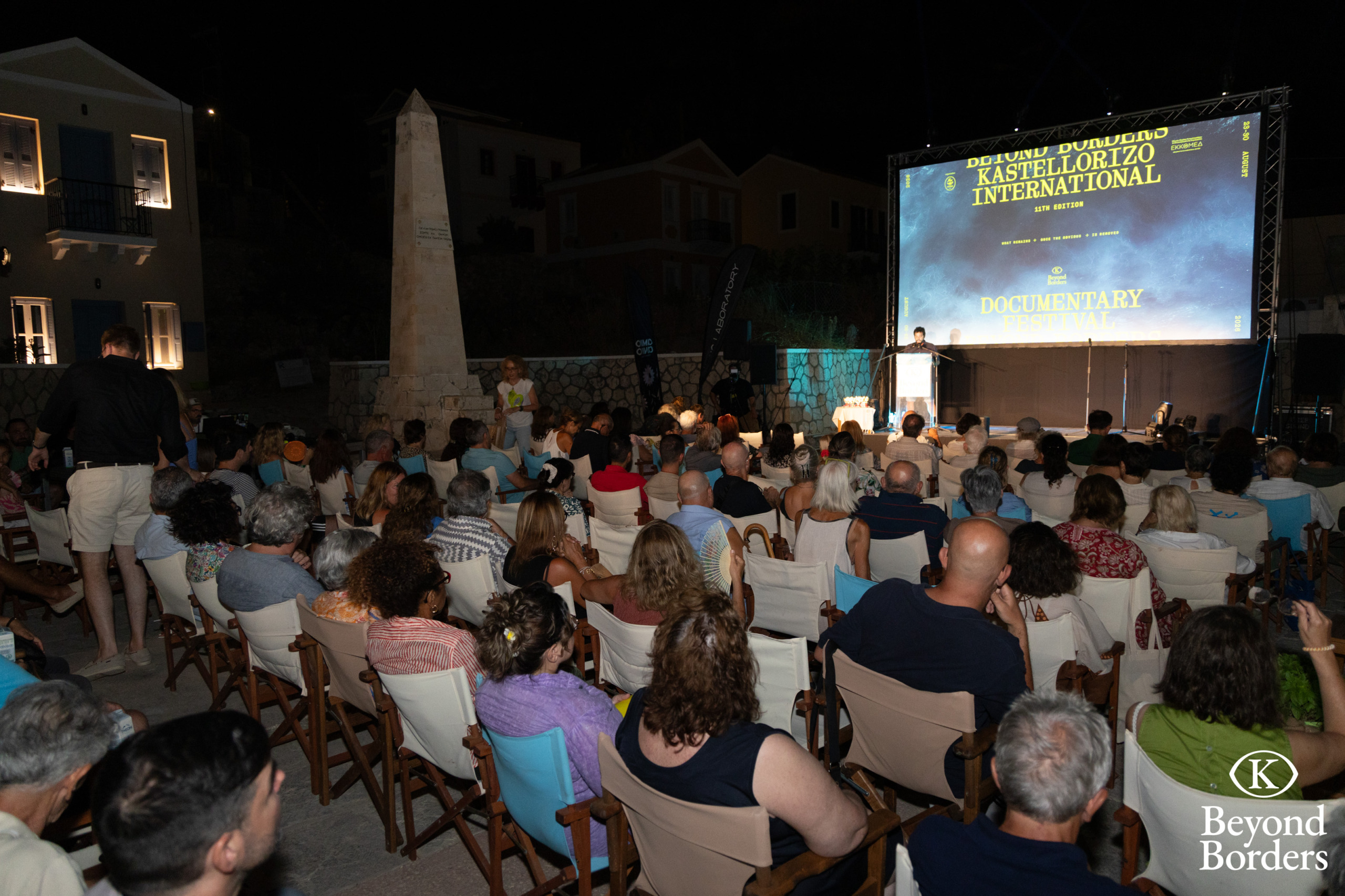
The Greek island of Kastellorizo, one step away from the Turkish coast, is the perfect setting for this film festival, now on its 11th edition, which reminds us that national differences can coexist in harmony.
How often do a film festival’s main theme and its location perfectly coincide? It is certainly the case with the Beyond Borders Documentary Festival, which is set in Kastellorizo, the Dodecanese island farthest from its Greek homeland and closest to Turkey, right off the Anatolian coast. Kastellorizo has a very complex history of foreign domination, from the Medieval occupation by the Knights Hospitaller to the long-term Ottoman rule, as well as Egyptian, Spanish, French, Italian, and British control. The island was officially ceded to Greece via the Paris Peace Treaties in 1947, and the Italian part of its past is featured in Gabriele Salvatores’ film Mediterraneo, which won the Oscar in 1991 for Best Foreign Language Film.
Today, a Greek Navy ship stations in the main port of Kastellorizo, Megisti, to avert the danger of a possible invasion by Turkey, whose city Kaş sits right across the water. The Greek flag is displayed everywhere on the small island, painted on its mountains and swinging from the top of the castle that gives the island its name (Kastellorizo means “red castle,” referring also to the red earth that distinguishes the island). No place could better exemplify the theme of the Beyond Borders festival, now in its 11th edition, since Kastellorizo’s own borders have been repeatedly invaded and their protection has always been a priority.
However, the festival prefers to concentrate on the desire to go beyond any geographical, political, and ideological boundaries, and the films shown in the main competition in August 2026 are proof. These range from the desperate attempt of a Sub-Saharan group of migrants aiming to cross over to Europe by way of the Spanish city of Ceuta in North Africa (very much in the news these days) in Les Voyageurs (The Travellers) by young Cameroonian David Bingong, himself a migrant, to a group of investors trying to prey on the lithium resources of Bolivia in Materia Prima by German director Jens Schanze. They also span from the troubled history of the village of Imbros, torn between Turkey, Greece, and the Balkans in EXILE(S), ιστορίες ενός νησιού (Exile(s)) by Greek helmer Giorgos Iliopoulos, to the destruction of a community of sea nomads in Borneo at the hands of Malaysian developers in Bajau Laut – The Sea is Our Home by German filmmaker Joo Peter.
Both The Travellers and Exile(s) won awards in Kastellorizo, while FIPRESCI’s International Critics Prize went to Yrupẽ by Spanish director Candela Sotos, which deals with the conflicted memory of the Spanish Civil War in Argentina as told by a pioneer of scientific cinema through his documentary The Flower of Irupé: a film within a film, and the memory of domination through the lenses of a descendant of the conquerors.
The legacy of an ethnic background that conflicts with one’s surroundings recurs in three harrowing documentaries: Ce qui reste des amours de nos mères (What Remains Of Our Mother’s Love) by Cathy Dubois, where a French woman looks for her Senegalese roots; in بابا و القذافي (My Father And Qaddafi) by Jihan K, where the daughter of Mansur Rashid Kikhia—a human rights lawyer and former Libyan foreign minister and ambassador to the United Nations—recalls her father’s “disappearance” at the hands of Muammar al-Gaddafi and the impact it had on his family; and Past Future Continuous by Morteza Ahmadvand and Firouzeh Khosrovani, where a woman who escaped Tehran to France after the 1978 Islamic Revolution observes through video cameras her parents slowly aging in her native Iran.
The issue of crossing borders—whether by necessity, dominance, greed, the need to find a better life or to reconnect with one’s roots—was at the center of the Main Competition in Kastellorizo in many other titles selected by Artistic Director Irini Sarioglou and Programmer Stefanos Velmachos Bonos. Their dedication to the Beyond Borders festival, even through current financial difficulties, remains unyielding and continues to provide viewers and critics with a high-quality selection of titles which remind us that we all belong to the human race, regardless of where we choose—or are compelled to—live.
Paola Casella
© FIPRESCI 2026