
Forever Never Forgotten
I find it admirable that the Viennale presents itself as a public film festival made for the
audience. The phrase points to a financial matter, namely state funding, but it suggests far
more: a question of ethos. More precisely, the word “public” is not only perfectly
representative of what I have seen in Vienna during the festival, but it is an all-encompassing
term ideal for a programme and an agenda (artistic and ideological at once) of the
responsibilities such an event holds toward its audience: on the one hand, the Viennese public,
and on the other, the cinephile international visitors, which together form a human chain
through the festival. Among those responsibilities is the refusal to approach cinema with the
philistinism so common in the film industry. The Viennale is indeed a festival of festivals,
showing the “best-of” the cinematic year, but not inert, merely echoing the major prize winners
for validation. Under the artistic direction of Eva Sangiorgi, it is a vivid reflection of the
contemporaneity of cinema, addressed to the public rather than the industry. In that reflection,
renowned yet often misunderstood filmmakers such as Hong Sang-soo, Mariano Llinás, Radu
Jude, Angela Schanelec, Phil Solomon, Jocelyne Saab, Albert Serra and others are placed front
and centre, in the midst of their audience.
The Viennale is a young festival, and the FIPRESCI prize, one of very few in the awards list (the
festival is largely non-competitive), considered thirteen debut films: first or second features by
directors from several continents. This is a customary arrangement for our film critics’ juries
(Visions du Réel, Festival du Nouveau Cinéma, Sundance Film Festival, etc.) and meant,
obviously, to ease our encounter with new cinema. Seen on Viennese screens, this new cinema
promises a future that could not be brighter, provided we know how to take care of it.
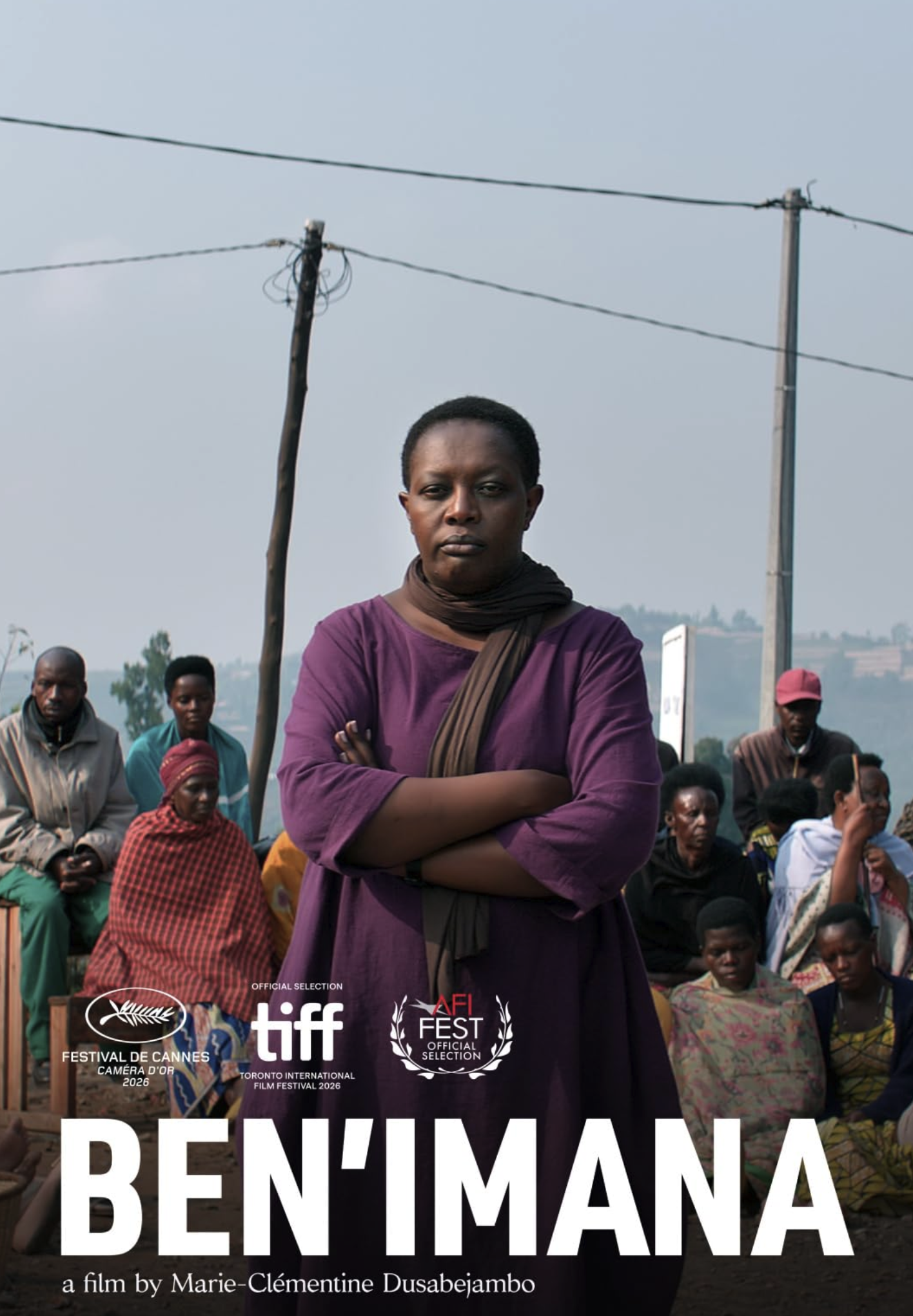
This year’s FIPRESCI Prize went to the Rwandan film Ben’Imana by filmmaker Marie Clémentine
Dusabejambo, her feature debut. Our colleagues from FIPRESCI already championed the film in
Cannes (as the winner of their Un Certain Regard award), concomitantly with the Caméra d’Or
jury, so ours might seem an unusual decision. But protocol couldn’t be in the way of our
unanimous feeling that we encountered a masterpiece, which is a feeling so rare. We are
grateful to the Viennale for such an encounter – for us it makes perfect sense to celebrate
Dusabejambo’s film on this stage, the very same stage that has been championing the
consciousness of political filmmaking for decades.
Ben’Imana tells a story that seems to come from the near future, about a community’s
agonizing attempt to make peace, twenty years later, with the historical trauma of genocide:
the 1994 killings committed by one part of the Hutu population (the majority in Rwanda)
against the ethnic Tutsi. This time, peace takes the form of justice, as false oblivion can no
longer be endured. A people’s tribunal listens in the open air to the testimonies of Tutsi
survivors against their attackers, murderers, and rapists from 1994, often their own neighbours.
Once again, in the hands of Dusabejambo, cinema becomes part of the modern art of the great
African oral culture. Weaving together fact and fiction, extensive research and a story written in
collaboration with Delphine Agut, professional actors but above all local non-professionals, the
filmmaker makes the spoken word, monologues and dialogues, the true engine of her film’s
narrative, lending it a thrill of horror, curiosity, and perpetual “to be continued.” The airy,
inquisitive mise-en-scène, almost hands-off out of piety, makes room for the spectacle of these
bodies, for gestures of aplomb that claim a space segregated by invisible borders. But before
anything else, Ben’Imana is a logocentric reflection on putting human horror into words, on
acts often considered “indescribable”: words with legal weight, words that differentiate, and
also missing words.
The filmmaker tells a great story – of a minority, of a nation, of a world in which genocide can
unfold with impunity, but above all of three generations of Tutsi women whose lives have been
defined by the trauma of horrors endured. There are two sisters, Vénéranda (Clémentine U.
Nyirinkindi) and Suzanne (Isabelle Kabano); one believes in reconciliation and organizes group
therapy sessions, the other in justice; and Tina (Kesia Kelly Nishimwe), Vénéranda’s daughter,
who unexpectedly becomes pregnant by a young Hutu man, putting her mother’s convictions
to a personal test. Without relativizing the historical massacres in any way, Dusabejambo
explores the limits of memory, or rather of forgetting (such a thing cannot be forgotten), but
also those of guilt, both individual and collective. Justice can offer these women little, and its
conclusions seem petty in the face of their tragedies, of the suffering, vulnerability and dignity
we have witnessed.
Ben’Imana is a drama without solace, yet one of great visual consciousness. Rarely does a form
come to know its content so intimately. The filmmaker’s style is by no means an easy or hip way
of making films; on the contrary, it has an academic air, perhaps out of an awareness of its own
importance. Yet for some time to come, it will be hard to imagine how else a film on such a
subject could look.
Călin Boto
Edited by Birgit Beumers
Copyright FIPRESCI 2026