
Hug of Emptiness: Human Solitude and Quiet Resistance
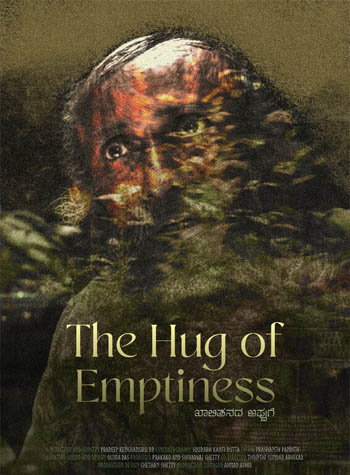
From Mumbai, Indian critic Rwita Dutta takes a detailed look at the 2026 FIPRESCI prizewinner, which follows a resilient man who, after losing everything, rebuilds his life in the forest.
Pradeep Kenchanuru’s debut documentary Hug of Emptiness, which won the FIPRESCI award in the 2026 Mumbai International Film Festival, narrates the life of an exceptional human being: Chandrasekhara Gowda, who lives a life in desolation in a remote forest. He makes a living by making baskets out of the vines he collects from the forest. He describes how after his parents’ demise, he planned to sell the property and settle down but suddenly the police came and eventually his property was auctioned. Since then, he began living and harvesting in the woods, and over the years turned into an environment warrior. He alerts us to how environmental disaster can erase us from this planet and that it is our responsibility alone to plant trees and save ourselves and future generations.
As an example, he cites the green tribunal set up in Delhi where people have already started reporting breathing difficulties, and some also suffered suffocation. This problem has not only been confined to the capital of India but might spread across other regions of India in the next fifty years. For nearly twenty years, Gowda worked the plantation alone, finding no one from the Aranthodu village nor from Nelluru Kemraje Community to help. Never did he participate in skill development courses in Madhikeri, Ujire, or in Bengaluru. He learned the art of basket weaving on his own; his self-respect drove him to be self-dependent. He could have become a house servant but his dignity prevented him from doing that. Despite losing all of his assets, he chose to remain independent. Therefore, he invented his own alternative way of life. He uses solar power to charge his phone. When he borrowed some money from the bank his property was confiscated. Even then, he didn’t resort to the profession of begging; he, like a lone warrior, educated himself in the skill of basket weaving and tried to lead a dignified life.
Living in the lap of Mother Nature, he turned into an environmentalist who tries to preserve that nature as he realized that human beings are rampantly destroying nature, causing drought, pollution, soil erosion, etc. He observes that human beings destroyed the forest to create urban zones, and now they are facing a crisis. He even went to the court to ask means for his survival but in vain. Surprisingly, even after this stupendous struggle for survival, he turns philosophical. To quote him, birth and death are inevitable. Repentance emerges from pain, and the moral dilemma a person endures as a result of his deeds and delusion arises from selfishness, desire for women, money, and possessions. A person is overcome by the six fold vices of Hindu philosophy: the Arishadvarga. It’s necessary for a human being to live a life like a sage which is only possible if that person is free from all these six vices. Also, violence begets violence. Anger cannot answer the problems of the society.
In 2003, Chandrasekhar lost his property to the Sullia cooperative bank, a seizure that defied Reserve Bank of India norms. The case is still under trial. Meanwhile, for the last 24 years he lives with a damaged car, fighting a solitary battle of justice. A man who, stripped of everything, finds a way to survive and rebuild when his entire world falls apart. With a camera that never intrudes and a somber voice that simply tells its own story, the film turns twenty-four years of solitude into a quiet act of resistance. Raghava Suresh and Sourav Kanti Dutta create magic in every frame, whereas Subrata Pramanik and Krishnendu Mandal add finesse to the film with a brilliant sound design.
The Director unhurriedly tells us a story of injustice, trauma, and human solitude in a most compassionate manner without being unnecessarily garrulous.
Rita Dutta
Edited by Robert Horton
© FIPRESCI 2026