
Feels Like Home: Family as Political Allegory
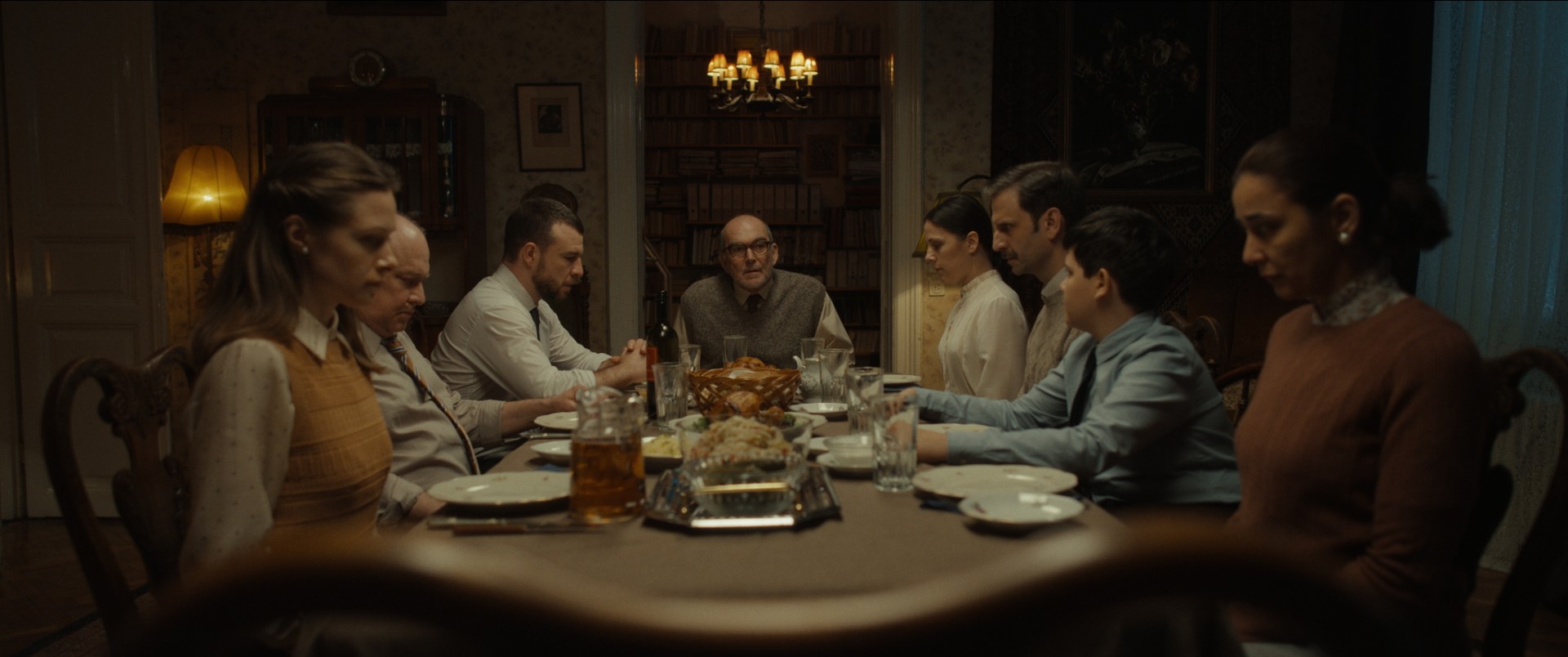
Hungarian director Gábor Holtai‘s accomplished feature debut blends psychological thriller, dark comedy, and political allegory into one of the year’s most striking genre films. Michael Phillips explains why the FIPRESCI Prize winner at the European Film Festival Palić succeeds both as an entertaining genre piece and as a sharp portrait of contemporary Hungary.
The standout film at this year’s European Film Festival Palić, the intimate lakeside festival held near the Serbian-Hungarian border, begins as an unnerving abduction thriller. Two hours later, Feels Like Home (Itt érzem magam otthon) has drawn its audience into an ordinary Hungarian family’s living room—never mind the blood on the walls and floor—as a new generation contemplates its future.
If that description makes Gábor Holtai‘s feature debut sound like splatter cinema, the film certainly has its moments of graphic violence. Since its completion last year, Feels Like Home has screened at several genre festivals across Europe, including events in Spain and Austria. Earlier this year, it also enjoyed a successful commercial release in Hungary, shortly before Viktor Orbán’s electoral defeat.
Yet the violence is never deployed for empty sensationalism. Instead, it becomes one element in a gradually unfolding metaphor, subtle and intelligent, driven by genuine outrage at authoritarianism.
The film opens with Budapest shop assistant Rita (Rozi Lovas) finishing her final shift after losing her job. As she walks home carrying her former employer’s parting gift—a pair of bright white trainers—she is suddenly kidnapped, hooded, and transported to a dark room in an unknown location.
Her captor, Marci (Áron Molnár), has a singular objective: to convince Rita that she is actually his long-lost sister, Szilvi. According to him, she simply wandered away years earlier and is now being forcibly returned to her family. These early scenes of interrogation, sleep deprivation, and psychological manipulation reveal that Marci himself is an uneasy authority figure, carrying out a role that seems to have been written for him by someone else.
Rita gradually commits to her own performance, assuming the identity of the missing Szilvi, the family’s aspiring poet and her father’s favourite child. For much of its first half, Feels Like Home unfolds as an intimate duel between captor and captive as Rita memorises Szilvi’s biography from Marci’s homemade instruction manual and learns the histories of the family she is about to meet.
At this point, screenwriter Attila Veres and Holtai shift effortlessly into another register, transforming the film into a dark comedy about family tensions, sibling rivalries, and the poisonous legacy of parental favouritism. The ensemble cast is superb throughout. Tibor Szervét gives a remarkable performance as Papa, a sentimental tyrant trapped in nostalgia for an earlier Hungary before, as A Serious Man memorably put it, “the new freedoms” arrived.
Papa is incapable of tolerating dissent or independent thought. Why abandon the comfort of familiar certainties, however suffocating they may be? As Rita increasingly masters her role within the family—Lovas subtly revealing new facets of her character’s intelligence and resourcefulness—the film undergoes yet another transformation. Papa Árpád and his damaged family gradually become recognisably human embodiments of Orbán-era Hungary.
The film is a triumph of micro-budget filmmaking. Holtai also composed the score and co-edited the film with Vica Éva Kovács, whose sharp editorial rhythms continually unsettle the viewer while allowing the performances to remain firmly at the centre of attention.
The film inevitably recalls other works. One detects echoes of Yorgos Lanthimos‘ Dogtooth, with its unsettling codes of family behaviour; of Max Frisch‘s The Firebugs, where authoritarianism quietly infiltrates bourgeois domestic life; and of Jordan Peele‘s Get Out, another genre film using suspense to expose deeper political anxieties.
Yet Feels Like Home never feels derivative. Its greatest achievement lies in its mastery of tone. Holtai never pushes his allegory too hard, instead drawing the audience ever deeper into an atmosphere of mounting unease. Even if the second half occasionally loses momentum, the film remains as funny as it is disturbing. I was especially taken with Kórnel Simon’s wonderfully hapless accountant brother-in-law, a man seemingly gifted with neither accounting nor social skills.
My fellow FIPRESCI jurors and I were delighted to recognise such a confident debut. Feels Like Home announces Gábor Holtai as a filmmaker of remarkable assurance, and it leaves us eager to see where his career will lead next.
Michael Phillips
© FIPRESCI 2026