
Who is leading all these beasts and where to?
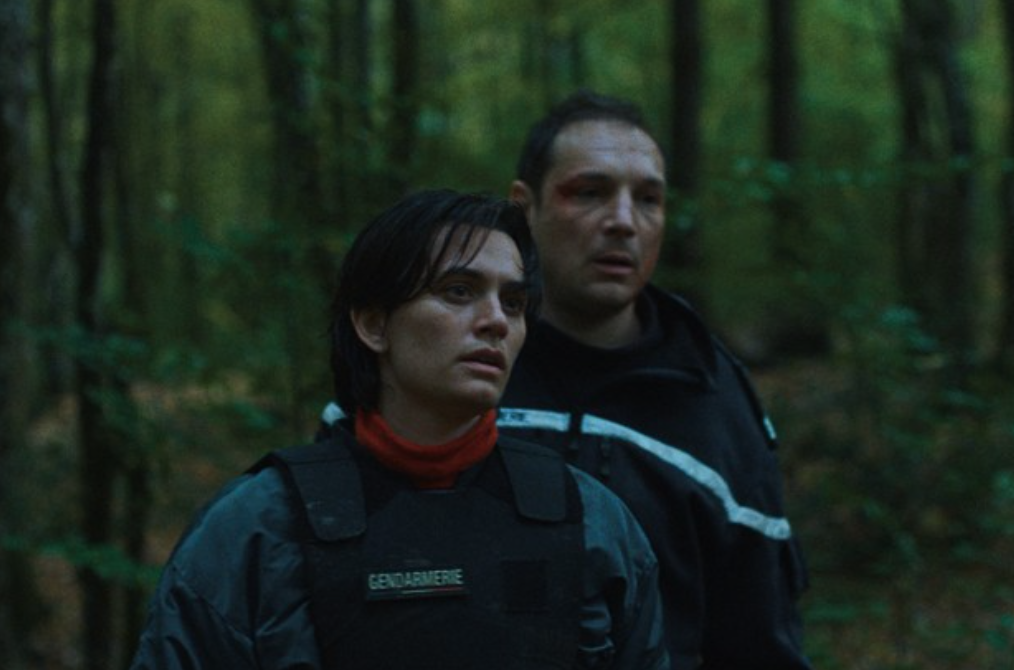
Playing at CineFest Miskolc International Film Festival in Hungary, Too Many Beasts is the exciting feature debut of Italian-Swiss filmmaker Sarah Arnold. A combination of political commentary and gleeful comedy makes this an expansive addition to the genre of French police comedies.
Police comedies are a staple in French cinema’s past and present. In the 1950s and 1960s, Louis de Funès became an icon portraying the gendarme in Jean Girault’s police film series, at the same time stepping into Jean Marais’ spotlight in the Fantômas series, with Marais as the ghostly bandit and de Funès as the comical commissioner trying to catch him. More recently, all the works of Dany Boon include the presence, more precisely the clumsiness and inadequacy, of police officials. A darker tone is audible in the works of Alain Guiraudie, where policemen and women deal with strange things happening in the French countryside. The policemen are soft-hearted and eerily gentile in his work.
There’s no women on that list, but there is one now. Italian-Swiss filmmaker Sarah Arnold has tossed her hat in the ring with her debut feature film, Too Many Beasts (L’espèce explosive, by Sarah Arnold, 2026), a wonderfully funny drama which involves quite a few police officers and many more boars. All together: too many beasts. Some of them have offices, others eat through crops. Some are illegally brought into the country, others are relocated to safer areas away from the big cities where they cause too much harm. There are those with psychological issues, and those with real sharp teeth and thick hair covering their bodies. If you squint your eyes, the four-legged and the upright beasts start to resemble each other a whole lot.
In a small village, they meet. The local farmers are mad because their crops are ruined by the boars, but the owners of the hunting forests see their membership numbers increase as well as their financial capital. The cops assigned to the case have a lot to investigate, while their captain remains rather silent. Yes, the metaphor to current mega-corporations and their political friends is easily detected, but how else is one supposed to deal with what is nothing more than a blunt reality? Very subtly, Arnold adds nodes of queerness and mental health – not in a capricious, gratuitous way, but as a part of that same reality. The capitalist machine is in full swing, but psychologists are sent to police stations as tokens of progression.
In the film, there are most definitely too many boars and, through (not so) mysterious ways, they grow too big. In present day political and financial organizations, in the same fashion, the heads grow unnaturally big. The good news is that the targets on their heads grow with them. It might teach farmers and workers alike to work together and shoot a single, thick arrow at the nastiest of them all. Perhaps, in this way, can the herd be led back to a well-guarded playground. Arnold’s film in itself has a lot of playground qualities: great fun, sharp edges to some of the structures, a soft landing, and loving family watching over the scene.
Arnold is a filmmaker to be watched, as this was a strong debut. With her earlier work, she had already caught the attention of film critics, producers, and programmers around the world. She won prizes for her short films in Locarno, Glasgow, and Torino amongst others. At Cannes this year, Too Many Beasts was in competition for the Caméra d’Or for best first feature film and won the Europa Cinemas Label Award. She is far from done touring festivals and, without a doubt, will add more prizes to her mantel.
Kathy Vanhout
Edited by Olivia Popp
© FIPRESCI 2026