
Goran Stanković on Our Father at CineFest Miskolc
At the Hungarian festival, the Serbian director speaks about coming up with a haunting final shot, working with his cinematographer, and making a film about a man who uses violence to exert power on those he’s meant to heal.
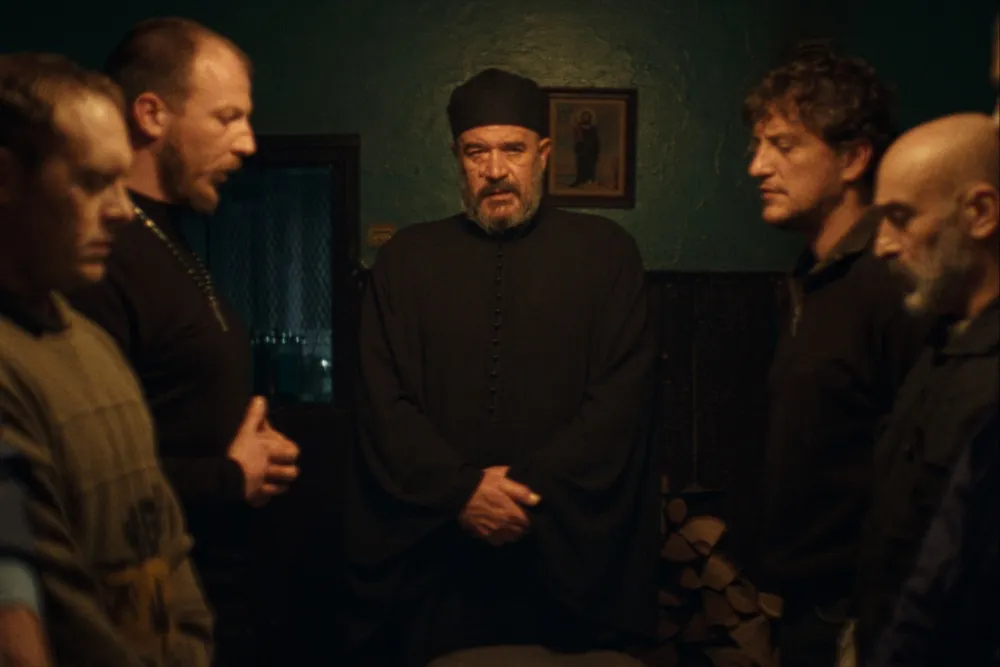
Serbian filmmaker Goran Stanković’s Our Father (Oče naš, Serbia, 2025) follows Dejan (Vučić Perović), a man with substance abuse problems, who arrives at a mountain commune where Father Branko (Boris Isaković) treats addiction with labour, obedience, and beatings. There, Dejan is taken under the wing of Mionica (Goran Marković), a fellow patient who has spent three years there and believes this savage, violent method has saved him. The two develop a friendship built out of compassionate glances, shared cigarettes, and hours of cutting wood together. Isaković gives Branko enough magnetism that you understand why nobody walks out, and Perović plays a man discovering he is capable of doing something good and then having to pay a high price for it.
The film, which played in competition at the 22nd CineFest Miskolc International Film Festival in Hungary was one of many with male leads who didn’t know “how to be men”, or knew and couldn’t bear it anymore. The Red Hangar (Hangar rojo, 2026), directed by Chilean filmmaker Juan Pablo Sallato, puts an Air Force officer (Nicolás Zárate) in the days before Pinochet takes Chile and makes him understand that duty has almost nothing to do with right and wrong. God Forgives Everyone (…che Dio perdona a tutti, 2026), directed by Italian filmmaker Pif, needs the Pope (Carlos Hipólito) as its hero’s (Pif) unlikely sidekick before he can hear what the woman (Giusy Buscemi) he loves is actually asking of him. Heysel 85 (2026), directed by Romanian-Belgian filmmaker Teodora Ana Mihai, has the mayor of Brussels (Josse De Pauw) living inside a catastrophe that didn’t have to happen, and an Italian journalist (Matteo Simoni) filing pieces hour after unbearable hour while he waits to learn whether his little brother got out of the titular stadium alive. Truly Naked (2026), directed by Belgian filmmaker Muriel d’Ansembourg, has a man (Andrew Howard) figuring out that he has to parent his child differently. Stanković’s bruised men fit perfectly into a collection of imperfect men bearing the unbearable weight of masculinity.
Our Father is inspired by a real case. Leaked videos in 2009 showed men in recovery at the Crna Reka monastery in Serbia, being brutally beaten, and put a spotlight on the methods of priest Branislav Peranović. That centre was closed but he opened another one, which stayed in operation until 2012. A patient died after a beating at his hands, upon which he was arrested and stripped of his priesthood. In June 2026, he was sentenced to 21 years in prison.
I spoke to Stanković on the eve of the premiere of Our Father at CineFest.
Jose Solís: Most of the interviews you’ve given are about social justice and what the Serbian government and the Serbian health system do to people who use substances. Those are fair questions, but I’d like to talk about the cinematic aspects instead.
Goran Stanković: It takes over, because it is a strong, real event that left an impact, so it’s no wonder that people attach to that and then put the filmmaking elements second.
Jose Solís: Let me start at the end, then. I love your final shot. The men are left to their own devices, the camera leaves them, and I couldn’t help thinking it was God’s point of view, abandoning them there.
Goran Stanković: Did you notice the dogs?
Jose Solís: I did. Of course I did. They’re left like dogs in the street, but I’m less interested in what that means symbolically than in what it means at the level of cinematic grammar. Was that always the final shot?
Goran Stanković: In my mind, it was basically leaving them and showing first that they’re becoming a part of a bigger community, that they’re getting smaller and smaller and that they’re left to their own devices. It happened that, on the day of the filming, there were a bunch of stray dogs at the station, and we gave them some food so that they could come into the shot, and then it all came together. But if it’s a story about faith, then the assumption that God is leaving can come to mind. I was more thinking about leaving them to get smaller and smaller, becoming part of an environment, and becoming invisible to people.
The thing is that this was not the original ending that was written, shot, and edited. I shot and edited a version of the film that starts in Belgrade, where the main character lives, and he’s being taken away from his house. If you pay extra to this paramilitary rehab centre, they actually provide a service of kidnapping your loved one and bringing them there against their will. So many people do that. I always thought, “Wow, that’s such a powerful way to start the story” – that someone is being taken away without their will and put to this isolated mountainous area. That’s how the film started, and it ended with him coming back to Belgrade and watching his son from afar – trying to get in touch with them but just not wanting to interfere into the life of his wife and his son.
Months went by, and we sent this cut to certain festivals, and it was always kind of there but just wouldn’t get in. In the editing room, the editor suggested this version where we’re only in the centre, and I thought it was so important to have this bookend because it gives more insight into the character. After a couple of months I decided that we should just stick to what happens in this rehab centre, and so the last image became the image at the station, which was not intended to be from the very beginning. And the moment I did that, the film got into TIFF (Toronto International Film Festival). It was next week that we sent the movie, and they said, we want to have it. So it unlocked something that needed to be. It was a final touch that made a difference.
Jose Solís: You said “bookend”, and that confirms an instinct I had, because the film is full of these poetic symmetries. We have Mionica beating Dejan, and then later Dejan being asked to beat the man who beat him, and that’s where he breaks apart. Those two scenes hold the entire dialectic of the movie. Did you find that symmetry in the edit, or was it written?
Goran Stanković: No, it was definitely something that was written in. A crucial part happens before this final encounter of these two characters, where the one that we thought was cured has spent three years of his life there and followed all the rules. Finally, he’s let go, and we all believe that he is cured. When he comes back and tells our character that this method doesn’t work, the method that is so violent that everybody had a hard time believing in it. But in the end, they accepted it and started practicing it, and the idea for our main character crashes. This is something that enables him and makes him capable of now causing pain to someone that he feels so close to, because he no longer believes in this ideology: this idea that this method is going to make someone better. So that’s a very important part in having to decipher the last scene.
But also my idea was to show that, as they say, there’s a way of nature and a way of grace. I strongly believe that force is not the only way through life. That’s why I wanted the two main ideas placed in the two main characters as the carriers of these ideas: the priest and the young addict that comes to be cured.
In the Balkans, it’s so easy to accept the idea that force is how you recognise a man, and that’s his role in this world and how he’s to go through life. I was taught that by my parents and so on. So I wanted this main character to break off from this tradition of hurting other people in the idea of helping. This is why he refuses, in the end, to make that beating. That was very important for me, to break the cycle.
Jose Solís: Mionica tells Dejan, “There is a God here, and there’s a different God out there,” which is incredibly powerful. I was also struck by how these men come together through repetition – cutting wood, smoking, this constant ritual. I’m wary of how I talk about this, because I don’t want to make it sound like it’s a love story between men, which it isn’t. It’s a bromance. The hauling, the working together, “do you need a cigarette?”. Can you talk about building that relationship through these small kindnesses instead of embraces?
Goran Stanković: One of the interesting parts was that this was an isolated commune but where men have to come together, and there is obviously something they inherit being brought up in a very patriarchal environment. As you said, these emotions are interpreted as something weak. It was interesting to watch and to create a dynamic between these people that cannot show emotions because that makes them weak. When someone does something wrong, you need to punish them. I guess for the person that built this commune, that’s his way of looking at the world. Those are leftovers of some old, inherited ways of seeing the world.
This new generation of men still are trapped, but I did want it to feel like there is hope for them to break out. In this constrained world, all they have are these small gestures because they are not allowed to show anything more than that. You get sensitive and you notice these small things, like how they show love to each other. I thought that was a nice way to give an insight into how men defending the brinks of patriarchal society – thinking that it’s their role – show these small cracked pieces of something vulnerable when no one is looking. Vulnerability is not rewarded in this system.
Jose Solís: We’ve been talking about men, so I want to ask about Maja Pelević, one of your co-writers. Every woman we see onscreen is a guest. The mother who comes to visit, the mother who drops off a friend, the journalist who comes to do interviews, the girlfriend on the phone. What did Pelević see in these men that your male co-writers and you didn’t notice?
Goran Stanković: Maja was the godmother of the title of the film. That’s an important one, because the title, especially in Serbia, can come off as very provocative, because it is a symbol for the prayer. However, it has a lot more meaning if you watch the film, because fathers are such a big motive and a theme in the film. So it’s not just about the prayer – it is about the relationships between the fathers and the sons.
She was very critical of the environment and of the authoritarian power of this. She was very vocal about that aspect, whereas I was trying to give this man a position where we don’t judge him at the very beginning, but you take time to form your opinion about him. Having women come as visitors was important to feel the absence of them. It’s like a yin-yang philosophy, where if you have too much of one kind of energy, there’s a disruption in it. That’s exactly what happens when you leave men on their own. This is what is bound to happen, so we need that other side to counter it.
Jose Solís: I don’t want to offend anyone, but even the chocolate cake in the movie looks miserable.
Goran Stanković: It looks horrible.
Jose Solís: It looks like the saddest cake ever, and it’s meant to be part of a celebration. You also use music very sparingly. You don’t give the characters any joy or any pleasure, and you don’t give it to us, either. The audience gets no respite. Was that conscious?
Goran Stanković: I’m sure that there were moments of relief in a place like that. I’m very sure. And we did actually film some of those, but in the final edit, there just wasn’t a place where you could demonstrate that, illustrate it. It was like a side note, because it relieves the tension, and if you keep something suspenseful, it also gives a place where everything just sits still. There are moments that you take a breath in; there’s a scene where they’re cutting each other’s hair. They get drunk, but that’s also a scene that turns out…
Jose Solís: Tragic.
Goran Stanković: Tragic, obviously, and we know that is coming. There are these little small moments, but again, providing something more than that would destroy the overall suspense of the film. But I am sure that there were these moments in real life, and as a director, as a screenwriter, you have to condense reality. In condensing reality, some things just fall out, and maybe they are missed in the bigger picture, but you do need to make these choices in order to tell certain aspects of the story. This is not a documentary that is showing life as it is. There is an idea that is trying to be told, and so you question, “Is this scene guiding us to that idea, or is it derailing us?”
Jose Solís: Watching the way this priest runs the place, you see literally everything you should not do as a film director. All these men are submitting to a dictator who exerts horrible power. What did being in community with your cast and crew, while filming a place that felt like the opposite of that, tell you about your own position and power as a director and a screenwriter?
Goran Stanković: My schooling in the US, especially at AFI, taught me one of the things that I definitely now practice in every aspect of filmmaking, which is that criticism of the first take is given to the actors. That means that you come, you have something in mind, but also the people you invite to collaborate with you have something in mind, too. The criticism of the first take means that you allow this person or these people to bring their own idea, and you allow them criticism of the first take to do it their own way. And then you start directing, and then you start moulding.
This is true for all the collaborators. The DoP has read the script, he knows the story, and so he brings his own. The production designer brings her own palette of how she felt. And so, you start a conversation. If you start the process as a dictator, in that sense, then people switch off. That’s exactly what happens in this movie. People switch off. Their will dies off with them, because they feel safer if they just don’t think, because then they know they can’t go wrong, because someone else is making decisions for them. They switch off, and then they’re not invested. They’re not involved in their own lives.
The thing that I learned was definitely to give your collaborators the courtesy of their first idea and then to start the conversation. That has saved me so many times, because I couldn’t come up with something like that. If in the beginning I said what my intention was, I would have killed maybe a great idea for a movie, So I tend not to do it.
However, there are times where democracy is not the best organisation of work, especially on a film set. The hierarchy is extremely simplified and direct. There are times where you have to call on the role that you have and make a decision, because people have their own way of seeing things. My friend calls it sewing a giant sweater. You know what the sweater is like, but then you have the material, you have the sleeve, and people that are working on the sleeve can’t really see the rest of the pieces. That’s where you have to guide them to have that vision intact in the end.
So the answer is, there are times where you have to perhaps take the leadership role. But most of the time, you create an environment where everyone is welcome with their ideas and they get discussed, and you get way better collaboration than if you just came and said what you wanted to see. People will switch off.
Jose Solís: How did you unwind on set? How did you find levity between takes or once the day was over?
Goran Stanković: That shoot was specific because we all lived together for that month and a half. We moved down south. We found an abandoned military post, and they gave us that post, and we actually built the church there. And we found a hotel that is 45 minutes away from there, because there wasn’t civilisation closer than that. So every day, we would travel 45 minutes there and back, and we would stay in this one place all together.
These dynamics continued into the set. Everyone was there with the purpose of doing the movie. You didn’t go about your daily life when you finish work. Everyone was focused. We were talking about the stuff we were going to do. We were talking about each other’s lives and all these things. We bonded, so that helped immensely.
Regardless, I feel like there was always a bit of tension in the air, because it’s such an uncomfortable story – there’s always something there. There is a darkness in this, but here is always humour that is a counterpoints. That’s a great way to relieve, and there were very fun and humorous people around. But again, there was always this veil of some sort of darkness, because we all know how the story ends.
Jose Solís: I read that you worked with your cinematographer, Dragan Vildović, on In the Dark (U mraku, Serbia, 2014) as well, which I haven’t seen and am now dying to see. Most of Our Father is close-ups of these men’s faces. The only sustained violence we see is the recreation of the video that leaked. The rest of the time you give them the grace that the priest and the system don’t. You shoot them in chiaroscuro, almost out of a gothic painting. Can you talk about working with your DoP and about granting your characters that grace rather than doing what society did with that clip, which was to decide they deserved it?
Goran Stanković: Both of us really love finding beauty in the ugliest places in the world. I’m not going to say that the world of mining is ugly, but it’s gritty. And with that one, too. we found beauty in this grittiness. Here it was also the idea of treating the physiognomies of these people. There are a lot of these images of them and their bodies, and we wanted to glorify the human condition within, but also the gift of the human body as something beautiful that is being destroyed and killed in a way. That was a counterpoint to that. Then, this location lent us so many possibilities. We intervened by painting all the walls and creating the look that we thought was a stylised world that felt more authentic. It was a thin line, but we wanted for viewers to feel our presence while maintaining that fine line where the aesthetics are there but they’re not interfering with the storytelling.
Jose Solís: I admired the symmetry and symbolism of the production design. We have all the icons and paintings of saints that seem to be looking away from the horrors that happen in those rooms. Lastly, I want to ask you about this theme of men straying from their fathers’ paths, which seems to be prevalent in your work…
Goran Stanković: …and the next movie I’m working on has this theme.
Jose Solís: What do you know about your fatherland now that you didn’t know when you made In the Dark?
Goran Stanković: My fatherland belongs to a destroyed country – Yugoslavia. I was born in Croatia, my father is from Montenegro, my mother is from Bosnia and Herzegovina, and I’m Serbian. My next film is going to deal with the question of fatherland, because Montenegro is a place where masculinity is very valued. Even women have to have a firm hand and sometimes replace men. This behaviour has been passed on from generation to generation. The fatherland I was born in doesn’t exist anymore. It’s now six different countries, so my fatherland and motherland now is Serbia, and it’s going through a rough patch in many aspects. I hope it will see brighter days soon.
Jose Solís
Edited by Olivia Popp
© FIPRESCI 2026