
Three new voices at the 9th Brussels International Film Festival
In the three winning films of this year’s BRIFF, we find an unwavering commitment to being authentic.
To begin with, let’s recall that the Brussels International Film Festival is the only Belgian festival to have hosted the FIPRESCI Prize since 2022, which, here, honors the best debut film in the various sections offered: International Competition, Director’s Week Competition, and National Competition. During this 9th edition of the BRIFF, we had the opportunity to discover and consider 3 Belgian films (out of the 9 presented across all sections) – three different approaches to filmmaking, all sharing the same commitment: to be completely authentic. A selective framework that gives the distinction its full weight, and that immediately casts these works under a particular light: that of first steps.
Ceci n’est pas un film français by Tom Adjibi hits the ground running. An actor trained at INSAS, who has performed under Milo Rau and Tiago Rodrigues—two of the most demanding directors on the contemporary European scene—Adjibi makes his directorial film debut with a formal approach that is as crafty as it is honest. The film begins as a making-of diary: a director of color attempts to make his first feature film, and runs up against the industry’s polite smiles, doors that don’t quite open, and questions disguised as kindness. Up to this point, we recognise the conventions of autobiographical filmmaking. But the film takes a sharp turn when his own actors aim the camera back on him, forcing him to confront his own blind spots and unacknowledged assumptions. The docu-satire then reveals its full depth: it is no longer merely a critique of the film industry – and its ways of excluding people without seeming to – it is also a film about the inner contradictions of the one who speaks out. Funny, unpredictable and politically sharp without ever being didactic, Ceci n’est pas un film français builds itself up by deconstructing itself (!). The BRIFF jury awarded it the National Grand Prix, a well-deserved recognition for a debut film that refuses both the activist pose and autobiographical self-indulgence.
Comme un château fort by Lou Colpé takes the opposite path: that of silence, of the inner world, of necessary slowness. In this deeply intimate documentary, the director draws on a shattering experience—weeks spent in a hospital hallway accompanying a loved one, her partner, as he died—to ask a question that seems simple on the surface, but is in reality profound: do we inhabit places or connections? Here, the house is not merely a setting. It is the very subject of the film: a refuge, a fortress, a space for healing, but also a place where those who are gone continue to dwell. The camera films as close as possible to the body and to loss, without the comfort of distance, without reassuring effects. She does not seek to prove a point, nor to console – she seeks to see. And it is precisely this refusal of easy mediation that gives the film its singular power. Comme un château fort is a work that strikes the right chord precisely because it does not seek to convince: it simply invites us to stay, to watch, to journey through it.
The jury awarded it the National Jury Prize – a choice that speaks volumes about the formal maturity of this debut work.
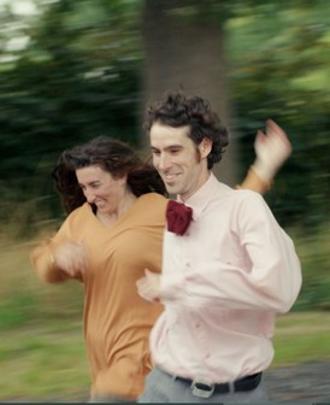
La Bucolie by Tom Boccara and Wided Ouassale comes from an entirely different background: the world of live performance, from which both filmmakers originate. This debut feature film—co-written, co-directed by, and co-starring the duo—is unlike any other in the selection. The film follows a young count expected to carry on the family legacy who chooses instead to run away and forge a different life, alongside Roza, a woman uprooted and searching for a world that suits her. Together, they create a bucolic utopia, fragile and luminous, on the edge between reality and fable. The title says it all, or almost all: there is something in La Bucolie akin to a reimagined pastoral, a gentleness that is anything but naïve, because it knows exactly what it refuses. The form is inventive, interwoven with several languages (French, Dutch, Spanish) as if to say that this utopia has no assigned borders. Boccara and Ouassale play their own characters with a rare presence, and the film strikes a delicate balance between a lighthearted tone and profound meaning.
The audience was not mistaken: Best Male Performance, Best Female Performance, and National Audience Award – a triple win that reflects the festival’s immediate embrace of a work that mirrors itself: plural and boundless.
Three new voices, three radically different stances toward cinema and toward the world. What these films share, beyond their individual uniqueness, is a refusal to enter familiar territory: each one invents its own rules, takes its own risks, and treats the debut film not as a calling card, but as an act in itself.
Perhaps that, ultimately, is what FIPRESCI seeks to highlight.
by Frédérique Morin
Edited by Savina Petkova
Copyright FIPRESCI 2026