
A Masterful Debut: Krux
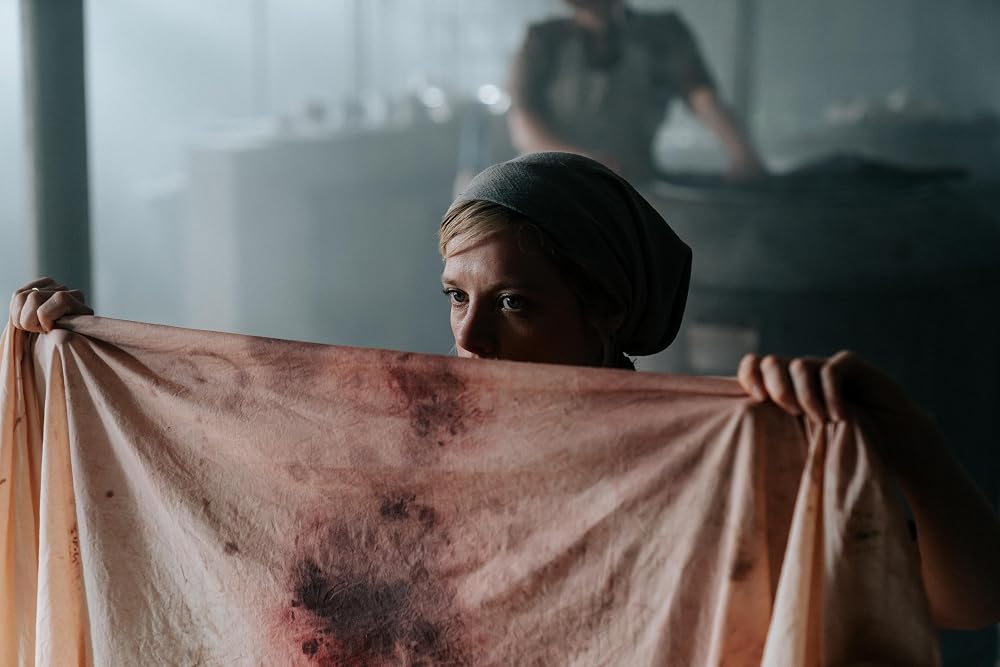
The German-Polish film Krux is examined by Brazilian critic Enoe Lopes Pontes, who applauds director Tony Vahl’s courage in tackling a difficult subject, one that is both World War II-era history and a contemporary warning to a world flirting with fascism.
In her debut feature film, director Tony Vahl achieves a level of artistic execution that even the most experienced directors often fail to reach. Krux is a production that harnesses the fundamental technical elements of filmmaking to evoke profound and provocative states of mind. Through this narrative, the audience encounters the story of a small German village that represents a historical event.
In 1945, at the end of World War II, a wave of mass suicides swept across Germany. This was the pact the people had supposedly made with their Führer in the event of imminent defeat. Beyond any technical considerations, it takes courage to tackle this subject matter. The portrayal of these citizens encompasses multiple storyline layers.
There is a deliberate humanization at play here, laying bare not only the fragility and ignorance of a community but also their perfidy and cruelty. These contrasting elements are established right from the start of the film. In this way, the audience is able to connect with the characters.
An example is the portrayal of the grief experienced by the protagonist, Greta (Jella Haase), over her late husband. At the same time, a sense of unease is immediately established. This is because Greta is marrying a dead man. This dichotomy between shock and empathy, which opens the film, sets the tone, connecting with the audience.
Here we have two sentiments happening simultaneously, revealing the magnitude of the population’s problem. In this sense, the use of horror elements elevates the potential of the discussion Vahl proposes. Humanizing Nazis is no easy task. Yet dismantling the image of German monstrosity is essential for humanity to understand that this was not an isolated case involving purely demonic, depraved individuals.
Ordinary men and women from small villages, people with young children and infants in their arms, were responsible, directly or indirectly, for the deaths of millions. As in Germany, other nations have been or remain involved in genocides, such as those linked to slavery or the colonization of the African continent.
So, when Krux lays bare the true nature of the Nazi project and the effectiveness of its indoctrination, capable of dominating not merely a specific group but an entire people, the film becomes all the more compelling; therein lies its true courage. Any misstep by Vahl could have either trivialized the situation or simply turned human beings into monsters.
Within this framework, the horror arises from a cinematic approach that carefully balances shot duration, alternating between moments of contemplation and suspense. Vahl’s mise-en-scène creates a dynamic of danger that permeates the environment. The camera moves in sweeping arcs, and the sound design ensures that noises echo all around, creating a visceral sensation in which the viewer is immersed.
The textures and colors chosen for the art direction and cinematography are the standout features of this universe. The visual composition blends heavy and fine fabrics, utilizing a restrained palette punctuated by specific accents of warm hues. This aesthetic mirrors the national psyche, characterized by a calculated detached composure that, when disrupted, causes individuals to crumble within their own systems.
Translating such intrinsic, profound, and conflicting national traits into imagery elevates Vahl’s work to the level of brilliance. The only hint of artistic inexperience lies in the inclusion of sequences featuring a snake circling the scale model of the story’s village. While the metaphor is valid in the context of film or art in general, here the repetition weakens her intentions.
It works well at the beginning of the film, but the lack of cohesion with the actual plot makes the symbol’s impact diminished. It is evident that the filmmaker is young; beginners often devise excellent strategies but struggle to let go of them, even when they do not know how to execute the idea effectively. Nevertheless, this element hardly detracts from the work as a whole.
Krux is a product of its time, attempting to warn a contemporary world that is once again flirting with fascism. The film is tenacious in formulating and maintaining its discourse; it is polished, successfully conveying diegeses and character development to the audience while leveraging cinematic techniques to transform images and sounds into a carefully crafted political argument. It is for this reason that this is a masterful debut.
Enoe Lopes Pontes
© FIPRESCI 2026