
Ian Bawa's Strong Son: Deconstructing the Myth of the Strong, Silent Hero
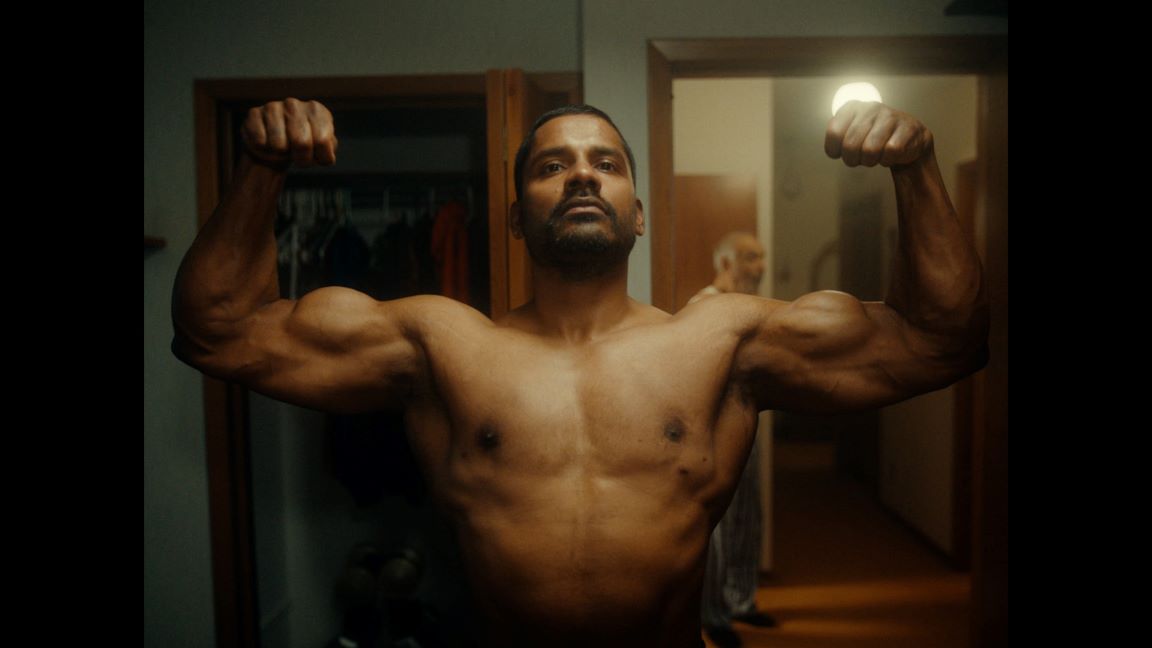
From the Toronto festival, Canadian critic Victor Stiff focuses on a debut director’s quiet powerhouse of a film: Against an icy Winnipeg backdrop, Strong Son delivers an intimate portrait of a son suffocating under the weight of expectations.
For generations, Hollywood portrayed strong, silent men as the masculine ideal. Clint Eastwood, Steve McQueen, and Arnold Schwarzenegger led the charge as dashing stoics who never buckled under pressure. But that skewed representation narrowed the mainstream template for onscreen manhood, conditioning generations of young men to bottle up their feelings. In Strong Son, director Ian Bawa calls this antiquated masculine ideal into question, subverting a long-held image of quietly simmering, square-jawed leading men. In his modern exploration of manliness, that silence is deafening.
At a glance, Harvinder “Harvey” Singh (Mandeep Sodhi) seems to have a lot going for him. He’s a handsome former bodybuilder with a physique looksmaxxers would kill for. But beneath his cool, chiseled exterior, Harvey is drowning on the inside. He’s moved back into his family home during a punishing Winnipeg winter to look after his ailing father, Jagdeep (Amrit Parbhakar). To make ends meet, Harvey works a thankless security guard job by day before returning home to watch his dad slowly succumb to illness.
Making matters worse, Jagdeep’s rigid definition of manhood casts a long shadow over his son, leaving him struggling to live up to his father’s exacting expectations. Overwhelmed by the barrage of pressures, Harvey begins having emotional breakdowns in public, exacerbating his feelings of emasculation and failure.
To help cope, Harvey distracts himself by diving into his father’s favorite sport: professional wrestling. Throwing himself into wrestling’s world of performative combat offers him temporary respite from his real-life pressures. Stealing time away from his responsibilities grants Harvey the headspace to separate the person he is from the man his father expects him to be.
Bawa’s screenplay crafts an intimate portrait of a man at war with his sense of self. Harvey is unable to reconcile what he’s feeling with the man his father expects him to be. This cognitive dissonance leads him to overcompensate through his imposing physique. His muscular frame functions as both a facade and a shield—a suit of armor protecting him from revealing his emotional sensitivity.
The immense effort he puts into sculpting his body at the gym mirrors the lack of time he invests in healing his emotional wounds. Bodybuilding provides a sense of purpose and validation that keeps Harvey in his father’s good graces while distracting him from confronting his pervasive anxieties.
Being a strong son, working security, and pro wrestling help satisfy his father’s expectations—serving in masculine-coded roles as protector, guardian, and warrior. However, this imposed value system has never offered Harvey the space to explore who he is beyond the tough and imposing figure he was conditioned to become. His father’s impending mortality forces him to confront who he is independent of his role as a dutiful son, and that’s enough to trigger an existential crisis.
Bawa’s use of a professional wrestling subplot presents an incisive commentary on performative masculinity. Wrestling may look hard-hitting and ultra-macho, but it’s performance art—a comforting illusion. Wrestlers theatrically take on intimidating personas, while devastating-looking drop kicks and armwrenches are choreographed to look brutal while landing with a feather-light touch.
As Harvey’s wrestling instructor, Nav (Yuvraj Dhesi) tells him, “It’s far more important that you entertain them [the audience] than actually win.” Harvey spent his lifetime performing for an audience of one, and he sure isn’t winning.
As Harvey, Sodhi threads the needle, speaking volumes within each scene despite his character’s lack of dialogue. In wrestling parlance, the film uses Sodhi’s subtle performance to piledrive the classic notion of the brooding tough guy straight into the mat. Here, Bawa makes his most assertive declaration: a man’s lack of expression does not equate to a lack of feelings. Harvey’s quiet disposition was never a sign of strength; it’s a cry for help from a man incapable of asking for it.
Strong Son comments on Hollywood’s hardcoded notions of manliness, asking us not to get swept up in the tides of conventional thinking. The film argues that healthy masculinity doesn’t require physical strength; it requires showing strength—the strength to be vulnerable, know your limits, and ask for help when it’s needed. Looking out for his father isn’t what makes Harvey a strong son; it’s recognizing when it’s time to finally look after himself.
Victor Stiff
© FIPRESCI 2026