
If You Can't Run, Don't Look Away: on Adrian Chiarella's Leviticus
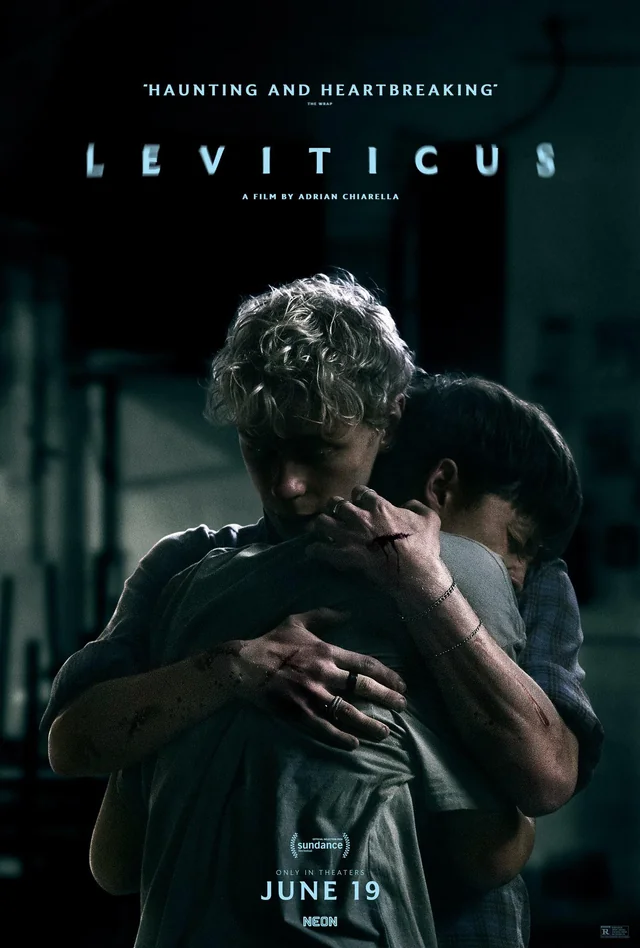
A queer love story. A religious nightmare. A monster with the face of the one you love. Leviticus turns horror inward, revealing how desire becomes terrifying when we learn to see ourselves through the eyes of condemnation.
A desolate field ringed with barbed wire; two transmission towers rising over it. A snake swallows a toad. Two boys stand side by side, watching. Ryan (Stacy Clausen), blond and strapping, teases the snake by prodding its head with a stick. Naim (Joe Bird), slight, with a nervous face, is getting uneasy and tries to stop his friend; yet he cannot take his eyes off the reptile. The boys move on to an abandoned mill, where they hurl and smash the junk lying around in a display of strength; their playful violence aimed at each other soon becomes a kiss. Just as the contact deepens, Naim catches sight of himself and Ryan in a shard of broken glass and recoils. Leviticus (Australia, 2026), the debut feature of writer-director Adrian Chiarella, buries its message in this first scene, making it fit into a single powerful metaphor: swallowing and being swallowed; the place where fascination and revulsion can no longer be told apart; and, above all, the eye that cannot look away.
Leviticus tells the story of two boys who fall in love in a small town ruled by evangelical faith, somewhere in Victoria, Australia. Naim has moved there with his mother, Arlene (Mia Wasikowska, who is also an executive producer on the film). “The Book of Leviticus”, from which the film takes its name, holds the Old Testament law and instructions, long invoked to prohibit homosexuality. In town, that law is not a text but a procedure — something the community actually carries out. And the story begins when Naim himself sets the procedure in motion. Seeing Ryan, whom he loves, kiss Hunter, the pastor’s son, a jealous Naim outs them to Hunter’s parents. The pastor and the parents, who deem homosexuality a sin, subject Ryan and Hunter to a deliverance ritual, ostensibly to save them from their desire. Not long after, Hunter is killed, hideously, inexplicably. Terrified and racked with guilt at what he has seen, Naim confesses his own relationship with Ryan — whereupon Arlene pushes him into the very ritual the other two endured.
After the ritual, Naim’s life is threatened by a monster in Ryan’s shape. He learns that the monster stalking Ryan wears his own face. The more the two want each other, the more often the double appears — and it turns most savage at the most romantic moments. So long as the boys desire each other, there is no escaping it. And yet there is a way: since the thing comes only to someone who is alone, they need only never be alone — always in company, so long as the company is not the other. This is the aim of the ritual, a method for prising the boys away from a forbidden love. But love is not something that can be stopped. To want the other, to be frightened by the wanting, and to be unable to stop: it is the terror of enduring that state that the film gives form to.
*
The summer of 2026 has brought one horror film after another from a new generation of young directors. The first to arrive was Backrooms (Kane Parsons, USA, 2026), which began as a web short series and became a feature; it opened in South Korea on 27 May and has drawn more than 1.2 million admissions, the first foreign horror-thriller to pass a million here since Jordan Peele’s Us in 2019. Then the 30th Bucheon International Fantastic Film Festival presented Obsession (Curry Barker, USA, 2025) and Leviticus. Obsession, made for $750,000 and now over $400 million worldwide, was warmly received at BIFAN as well and took the award for Best Director in Bucheon Choice: World, the festival’s international feature competition. More noteworthy still is Leviticus, which won both Best Film and the Audience Award in the same section. They say you cannot catch two rabbits at once. Leviticus caught both: the critics and the crowd.
Leviticus, which takes homophobia as its subject, may look, on the surface, unlike Backrooms, which stakes everything on the fear of space, or Obsession, which shows us a terrifying fixation that goes by the name of love. Look beneath the surface, though, and the three films share the following: each is about terror inside the most intimate of relations. Backrooms reveals that behind the space you thought you knew best, another space is hiding — one you have never seen. In Obsession, the horror begins at the very moment the wish is granted: a man who felt he would want for nothing if only he could have her love, entirely, gets exactly that. And in Leviticus, the face of the one the protagonist most loves and desires becomes the face of a monster that may take his life at any moment.
Horror arises with an inversion of the familiar. A department store or a hotel that was swarmed with people, suddenly empty. A school packed with students, and you locked inside it alone at night. Someone you trusted and leaned on, suddenly turning on you. In each case, intimacy becomes the precondition of the horror. The longer and deeper the intimacy, the wider the gap that opens when it turns strange — and the more intense the fear. It is why, in a horror film, so much fear can be packed into a single line: “Do I still look like your mother to you?”
And yet more frightening still: “I’m your mother.” Because it means there is no last redoubt — nowhere left to hide, nowhere left to run. Here the three films meet again, at the point where there is no way out of the space, or the relation. Horror without an exit is a long-standing convention of the genre. Ever since Sadako crawled out of the television screen in Ringu (Ring), directed by Hideo Nakata (Japan, 1998), Japanese horror has made a signature of the thing that will not go away — however fully the cause is uncovered, however thoroughly the grievance is appeased. Terror with no way out carries the anxiety of a roller coaster that offers no guarantee of ever setting you down.
This summer’s three films set out carrying that anxiety. Backrooms unfolds a space with no outside, and so nothing to take a bearing from. In Obsession, the protagonist has no way out of the friend who has come to cling to him — a clinging he himself wished into being. In Leviticus, the boys, subjected to a religious deliverance for what their town calls the sin of homosexuality, have no way to flee a monster that comes in the shape of the other. To have nothing to take a bearing from and no visible exit is, in itself, to produce a bottomless fear — one with neither cause nor cure. Hence the protagonist of Backrooms runs wild, and the protagonist of Obsession gives in. And so the two films leave the image of the terrifying space, and the terror of intimate feeling, to resonate exactly as they are.
*
It is here that Leviticus parts ways with the other two: it implies, and strongly, that the source of the terror was already inside Naim from the very beginning. Return, then, to the film’s first scene of the two boys. That scene has already told us all we need to know about the unaccountable violence of the monster that will come for Naim.
Naim cannot take his eyes off Ryan’s strength, his unhesitating manner, his sometimes cruel playfulness — even as they make him uncomfortable. He cannot look away — exactly as he could not look away from the snake he called disgusting. Ryan is, above all, what Naim cannot help being drawn to: what he wants to flee, to look away from, and at the same time to surpass. And so the monster wears Ryan’s face: a surface onto which Naim’s desire is projected. Ryan could not lift the heavy section of cast-iron pipe that Naim had wanted to lift. Later, the Ryan who comes as the monster tosses that same pipe around as lightly as a pebble as he attacks. The relation between Naim’s desire and the shape the creature takes is not hard to infer.
And the fact that he stops when he sees himself in the broken glass shows that homosexuality is taboo for him — that the gaze condemning it as sin has been internalized. Because that gaze is the source of a deep guilt and fear, to be attacked by the monster is also a figure of merciless self-punishment.
But what even extreme terror cannot stop is their burning desire for each other. And so the two boys cannot get out of this hell. Looking for a solution, they seek out a girl who has undergone the same ritual; all she tells them is that it gets worse when they are together, that they have to stay apart. Naim goes home and asks his mother for help. She tells him what she knew: that she put him through the ritual understanding exactly what would follow. This is the point at which Naim’s last refuge closes — the irreversible point at which “I’m your mother” is confirmed. From here on, he has to face this alone. The morning after the night he had gone, trembling with fear, to sleep on the floor beside his mother’s bed — never in it — she told him coldly to clear his things out of her room. What was coming had already been foretold there.
Now Naim gets out of his mother’s car. This is the resolve Naim arrives at: to walk out, on his own two feet, of what he had taken for his final shelter — away from the mother who pushed him into the ritual knowing there was no undoing it. The move looks like the arc of a universal coming-of-age story. But here the film rewrites the ending of It Follows, directed by David Robert Mitchell (USA, 2014). There, too, two people walk on together with the thing still behind them. What Leviticus adds is a look that can tell the one from the other — and it makes that look a queer one.
Setting out alone, Naim meets Ryan at the stop and they board a bus together. They split a pair of earphones, one bud each, heads leaning together. Naim takes Ryan’s hand and looks out of the window. Outside, something with Ryan’s face is standing. But the real Ryan is beside him, and Naim is at ease. Read the rule in reverse — the monster comes only to someone who is alone — and the thing outside is a Ryan who was never there to begin with, a Ryan who had been growing only inside Naim’s head. With a single pane of glass between them, Naim looks at once at what he has made and at what he loves, and at last tells the one from the other. Before the broken glass of the derelict mill, he saw himself and stopped; before the bus window, he saw what he had projected and did not stop. Then the credits come up, and with them Frank Ocean’s “Self Control” — the song the film asks us to imagine in those shared earphones. Through this altered gaze, the self-control that the law of Leviticus has always demanded comes back — into the ears the film has just shown us, and with the opposite meaning.
*
The monster never dies. It is still standing outside the window. The film does not dissolve the horror; it changes your relation to it. To call this ending simply a hopeful message is to have read the film only halfway. A horror film is under no obligation to console its audience, and it is no flaw in Backrooms or Obsession that they refuse us an exit. What makes the gaze of Leviticus valuable is not that it arrives at a brighter conclusion, but that the conclusion is a necessary one, drawn from within the film’s own coherent structure. From the start, this film built its horror out of looking: the eye that watches a snake devour a toad, the eye that finds itself in broken glass, the eyes of a town keeping watch on one another — and, at the end of that series, a monster wearing the face of the one you love. To a world built of gazes, the film answers at the level of the gaze. It is a head-on reply to three facts: there was never an outside, flight was never possible, and the monster was never out there.
Here a temptation arises: to call the film a universal coming-of-age story that transcends queer cinema. But to settle for that phrase risks erasing what matters most in it. What Naim has to confront is not some vague interiority; it is the gaze that the law of Leviticus planted inside him. This coming-of-age story has its force not because it goes beyond being a queer story, but because it remains, to the very end, exactly that. And it is precisely because of that specificity that the film has something to offer anyone shut inside a world with no way out: a method. If you can’t run, don’t look away.
By Yuhee Park
Edited by Savina Petkova
Copyright FIPRESCI 2026