
The Night: Perversion is freedom
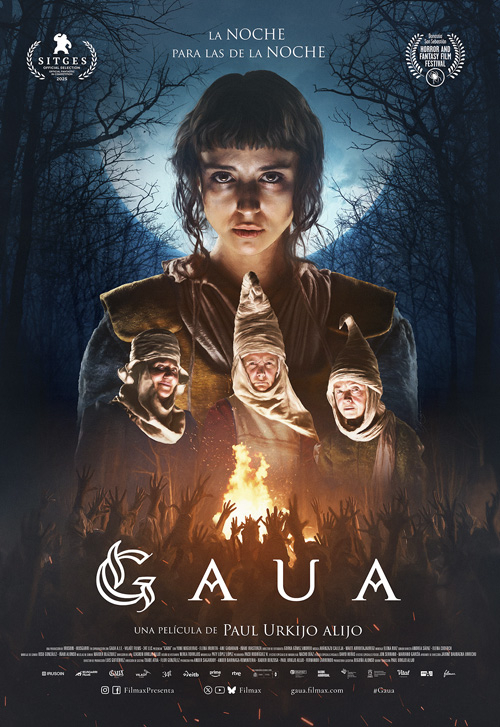
Winner of the first FIPRESCI Award at the Bucheon International Fantastic Film Festival, Paul Urkijo Alijo’s The Night blends Basque folklore, dark fantasy and queer liberation into a richly layered cinematic fable. Joonatan Itkonen explores how the film transforms witches, monsters and oral storytelling into a powerful rejection of religious control and patriarchal oppression.
The Night [Gaua], winner of the first FIPRESCI Award given at the Bucheon International Fantastic Film Festival, feels like a campfire story passed down from one generation to the next. It enraptures from the very beginning, as director Paul Urkijo Alijo skillfully leads audiences down a path of dark fairytales, impish humor, and sexual liberation.
Along the way, the film reveals itself as an immensely moving cinematic feast; equal parts Mike Mignola’s Hellboy and Francisco Goya’s Black Paintings. In our Jury deliberations, it quickly became all we could talk about, as every conversation led us down another path of exploration. Almost as if we, as viewers, could wander the endless forests of Alijo’s intricate fantasy.
The story unfolds through oral tradition, as each narrative thread loosely connects through varying perspectives around the small village where a vile priest controls the populace with an iron grip. Split into chapters, the film has a freewheeling looseness to its structure that plays like a bertsolaritza, an improvised song, performed specifically for the outsider. Time has little meaning here, and it doesn’t matter if some things do not make logical sense. They resonate on a deeper, more primal level, where our inner desire for the forbidden lingers in the soul.
The Night exists on the boundary between night and day. The former is the unknown, a time where the penitent man slumbers, dreaming of ways to please his masters in heaven and on Earth. The latter is the harsh reality where the church occupies every corner of life. Both are man-made fabrications, means of control that seeks dominion over nature itself.
The tale begins as our heroine, Kattalin (Yune Nogueiras), poisons her violent husband and escapes into the forest, where she encounters three storytellers. They are elderly women who pretend to work at night so that they can converse and celebrate freely, away from patriarchal judgement. Though Kattalin lies about her goals, the women know far more than they let on. They share a drink, and each tells a story about something that has happened in the village in recent weeks. As the night progresses, these stories grow more specific and pointed, and we realize that Kattalin’s guilt extends to greater and more immediate events.
It is here that Alijo’s sleight of hand impresses most. As a director, he is keenly aware of his audience and how ingrained certain stories are in our collective minds. We can easily recognize that Kattalin’s clothes are reminiscent of those of Snow White, while Maritxu (Erika Olaizola), the woman she adores, wears crimson red, the color of passion and temptation. But watch how beautifully Kattalin’s wardrobe reflects her bondage, and how gracefully Nogueiras’ body language changes as she learns to exist in a world beyond restrictions.
Despite its Basque roots, The Night works on a universal level. Here, the church is a colonialist power, and Alijo is not coy about his feelings about its brutal control in this history. The film speaks of queer love in a world controlled by those of poisoned visions. There are moments of gorgeous juxtaposition as worship, be it religious or sexual, takes on different forms, and the search for meaning can be as elusive as a spectral rabbit disappearing into the undergrowth. The film’s visual language builds on the verticality and hierarchy of religion. We expect to look up and find a heavenly power, but for the oppressed, it is just another way to anticipate the boot.
Even as The Night spins a tale of a world of witches and monsters, Alijo’s fable suggests that nothing is more profane than a man who uses fear to manipulate others. It is an act so total that it steals life from nature itself and leaves the world in a state of perpetual late autumn, like a half-twilight of the soul. In one of the film’s many gorgeous visuals, the townspeople, gathered for a funeral, blend against the greying forest, unrecognizable from their surroundings. If we cannot be true to ourselves, we are just as lifeless and brittle as dying trees.
As the film builds to its towering final act, Alijo refuses to trade character for spectacle. The chains of an invasive culture are torn away in the midst of orgiastic celebration of everything Kattalin has been taught to fear, but one that can offer her a connection that transcends flesh.
In one joyous moment, The Night delivers its final proclamation: If purity is control, then perversion is freedom.
By Joonatan Itkonen
Edited by Savina Petkova
Copyright FIPRESCI 2026