
Iron Boy: Louis Clichy's Animated Coming-of-Age Story Wins the FIPRESCI Prize at SCHLiNGEL 2026
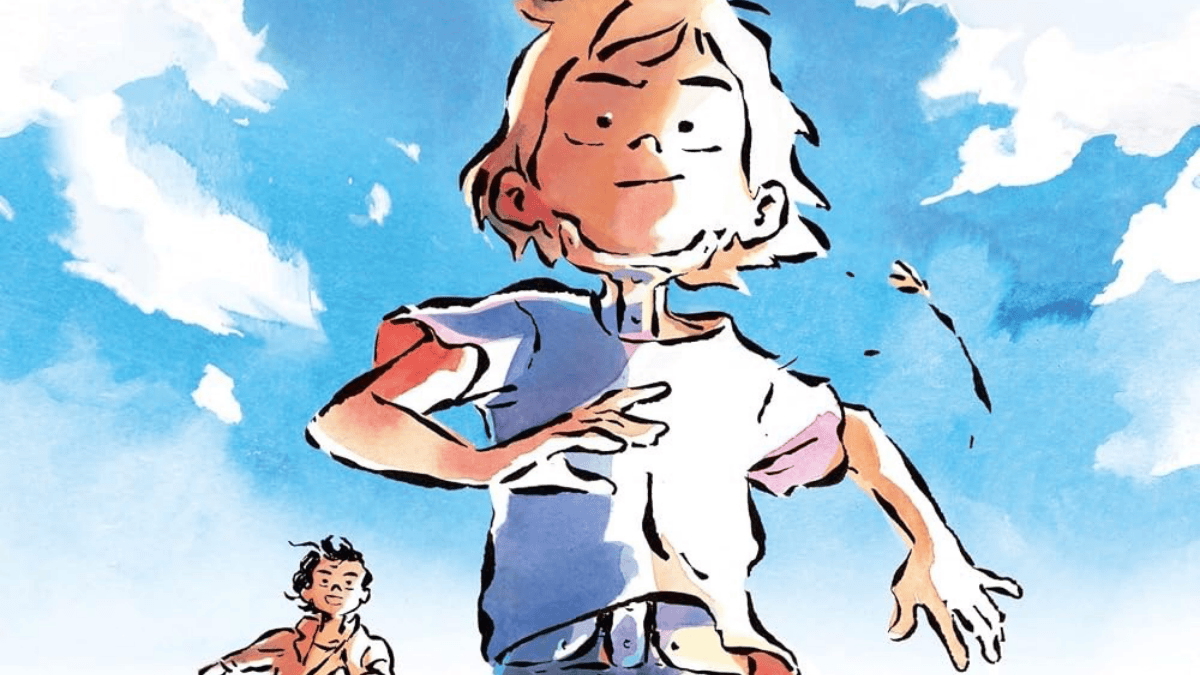
Film critic Ivan Magrin-Chagnolleau reports from the 31st SCHLiNGEL International Film Festival in Chemnitz, where Louis Clichy’s hand-drawn Iron Boy won the FIPRESCI Prize. Through a story of childhood, disability and family expectations, the film demonstrates how animation can address complex subjects without underestimating young audiences.
The 31st SCHLiNGEL International Film Festival for Children and Young Audiences took place in Chemnitz, Germany, from October 2 to 10, 2026. The festival, founded in 1996, presented 194 films from 60 countries and welcomed around 25,000 viewers, many of them school classes from elementary to high school. Watching films alongside the audience they were made for is one of the festival’s defining features, and an essential reference point for any critic assessing cinema for young people. The FIPRESCI jury awarded its prize to Iron Boy (Le Corset) by French director Louis Clichy (France, Belgium, 2026), which also received the award for best feature film and the prize of ECFA, the European Children’s Film Association.
Louis Clichy previously worked as an animator at Pixar and co-directed two Astérix features with Alexandre Astier. Iron Boy, co-written with Franck Salomé, is the first film he has directed alone, and the most personal. It premiered in the Un Certain Regard section of the Cannes Film Festival, where it received the Special Jury Prize, and later won three awards at the Annecy International Animation Film Festival.
The film is set on a family farm in the Beauce, the flat agricultural plain southwest of Paris, during the 1980s. Christophe, an eleven-year-old boy, keeps leaning to one side and falling over. The diagnosis leads to a rigid back brace that he must wear day and night. The brace keeps him away from sports, from the games of his classmates, and above all from the farm work that binds him to his father and older brother. At the same time, the family is slowly losing its land to a neighbor working for a large agricultural company.
At its core, Iron Boy is a film about a father and a son. Christophe’s father is a silent, unyielding man, shaped by a world in which one becomes a farmer because one’s father was a farmer, and in which feelings are seldom put into words. In interviews, Louis Clichy has noted that the French word “ferme” (farm) echoes “enfermé” (locked in), and the film builds on this association. The corset is not only a medical device; it becomes the visible form of all the other constraints surrounding the boy: a closed rural environment, an inherited role, a masculinity that leaves little room for vulnerability. The film’s intelligence lies in its refusal to turn the father into a villain. His rigidity is presented as another kind of corset, one he has worn for so long that he no longer notices it.
The central visual idea of the film is remarkably simple. When Christophe tilts his head, the horizon tilts with him, and in his imagination the whole landscape begins to shake. In a region defined by its unbroken horizontal lines, this single gesture becomes a form of resistance: a way for a child who is being forced to stand straight to bend the world instead. This device, which Louis Clichy has described as the original image from which the project grew, justifies the choice of animation more convincingly than any technical display could. It allows the film to move between realism and fantasy without ever losing its grounding.
The visual style supports this approach. Louis Clichy left behind the 3D animation of his previous work for black ink lines and watercolor. The colors do not always fill the outlines; they spill over them or leave areas of white paper, inviting viewers to complete the image themselves. The result is a style of great economy, where the landscape, the light, and the clouds carry as much meaning as the characters.
Christophe’s search for his place takes him away from the farm. At the swimming pool, where he has been sent to strengthen his back, he meets Clara, a girl his age. In the village church, an organist recognizes a musical gift in him and begins to teach him. The organ, a large and complex instrument, offers an alternative inheritance to the tractor he was never allowed to drive. The film handles these threads with restraint, letting humor coexist with sadness without tipping into sentimentality. The use of Stéphanie de Monaco’s 1986 hit “Comme un ouragan” to express the boy’s inner anger is one of the film’s most effective and surprising choices.
The voice cast contributes significantly to the film’s authenticity. Louis Clichy chose to record most of the family’s voices with non-professional actors from the Beauce, including his own son, Gary Clichy, as Christophe. Rod Paradot voices the older brother, while Brune Moulin, Alexandre Astier, and Jean-Pascal Zadi voice Clara, the organist, and the priest, the characters who come from outside the farm. The difference in vocal texture between these two worlds subtly reinforces the film’s structure.
In my view, Iron Boy demonstrates that a film for young audiences can address handicap, the decline of family farming, and the emotional distance between generations without simplifying any of them. It treats its young viewers as capable of complexity, and its adult viewers as people who were once children.
Several other films in the program explored related territory: young protagonists confronting institutions and absent parents, and finding their way through art, friendship, or adventure.
I Matter (Eu contez), the first feature film by Romanian Roma actress and director Alina Serban (Romania, Germany, Belgium, 2026), follows Rebeca, a Roma teenager raised in a children’s home in Bucharest while her father is in prison. As she approaches the age of 18, when she will have to leave the home, she hopes to join her father after his release and to enter drama school. The film draws on Alina Serban’s own experience and was shot in an actual children’s home. It portrays the combined weight of ethnic discrimination, institutional care, and gender with energy and warmth, supported by a striking performance by Denisa Farcas.
The Rainbow Fish (Der Regenbogenfisch) by Florian Moch (Germany, Switzerland, 2026) adapts Marcus Pfister’s 1992 children’s book, which has sold more than 30 million copies. Florian Moch, a director and puppet maker at the Augsburger Puppenkiste, Augsburg’s historic puppet theater, chose to make the film almost entirely with puppets filmed live. The film openly embraces its handmade nature, and its form echoes its message: what matters is not what shines, but what is built and shared.
Leo & Lou by Spanish director Carlos Solano (Spain, United Kingdom, Romania, 2025) is a road movie set in Galicia. Leo, a mute orphan, runs away from a children’s home to take part in a fishing competition in memory of her parents, and is picked up by Lou, a gruff, disillusioned loner. Carlos Solano’s first feature balances comedy and emotion with assurance, and gives non-verbal communication a central role in the bond between its two characters, played by newcomer Julia Sulleiro and Isak Férriz.
Ivan Magrin-Chagnolleau
© FIPRESCI 2026