
Maidan Time Machine: Returning to a Frame That Can No Longer Be Changed
Ukrainian critic Natalia Moussienko reflects on Volodymyr Tykhyi and Roman Liubyi’s Maidan Time Machine, a hybrid work that returns to the Revolution of Dignity through archival footage and the perspective of Ukraine’s present, transforming cinema itself into a “time machine” between two historical realities.
The 17th Odesa International Film Festival, held from August 27 to September 4, 2026, took place in Kyiv for the third consecutive time despite retaining “Odesa” in its name. In the context of the full-scale Russian-Ukrainian war, this shift of the festival’s geographical setting is particularly meaningful. Kyiv is not only the venue of the festival but also a city where the events of the Revolution of Dignity and the current war intersect.
This context was especially evident in the National Competition, which presented 14 feature films—four fiction films and ten documentaries. Many addressed the Russian-Ukrainian war, approaching it from different perspectives: the frontline, civilian life, displacement, veterans’ experience, environmental consequences, and personal trauma.
Among the fiction films were Valentyn Vasyanovych’s To the Victory! («За перемогу», 2025, Ukraine/Lithuania), Ana Rocha de Sousa’s Wings («Крила», 2026, Ukraine), and Denys Kolesnykov’s Kira’s Dream («Мрія Кіри», 2026, Ukraine). To the Victory! received the Golden Duke for Best Ukrainian Feature Film, as well as the FIPRESCI Jury Award. Among the documentaries, Yuliia Hontaruk’s To Die to Live (“To Die to Live”, 2026, Ukraine/Slovakia/Latvia) received the Golden Duke for Best Ukrainian Documentary Feature and the festival’s Grand Prix based on the audience vote. Mykola But’s The Miner («Гірник», 2026, Ukraine) received a Special Jury Diploma.
Against this background, Volodymyr Tykhyi and Roman Liubyi’s Maidan Time Machine («Машина часу Майдан», 94′, 2026, Ukraine, Germany) stands out through its unusual perspective. Rather than looking directly at the war, the film returns the viewer to the moment when the trajectory of contemporary Ukrainian history was only beginning to unfold.
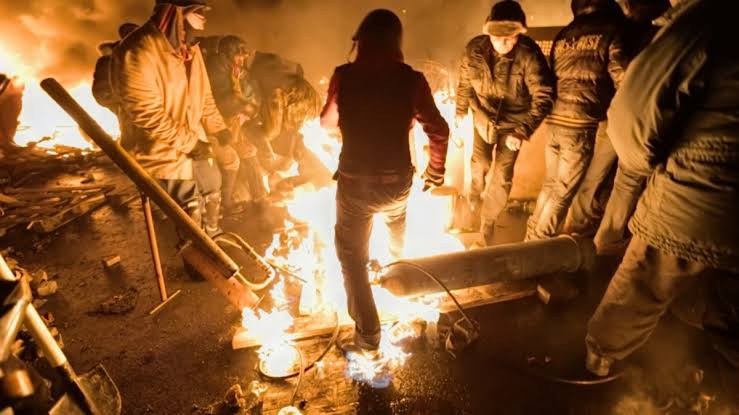
Its protagonist, a 21-year-old wounded soldier, is transported from the contemporary battlefield to December 2013, into the heart of the Maidan. The film thus creates a bridge between two Ukrainian realities: the Revolution of Dignity and the full-scale war. The archival images evoke the Maidan protests as they unfolded in central Kyiv: vast crowds gathered around Independence Square, barricades rising in the streets, protesters confronting riot police, and the distinctive presence of the stage, flags, helmets, shields, and makeshift structures that came to define the uprising.
The strength of this device lies in its effect on the viewer. We see Maidan not from within 2013, but from the perspective of 2026. We already know what happened next. Familiar archival images therefore acquire a different emotional weight.
The film’s most convincing achievement is its work with archival footage. These images are not merely historical evidence; they become an active part of the dramaturgy. Placed alongside the contemporary protagonist, they acquire new meanings. The archive is transformed from a record of the past into a dialogue between different historical moments.
The title itself operates on several levels. The “time machine” is not only the film’s narrative device. It is also cinema itself: the camera preserves a moment and allows us to return to it years later. Yet such a return is never complete. We can revisit the same images, but we can no longer see them as we did in 2013, because we know what followed.
The figure of Maksym “Dali” Kryvtsov—a poet, Maidan participant, and soldier who was killed in January 2024—intensifies this connection between the two periods. His biography embodies the trajectory of a generation for whom civic resistance eventually became armed struggle. Through his fictional return to the Maidan, the film makes us see those familiar images differently: not as the beginning of a story whose outcome was still unknown, but as the formative experience of a generation whose future would include another revolution, occupation, and full-scale war.
The film’s hybrid form makes this shift in perspective possible. By placing a fictional character shaped by the experience of war inside documentary images of 2013, it creates an encounter between lived history and imagined experience. Fiction does not replace the documentary record; it opens a space in which we can emotionally enter the past with knowledge of what came after. The archival images therefore become more than evidence: they acquire the weight of a future that, in those moments, had not yet been lived.
Ultimately, Maidan Time Machine is not simply a film about Maidan or about war. It is a film about changing perspective. Its central achievement is to return us to 2013 with the knowledge of the future—and to remind us that while a recorded frame can no longer be changed, our understanding of it can.
Natalia Moussienko
Edited by Ela Bittencourt
© FIPRESCI 2026