
Mysteries of Existence on the Screen
Reflecting on the National Competition at the 17th Odesa International Film Festival, Liudmyla Novikova considers how films including Kira’s Dream, Wings, To Die To Live, Time Machine Maidan and FIPRESCI winner To the Victory! confront the mysteries of human existence in wartime, where death and the stubborn determination to continue living remain inseparable.
This year, the FIPRESCI Jury at the Odesa International Film Festival evaluated the films in the National Competition. Despite being very diverse artistically, the films presented this year conveyed a cohesive theme of human existence in a time of war.
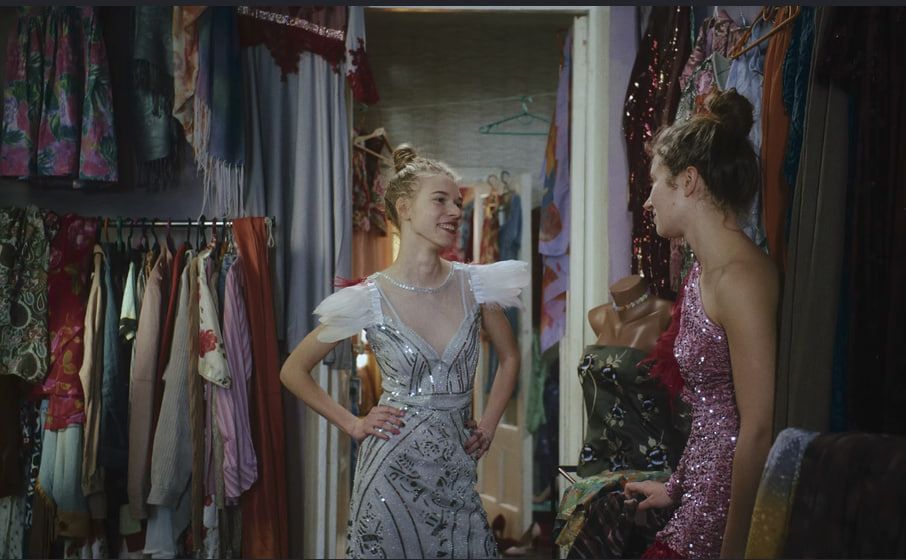
In Kira’s Dream (Мрія Кіри, 2026), two sisters, one of them still a minor, live in Ukraine on the eve of Russia’s full-scale invasion. The elder sister, a librarian by profession, is persistently looking for a job in Spain. Together, they run a small business: they steal clothes from a second-hand shop, wash them, and sell them online. Their life is ordinary and peripheral, and some of its brightest colors come from the stolen second-hand clothes. In their dreams, however, the girls become the heroines of a bizarre, predominantly black-and-white trash musical.
There is a strange inversion here: dreams are supposed to add color to everyday life, yet in the film color belongs to reality, while fantasy is drained of it. And the viewer knows what the heroines do not: very soon, the very possibility of living such an ordinary life will be threatened. The film echoes Lars von Trier’s Dancer in the Dark (2000), but the mechanism is reversed. In von Trier, musical fantasy offers an escape from a colorless reality; in Kira’s Dream, the coming catastrophe seems already to be casting its shadow backwards, into a time when no one yet knows what is about to happen.
A tragic echo of Kira’s Dream can be found in Wings (Крила / Asas, 2026), a film by Portuguese director Ana Rocha de Sousa, whose work consistently engages with social issues. Her social drama Listen (2020) convinced Ukrainian producer Ihor Savychenko to join as co-producer of this story about refugees from a frontline area in eastern Ukraine who find shelter in distant Portugal. A mother and her four daughters − three adults and a school-age girl with Down syndrome − are preparing to leave Ukraine. At the last moment, however, the eldest daughter, Maryna, refuses to go when she learns that the transport company will not allow her dog to travel without the required carrier, impossible to obtain in their frontline settlement. Despite her mother’s and sisters’ pleas to leave in order to save her life, Maryna cannot abandon the dog. Once again, sisters are at the center of the story, and once again there is the prospect of leaving Ukraine. But while the heroine of Kira’s Dream looks for work in Spain in hope of changing her everyday life before the full-scale invasion, in Wings, leaving the country means not the search for a better future but the preservation of life itself. Her choice turns a story of evacuation into a story of loyalty − unto death.
Only in the film’s final scenes do we see a Ukrainian landscape on screen − and Maryna’s emaciated dog, which howls pitifully over her body and then lies down beside her, for the lives of both have been cut short by the war. Maryna did not abandon it in the face of death; now it does not abandon her in death. At the same time, the image of the dog lends itself to an archaic, mystery-like reading − as a guide to the realm of the dead, accompanying a human being across the final threshold. It is a powerful image, yet its almost ritualistic sense of finality felt overdetermined. The Ukrainian experience of war is not only an experience of death; it is also an experience of stubbornly continuing to live in death’s immediate presence. Cinema that sees only the former inevitably loses something essential.
A different experience of living alongside death is offered by Yuliia Hontaruk’s documentary, To Die To Live (2026). For eleven years, the camera follows three volunteers − Shakhta, Potter and Dancer − from the war of 2014 through their return to civilian life and on to the full-scale invasion.
The impression the film left on me was paradoxical. While watching it, I was completely immersed in the lives of its protagonists, yet afterwards I found it almost impossible to reconstruct in my memory the complete story of even one of them. The images capturing the people in the film seemed to disintegrate at the very attempt to fix them in the mind. It reminded me of the famous episode in Federico Fellini’s Roma (1972), in which ancient frescoes discovered underground begin to lose their colors before our eyes as soon as they come into contact with fresh air.
Something similar happens to human stories in To Die To Live. While they are before us, they are astonishingly alive. Yet the moment we try to turn them into completed biographies, they resist. Perhaps because war itself destroys the expected completeness of a human narrative: just when one chapter seems to have ended and life has regained some kind of shape, history begins the next. Even the film’s title ceases to be merely a striking paradox: in order to go on living, its protagonists have to coexist with their own death − witnessed, experienced and internalized.
To Die To Live was named the Best Ukrainian Feature-Length Documentary and received a Golden Duke. The audience voting for films in the National and International Competitions also awarded it the Grand Prix of the 17th Odesa International Film Festival.
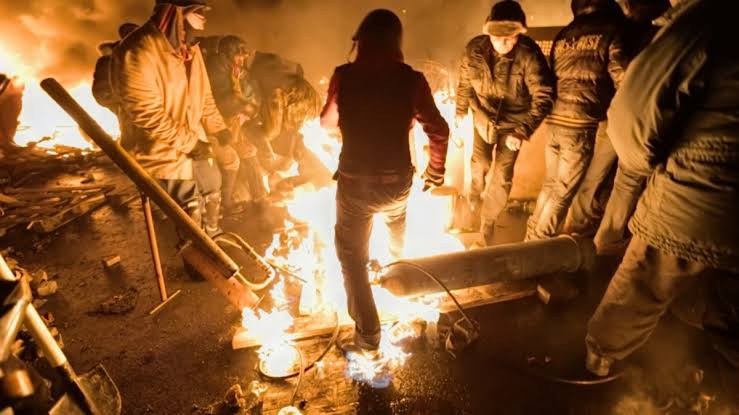
The documentary Time Machine Maidan (Машина часу Майдан, 2026), directed by Volodymyr Tykhyi and Roman Liubyi, brings the events of the 2014 Revolution of Dignity—when Ukrainians took to the streets to protest corruption and abuses by law-enforcement agencies and special police units, and to support their country’s European foreign-policy course—into dialogue with the present. I first saw the film during the festival at Kyiv’s Zhovten cinema. On my way to the screening, during an air-raid alert, I could hear shots being fired at drones and explosions; not far from the cinema, a cloud of smoke rose above the city. Then, inside the auditorium, came the gunshots of the killers of the Heavenly Hundred (participants in the 2014 Ukrainian Euromaidan killed by security officers and their mercenaries) and the explosions on Maidan. At one point it became difficult to tell where the sound was coming from − the screen or the street. The action on screen became directly connected to an event in the present, making tangible the link between Maidan and the full-scale war.
Yet Time Machine Maidan matters not only as a historical chronicle. It reveals a structure of meaning that existed within the event itself and that the filmmakers had to be able to see: fear and its overcoming, solidarity, sacrifice, death, the capacity to protect another person and to remain free in the face of physical violence. This is no longer merely political history; it is a history of the human spirit in existence.
Particularly striking is the image of Serhiy Nigoyan, one of the first people killed on Maidan. Only a few minutes before his death, we see him alive and smiling. Then comes his dead body, filmed from a powerful angle that evokes, in iconographic memory, Andrea Mantegna’s Dead Christ. Pier Paolo Pasolini drew on the same iconographic source in the final images of Mamma Roma (1962). This is not to suggest any equivalence between the characters or their meanings, but rather to recognize the capacity of the same visual archetype to acquire a new significance. In Nigoyan’s case, the image of death becomes one of sacrifice − of a man who gave his life for Ukraine.
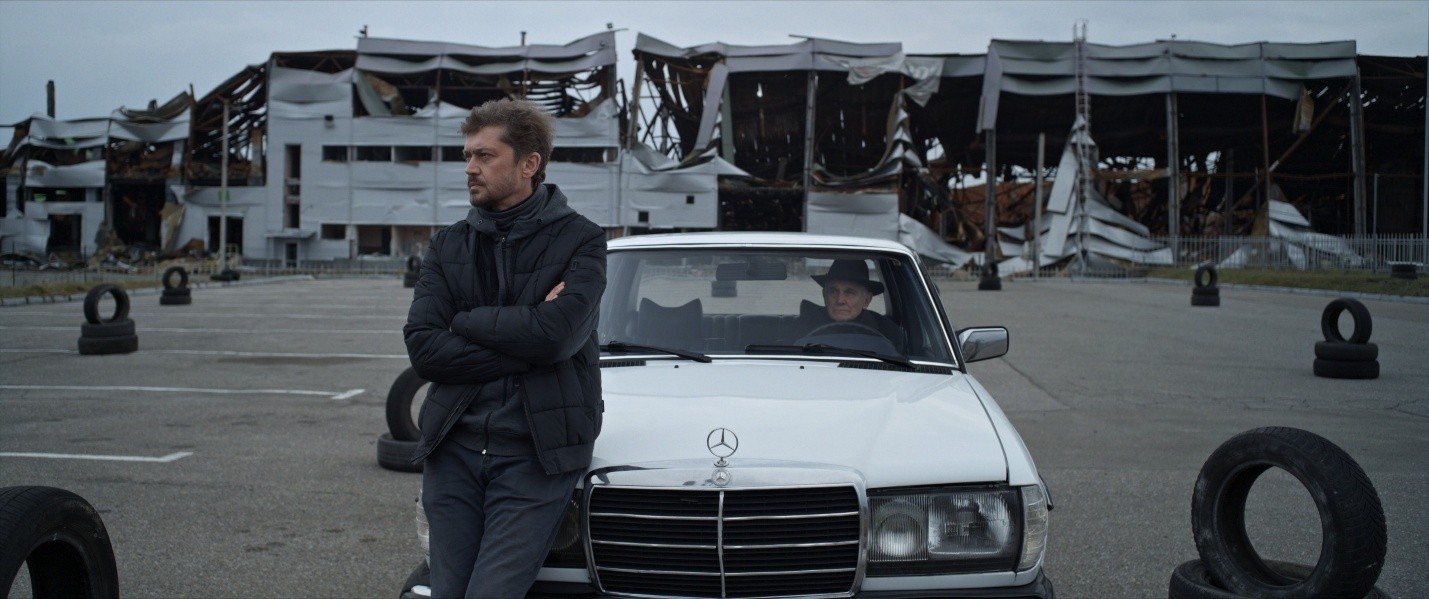
Valentyn Vasyanovych adopts a completely different tone in To the Victory! (За Перемогу!, 2025). The film’s protagonist is a Ukrainian film director whose wife and daughter have been living in Vienna since the start of Russia’s full-scale invasion of Ukraine. He suffers from the separation from his family but remains in his native Kyiv in pursuit of creative fulfilment, which seems possible for him only in Ukraine. In a sense, this is a Ukrainian 8½ (1963), with the filmmaker and his screen protagonist becoming one and the same person. A filmmaker whose work has been honored at Venice’s Orizzonti and the Toronto International Film Festival, Vasyanovych adopts an ironically egocentric tone that places him in a peculiar club of cinematic egocentrics alongside Woody Allen and Nanni Moretti.
To the Victory! is at once a film about the nature of creativity, a midlife crisis, marriage and professional ambition, but most poignantly it is about war destroying the rituals of life. War intrudes not only into physical space but into the repetitive patterns of everyday existence: habits, work, relationships, the very possibility of planning a future. The characters find themselves caught in a storm of existence, swept along by the winds of history.
Vasyanovych − both filmmaker and screen protagonist − repeatedly turns a moment into eternity. He mocks the vogue for queer themes, stages his own suicide, balances on the boundary between life and death, moving from sincerity to clowning and back again. Yet every moment of his despair, irony, sincerity and buffoonery is filled with a single underlying movement of the human spirit − towards Victory.
To the Victory! received the Golden Duke as the Best Ukrainian Feature-Length Fiction Film. It also received the special MEGOGO prize of UAH 500,000 for the film’s promotional campaign. The FIPRESCI Jury likewise awarded its prize to Valentyn Vasyanovych − the film’s director, producer, and leading actor.
The films in this year’s National Competition are difficult to reduce to the familiar formula of “films about war.” Here, war is not merely a subject. It becomes an environment in which the oldest questions are laid bare with a particular intensity: what does it mean to live when death ceases to be an abstraction? What remains of a human being when the familiar forms of existence are destroyed? What compels us, despite everything, to keep on going? The Ukrainian experience of war proves to be simultaneously an experience of death and of stubbornly continuing to live in its immediate presence.
In this sense, the screen of the 17th Odesa International Film Festival became a space for several different mysteries of existence.
Liudmyla Novikova
Edited by Ela Bittencourt
© FIPRESCI 2026