
Memories as Creative Acts in Central and Eastern European Cinema
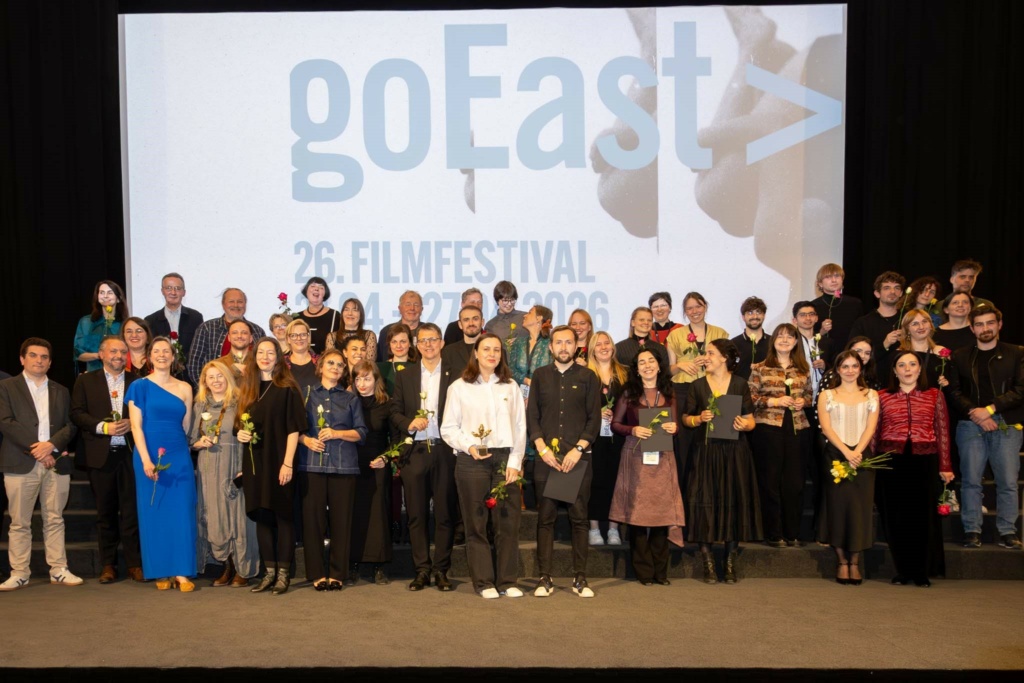
At the 26th goEast Festival in Wiesbaden, several films in competition approached memory not as a passive repository but as an active, creative force shaping narrative, identity, and cinematic form. Macedonian film critic Stojan Sinadinov reflects on how filmmakers transform recollection into a generative artistic principle.
Memory as a subjective construct—rather than a mere recording of events and emotions—emerges as a central motif in several of the 16 films presented in competition at this year’s edition of the festival.
The idea is not new. Gabriel García Márquez, in his 2002 memoir Living to Tell the Tale, famously wrote: “Life is not what one lived, but what one remembers and how one remembers it in order to tell it.” This notion of memory as an act of creation resonates strongly across the selected works.
In Cat on My Mind (Es domāju par kaķi, 2025), director Laila Pakalniņa—winner of the FIPRESCI Award for Best Fiction Film—begins with several rolls of undeveloped black-and-white photographs. These images, capturing anonymous people and events, become the foundation for constructing the imagined life of an unknown Latvian photographer. Pakalniņa transforms archival material into a cinematic panopticon, where the viewer is left to question whether what they see are authentic documents or carefully staged recreations. Memory here is not restored but reinvented.
A Goodnight Kiss / Irena by Giedrė Žickytė offers a more classical documentary portrait. It traces the life of Irena Veisaitė, a Lithuanian theatre scholar and Holocaust survivor, whose personal memories become a testament to resilience and moral clarity. Having endured the loss of her mother during the Nazi occupation, Veisaitė’s later life reflects a commitment to preserving memory as an ethical imperative—one that insists on the possibility of a more humane future.
In Laguna (Lagūna, 2025), Šarūnas Bartas engages memory as a deeply personal and philosophical process. Following the death of his daughter Ina Maria, Bartas travels with his younger daughter Una to Mexico, reconstructing grief through a contemplative journey. Memory here is neither archive nor narrative device, but a fragile, spiritual terrain where love and loss coexist.
A similar resistance to oblivion is present in the FIPRESCI-awarded documentary Outliving Shakespeare (2025) by Inna Sahakyan and Ruben Ghazaryan. In a retirement home, residents stage a play titled Shakespeare’s Sins, using performance as a means of reactivating personal histories. Through theatre, memory becomes embodied—confronted rather than repeated—echoing the enduring relevance of William Shakespeare’s own work. Notably, the film suggests that while memory is fragile, it is not entirely subject to erasure.
In The Beauty of the Donkey (La Beauté de l’Âne, 2025), Dea Gjinovci reconstructs her father’s past through staged reenactments performed by villagers in Kosovo. Returning after decades in Switzerland, her father revisits childhood memories while seeking answers about his mother’s death during the 1999 war. The film merges personal testimony with collective performance, illustrating how memory operates simultaneously as reconstruction and investigation.
Across these films, memory functions as both a defense against forgetting and a tool for artistic creation. It is through this dynamic interplay that filmmakers construct new cinematic worlds—ones that blur the boundaries between past and present, fact and fiction, documentation and imagination.
Stojan Sinadinov
© FIPRESCI 2026