
Under the Judas Tree : The Greek film that stood out in Thessaloniki Film Festival
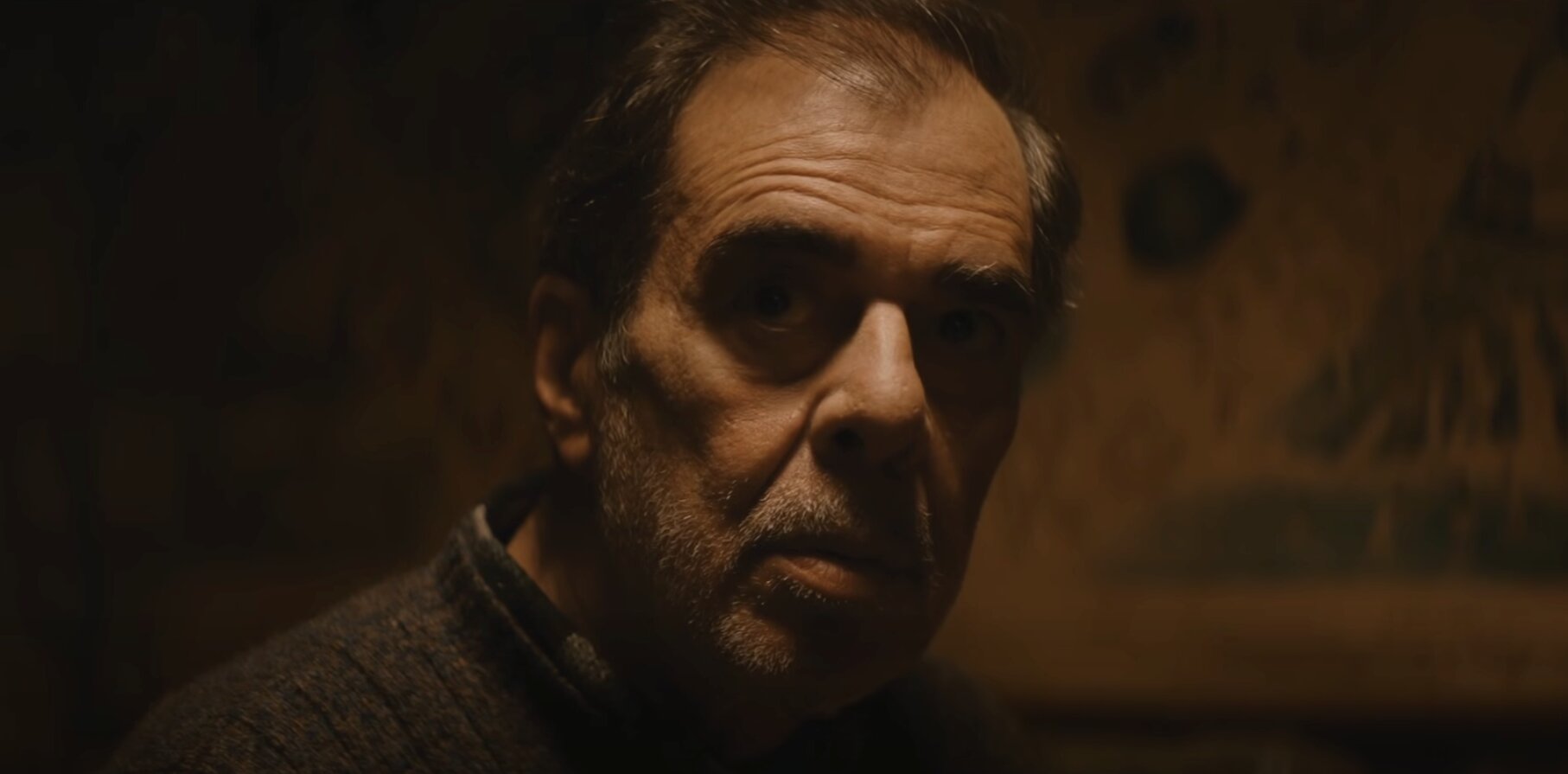
Greek film critic Dimosthenis Xifilinos examines Christos Chouliaras’s fiction feature debut, Under the Judas Tree, a slow-burning rural noir in which a murder investigation exposes the moral decay of an isolated community against the haunting landscape of Epirus.
Having served a long tenure alongside renowned directors with rich international careers (Costa-Gavras being one of them), Christos Chouliaras has proceeded to his first fiction feature as director with Under the Judas Tree (2026). This new film was, of course, preceded by Choulairas’s remarkable and full-of-love-for-its-subject Directing Hell (2011), a documentary about the great Nikos Nikolaidis, the most “American” of Greek moviemakers.
There is, however, nothing American in The Judas Tree, except perhaps for its approach to Michalis Makropoulos’s source novel of the same name with an idiosyncratic noir structure. To succeed in adapting the book, Chouliaras chose a non-actor for the leading role: singer and musician Alexis Kalofolias, a leading figure within The Last Drive, one of the most historically important Greek rock bands. In Judas Tree, Kalofolias is called upon to embody the film’s “hero”, the constantly expressionless and unsmiling Ilias, and succeeds to an absolute degree. Not an easily approachable character to the viewer, Ilias is a “dead” man, someone who returns from a time living in the Greek capital, Athens, having tested his strengths there and ultimately failed. Expectations crushed and emotionally and professionally broken, Ilias returns like a human shipwreck to his poor and forgotten little homeland, the village of Epirus, near the Greek-Albanian border.
But Epirus does not prove all that hospitable. For most, Ilias is now one of the few (and rarely welcome) strangers who visit. Only one couple there, the local policeman and schoolteacher, once old friends of his, open their door to him effortlessly. It is obvious that the “mountain folk” who remain in the village are very few and young people are a rare species. Ilias and his two friends form a triangle that is likely also connected with secrets and lies of the distant past, wonders and signs that unite and separate them at the same time. In this, they recall Nikos Grammatikos’s excellent (and now-classic) film The Absent Ones [AKA Truants] (1996). With the dominant landscape essentially depicting the characters’ souls—silent, sorrowful, freezing—the tone is set for a thread to unravel, all starting from a corpse and a crime.
Recalling also Theo Angelopoulos’s debut feature, Reconstruction (1970), Under the Judas Tree gradually builds a thriller of Northern European aesthetics, wherein the culprit (or culprits) is sought for the murder of a young girl in the surrounding forest. In the eyes of the residents of Epirus, the victim is akin to an unidentified flying object: nobody bothers to enquire too closely into the how and why of her killing, not even the local representative of law and order. Here, then, is a glorious field of action for Ilias, who obsessively behaves like a private detective, giving meaning to his lifeless everyday life and stirring the stagnant waters.
Giannis Simos’s cinematography captures the dead colors of the film’s physical and social settings, grasping the eerie beauty of trees stripped of their fallen leaves and an autumn on the verge of swiftly oncoming winter. Narratively speaking, this film favours slow rhythms, just as the days of its mountain dweller characters roll by: conspicuously unadorned and austere, Judas Tree’s narrative is one within, speech exists only when necessary.
Many questions arise as the film progresses. Who is the killer, with what motive? Is there a logical explanation for murder? Does anyone care about the dead girl’s name? Everyone striving to cover up the mystery, to sweep the dirt under the rug, energises the hitherto flat Ilias even more. His present-day return to Epirus is unlike his previous transitory ones: this time he wishes to stay, but only after he is done with the “sickness”—both his own and that of the isolated rural society he has returned to. Like a surgeon dissecting the body in order to heal it (or, even worse, like a coroner doing the same in order to establish a cause of death), Ilias constantly hovers near the naked corpse he found. He tests his endurance, as well as that of those around him, as he gathers and puts together the various pieces of the puzzle, eventually confirming what seemed apparent from the very beginning, namely, the guilt of a prime suspect. Yet is this clearly evil person the only culprit?
When friendship, as believed in and honored by Ilias, gives way to betrayal, when even the last hope for the future is hanged like Judas from the proverbial tree, then accounts will be settled for good, albeit not bloodlessly, optimistically or joyfully. Life will go on, yet it will not be “happily ever after”. Leaving ideas of utopia behind and returning to realism, Christos Chouliaras’s film was the most interestingly written and bravely observant Greek film of this year’s Thessaloniki International Film Festival.
Dimosthenis Xifilinos
Edited by Jonny Murray
© FIPRESCI 2026