
Made in EU: Iva, a Seamstress Made a Scapegoat for the Spread of COVID-19
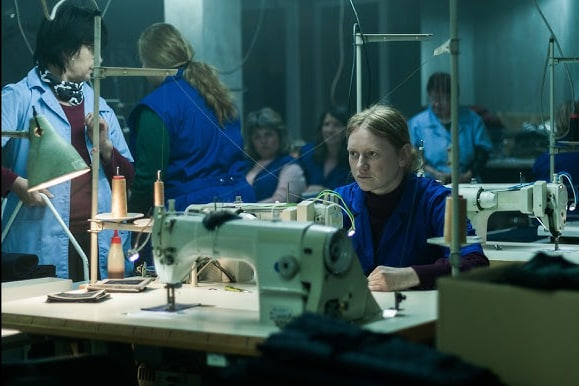
The FIPRESCI Prize winner at the 32nd IFF Art Film in Košice revisits the first months of the pandemic through the story of an ordinary woman turned into a public enemy. Pierre-Yves Roger examines Stefan Komandarev’s portrait of fear, misinformation, and social exclusion.
Made in EU—winner of the FIPRESCI Prize at the 32nd IFF Art Film in Košice (Slovakia)—takes us back to 2020, at the onset of the COVID-19 pandemic. Stefan Komandarev immerses us in that period through the story of a seamstress who becomes a scapegoat for a previously unknown disease. He depicts how hysteria can grip an entire population and how rumours can snowball, ultimately casting a woman out of her local community.
Iva (Gergana Pletnyova) works at a garment factory in a small Bulgarian town. Her husband died in an accident while working as a miner. Earning only a meagre wage, Iva must support both herself and her son. Exhausted and believing she has flu-like symptoms, she visits her doctor. She asks for sick leave, but he refuses, deeming it unnecessary. Shortly after returning to the factory, Iva collapses and has to be taken to hospital. The diagnosis comes quickly: she has COVID-19.
As the first person in her town to be officially diagnosed with the disease, she becomes a scapegoat. A local TV station accuses her of bringing the virus to the town, even though she had never actually left it. Upon leaving the hospital, her life turns into a nightmare. Almost all the residents shun her; she can no longer shop at supermarkets, and her employer threatens to sue her. Even her son—forced to stay with her because he, too, has contracted the virus, just as he was planning to move to Germany—initially blames her for preventing him from realizing his dreams. Eventually, however, he recognizes the injustice of the situation and tries to help her through it.
Shot in a documentary style, the film also exposes the working conditions of these women—modern-day slaves to an exploitative capitalist system—who are managed by an unscrupulous boss whose sole aim is profit, with no regard for their welfare. He communicates with them only through a foreman who is equally devoid of conscience. These women, who manufacture “Made in the EU” clothing, are paid lower wages than their counterparts elsewhere in the European Union.
Stefan Komandarev, who is also a screenwriter and producer, has directed several feature films, including The World Is Big (2008), Taxi Sofia (2017), and Blaga’s Lessons (2023)—the latter winning the Crystal Globe at the Karlovy Vary International Film Festival in 2023.
One might wonder whether the director—who began his professional career as a doctor—has infused something of himself into the film’s only character who, alongside Iva’s son, comes to the aid of the mother who has become the town’s scapegoat. This character is a doctor who treats her without prejudice, speaks out against the campaign waged against her, and offers encouragement to her son. True to his medical background, he makes a diagnosis and proposes solutions to resolve the problem.
A Bulgarian, German, and Czech co-production, Made in EU is a realistic film featuring sparse dialogue but lines that hit home. It also has a political dimension, exploring the power dynamics between a boss and his employees. It shows, without embellishment, how a crisis situation can bring out the vilest behaviour in certain individuals.
This poignant feature film keeps us gripped—despite its conventional form—thanks to a strong screenplay. We follow, step by step, the consequences of a false rumour, the kind that proliferated during the COVID-19 pandemic. The performances are highly convincing, particularly that of Gergana Pletnyova. She portrays a dignified woman who initially falls victim to a public backlash but ultimately decides not to let herself be pushed around by a society determined to marginalize her.
Pierre-Yves Roger
© FIPRESCI 2026