
The Other Side of the Sun: Reclaiming Sednaya Through Memory
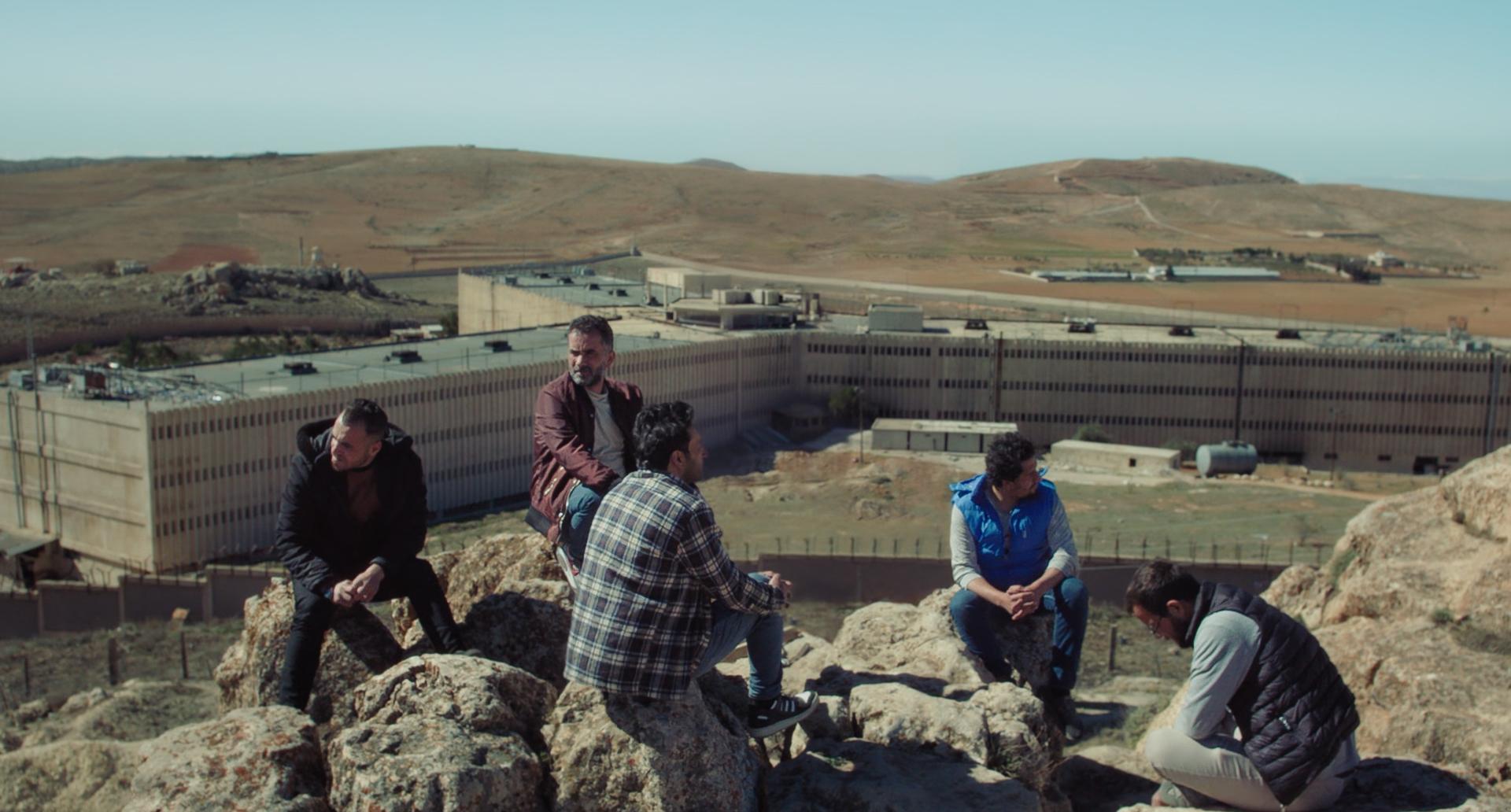
Israa Radaydeh examines Tawfik Sabouni’s FIPRESCI-winning documentary, filmed inside Sednaya Prison immediately after the collapse of the Syrian regime. Through survivor reenactment, collective memory, and the still-raw architecture of repression, the film captures the extraordinary historical moment when a site of captivity became accessible to those who had survived it.
The most striking quality of The Other Side of the Sun is not simply that Tawfik Sabouni returns to Sednaya Prison, where he was once detained under the Assad regime, but that he does so at a moment when the prison has barely had time to become a place of the past. Filmed in December 2024, immediately after the collapse of the Syrian regime, the documentary enters Sednaya while its political function has ended but its physical reality remains almost untouched. The guards have disappeared, the cells have been emptied and the system that controlled the building has broken down, yet the walls, corridors, staircases and doors still carry the memory of what happened inside them.
That timing gives the film a historical urgency that no later reconstruction could reproduce. Sabouni is not visiting an established memorial or returning decades later to a place whose meaning has already been absorbed into official history. Sednaya is newly abandoned, still suspended between being an active instrument of repression and becoming evidence of that repression. The film exists within that narrow interval, when the prison is no longer functioning but has not yet been transformed by distance, preservation, political interpretation or collective ritual.
This is what makes the experience of The Other Side of the Sun so unsettling. The survivors return to Sednaya with the knowledge that the authority that once controlled their bodies has vanished, while their bodies continue to respond to the building as if part of that authority remains. The emotional force comes from this collision between present freedom and physical memory. Sabouni does not separate the shock of rediscovery from the experience of liberation. They occur together, sometimes within the same gesture, the same silence or the same passage through a corridor.
The prison is familiar to the five men, yet their knowledge of it is incomplete. Incarceration had given them an intimate knowledge of individual spaces while denying them a coherent understanding of the building as a whole. Fear, darkness, controlled movement and the prohibition against looking freely had fragmented their perception. On returning, they encounter Sednaya differently. The physical structure that had once been experienced through commands, sounds and restrictions becomes visible as an entire architecture.
Sabouni understands that this changed relationship with space is more revealing than any explanatory political statement. He allows the prison itself to demonstrate what has shifted. The survivors move through places that once controlled them, but the film avoids turning this into an obvious performance of victory. Their freedom is accompanied by hesitation, bodily memory and a recognition that a political system can disappear faster than the reflexes it has implanted in those who lived under it.
This tension is central to Sabouni’s method. The Other Side of the Sun is less interested in narrating imprisonment than in examining what imprisonment leaves behind.
The film’s most distinctive device is physical reenactment. Instead of relying primarily on conventional interviews, Sabouni and the four other survivors reproduce movements and routines associated with life inside Sednaya. They demonstrate how prisoners slept, moved through corridors, positioned their bodies, avoided eye contact and adapted themselves to the severe restrictions of the prison.
These sequences are more complicated than straightforward reenactments. The men are not professional actors recreating the experiences of others, and they are not performing inside a reconstructed prison. The bodies in front of the camera are the bodies that survived the system being described, and the architecture surrounding them is the actual architecture in which that system operated.
This gives performance a different documentary function. Words recall the past through explanation, while the body often reveals how deeply the past has remained embedded in the present. A posture can communicate the structure of authority that produced it. A movement can expose the survival mechanism behind it. The physical act of reenactment allows memory to emerge not only as narrative but as reflex.
Sabouni effectively turns the body into an archive.
This idea is particularly important because the film does not depend on a conventional archive of atrocity. It largely avoids graphic footage of torture, blood or extreme physical violence. Given the history of Sednaya, the temptation to demonstrate horror through horrifying images would have been understandable, but Sabouni chooses a more restrained strategy. He is not interested in escalating the visual representation of suffering in order to convince the audience of its reality.
Instead, The Other Side of the Sun works through consequences.
The prison’s violence is present in the way a man remembers being required to move, in the fear associated with looking at a guard, in the sound of a door, in the distance between one space and another, and in the emotional reactions produced by returning to rooms that had once defined the limits of existence.
This refusal of spectacle is among the film’s strongest qualities. Sabouni does not ask the audience to consume images of pain. He asks it to observe what pain has left inside people who survived it. The distinction is ethical as much as aesthetic. It shifts attention away from the suffering body as an object to be observed and toward the survivor as a person capable of remembering, interpreting and reclaiming the experience.
Even one of the documentary’s most overtly constructed images, the life-sized emaciated puppet used to evoke what prisoners could physically become, follows this principle. The figure is artificial, but its effect on the survivors is real. Its distorted thinness evokes the bodies of prisoners who died without requiring the film to display those bodies directly. The intervention creates distance from graphic representation while remaining emotionally disturbing.
This is also where Sabouni’s position as both director and survivor becomes fundamental. He is not standing outside the experience and organizing the memories of other people. His own history belongs to Sednaya. The relationship between filmmaker and participants is therefore different from the hierarchy often found in documentaries based on testimony.
The film does not feel built around an interviewer extracting information from subjects. Its conversations develop through shared experience. The men remember together, correct one another, recognize details and allow one person’s memory to release another’s. The documentary gradually becomes an act of collective oral history rather than a collection of individual interviews.
That collective dimension is one of the film’s strengths, but it also produces one of its limitations. By concentrating so heavily on Sednaya and the experience shared among the five men, Sabouni leaves relatively little space for their identities outside the prison. We learn less about their current families, professions, homes or the lives they built after surviving detention.
The absence matters because imprisonment itself works by reducing individuality. A system such as Sednaya attempts to transform a person into a prisoner before almost anything else. A fuller picture of who these men became after leaving the prison might have strengthened the film’s broader understanding of survival by showing not only what Sednaya did to them but what they constructed beyond it.
The film also leaves questions surrounding retraumatization relatively underexplored. Returning former prisoners to the actual place of their abuse carries obvious psychological risks. The documentary captures fear, hesitation and emotional rupture, but it could have devoted more attention to the decision to return itself. How did the participants understand the risks? What doubts did they have? At what point does reenactment become reclamation, and at what point might it reopen an experience that has never fully closed?
These questions do not weaken the legitimacy of Sabouni’s method, but they complicate it. They become especially important because the film treats reenactment not merely as a cinematic technique but as the central encounter between memory and place.
The rhythm of the documentary occasionally reveals another limitation. The repeated movement through architecturally similar spaces, combined with long recollections and recurring physical demonstrations, can produce a certain visual uniformity, particularly in the second half. Yet the repetition is also inseparable from the nature of the prison itself. Sednaya is a world built from confinement, duplication and limited physical possibilities. The film risks monotony because the experience it documents was itself shaped by monotony and repetition.
The prison consequently becomes more than the setting of the documentary. Sabouni and cinematographer Sameer Orabi treat its concrete walls, dark cells, iron doors and staircases as part of the film’s argument about power. Architecture is not neutral here. Sednaya was built to organize bodies, restrict movement and regulate what prisoners were able to see.
One of the most revealing memories concerns the prohibition against looking directly at the guards. A survivor recalls imagining them as enormous monsters until an accidental glimpse revealed one of them to be a physically small man. The memory almost inevitably suggests a broader understanding of dictatorship: sustained fear enlarges power, allowing ordinary men to acquire an almost mythological presence in the minds of those forced to fear them.
Sabouni does not need to explain this metaphor. The architecture and testimony already contain it.
His use of sound follows the same restrained approach. Echoing footsteps, doors and stretches of silence evoke the isolation of imprisonment without forcing dramatic emphasis onto every scene. The music remains reflective rather than melodramatic, allowing the emotional weight to emerge from the survivors and the physical environment.
It is impossible to consider Sabouni’s use of physical reenactment without thinking of Raed Andoni’s Ghost Hunting, one of the key Arab documentaries to explore prison memory through performance. The comparison is useful because the similarities between the two films reveal how fundamentally different their methods are.
In Ghost Hunting, Andoni reconstructs Jerusalem’s Moskobiya interrogation center inside a warehouse in Ramallah. Former Palestinian detainees collectively rebuild a space they cannot physically revisit. The reconstruction itself becomes part of the psychological process. Memory produces architecture, and the recreated prison becomes a stage on which trauma can be examined through psychodrama, performance, confrontation and emotional release.
The Other Side of the Sun begins from the opposite condition. Sabouni does not need to reproduce Sednaya because the political collapse of December 2024 unexpectedly gives him access to Sednaya itself.
The difference between the constructed prison in Ghost Hunting and the actual prison in The Other Side of the Sun is more than a production detail. It changes the relationship between memory and space. Andoni’s former prisoners must reconstruct the place from what they remember before they can confront it. Sabouni’s survivors enter a place that has survived independently of their memories and discover how closely, or imperfectly, the physical building corresponds to what remains inside them.
Andoni’s method is often explicitly psychodramatic. His film allows performance to generate confrontation, anger and psychological exposure. The boundaries between reenactment and therapy become unstable, and emotional eruption becomes part of the cinematic process.
Sabouni works with a noticeably different emotional register. His approach is quieter and more controlled. He is less interested in pushing survivors toward cathartic confrontation than in observing how memory appears through gesture, shared recognition and restrained emotion. Love, solidarity and the small systems of mutual protection that existed between prisoners become as important as the violence that surrounded them.
The comparison does not establish one approach as more authentic than the other. Ghost Hunting needs the artificial prison because reconstructing that prison is itself part of the film’s inquiry. The Other Side of the Sun derives its singular force from a historical circumstance that makes reconstruction unnecessary. The real space has suddenly become available.
Sabouni’s film also belongs to a wider conversation with Syrian documentaries about memory, displacement and political trauma, including the work associated in this critical context with Alsar Jandali, also known as Alsar Hassan, and a generation of filmmakers who have approached the Syrian experience through archival recordings, leaked images and testimonies produced from exile.
Much of that cinema has necessarily been structured by distance. Filmmakers and witnesses have often worked from Europe or other places of displacement, where the prison survives through testimony, photographs, missing-person narratives and images recorded in Syria. Exile becomes part of the documentary form because physical return is impossible.
The Other Side of the Sun represents a dramatic shift in that relationship.
Sabouni replaces distance with physical return. He does not ask the survivors to reconstruct Sednaya from Belgium, France or another place of exile. He takes them back into the prison itself at the moment when political circumstances finally allow such a return.
Where films of exile often examine the pain of absence and the difficulty of assembling memory from fragments, Sabouni deals with the equally unsettling experience of suddenly confronting the original place. The archive is no longer required to bring the prison into the present because the survivors themselves enter the surviving architecture.
That makes the timing of December 2024 inseparable from the film’s formal achievement. Ten years later, Sednaya might be a very different place. It could become a museum, a protected crime scene, a ruin or a site shaped by another political narrative. Evidence could disappear, architecture could change and the survivors’ relationship with their memories would inevitably evolve.
Sabouni entered during a much more unstable moment, when the old system had disappeared but the physical vocabulary of that system remained.
The recognition The Other Side of the Sun received on the festival circuit reflects the strength of this approach. At the Amman International Film Festival, the documentary won the Jury Award, the Audience Award and the FIPRESCI Prize in the Arab feature documentary competition. It had also received recognition at the Berlin International Film Festival, where it placed second in the Panorama documentary audience voting.
The FIPRESCI Prize is especially significant because it places the emphasis on cinema rather than simply on the historical importance of Sednaya. Awarded by critics through the International Federation of Film Critics, the prize acknowledges how Sabouni transforms testimony into visual memory while resisting the spectacle of suffering.
The distinction matters. Sednaya is such a powerful subject that the subject itself could overwhelm any critical conversation about filmmaking. A documentary could enter the prison, record survivors speaking and still command attention because of the historical importance of what it reveals.
Sabouni goes further. He creates a formal relationship between body, space and memory. He understands that documenting trauma is not simply a matter of recording what happened but of deciding how the spectator should encounter that history. The film’s restraint, its physical reenactments and its reliance on collective testimony keep the survivors at the center without reducing them to evidence of their own suffering.
For a first feature documentary, the film demonstrates an unusually assured understanding of that responsibility. Its strongest achievement is ultimately not the revelation of Sednaya as an infamous prison; that history already exists beyond the film. What Sabouni captures is more difficult to preserve: the brief moment when Sednaya stopped belonging exclusively to those who controlled it and became accessible to those who survived it.
The prison remains physically present, but its relationship to the men has changed. The building still contains the architecture of captivity, while the people moving through it are no longer confined to the identities it once imposed upon them.
The Other Side of the Sun derives much of its force from the fact that Sabouni filmed Sednaya before time had softened its physical and emotional impact. The prison is already emptied of its former authority, yet everything inside still bears the immediate trace of what happened there. What the film captures, then, is not simply memory, but the first difficult encounter between survival and a place that had only just stopped functioning as an instrument of fear.
Israa Radaydeh
© FIPRESCI 2026