
Documenting the Future: On Valentyn Vasyanovych’s To The Victory!
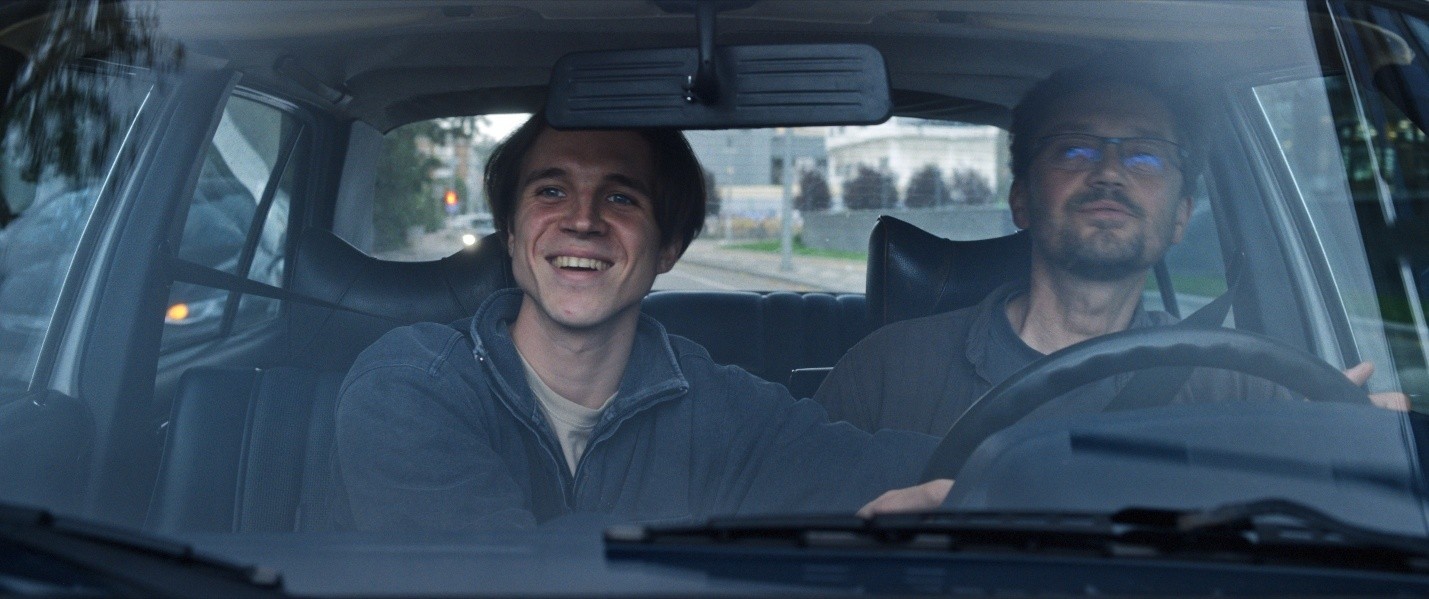
Ukrainian film critic Iryna Zubavina examines Valentyn Vasyanovych’s FIPRESCI-awarded To The Victory! as a “documentary dystopia” in which autofiction, post-war trauma, fractured families, and the act of filmmaking itself converge in an unsettling vision of Ukraine’s near future.
At the 17th Odesa International Film Festival, the real triumph was Valentyn Vasyanovych’s new narrative feature, To The Victory! (За перемогу!, 2025, Ukraine / Lithuania). Its widespread recognition confirmed the emergence of a high-profile artistic phenomenon in contemporary Ukrainian cinema, thanks to a series of prestigious awards: Golden Duke Award – Winner of the National Competition Program in the “Best Ukrainian Narrative Feature Film” category, accompanied by a cash prize of 75,000 UAH; FIPRESCI Diploma – Recognition of the film as the best feature by the jury of the International Federation of Film Critics; and MEGOGO Special Distinction – An additional award from the festival’s official partner.
Vasyanovych describes his film as a “documentary dystopia.” This definition contains a profound paradox. While dystopia traditionally constructs an imagined distant future, To The Victory! possesses exceptional biographical potential, since the filmmaker does not invent a future but rather documents his own feelings and premonitions. He captures entirely real trauma, societal shifts, and present-day threats, projecting them a few steps forward [or rather “into the near-future”?].
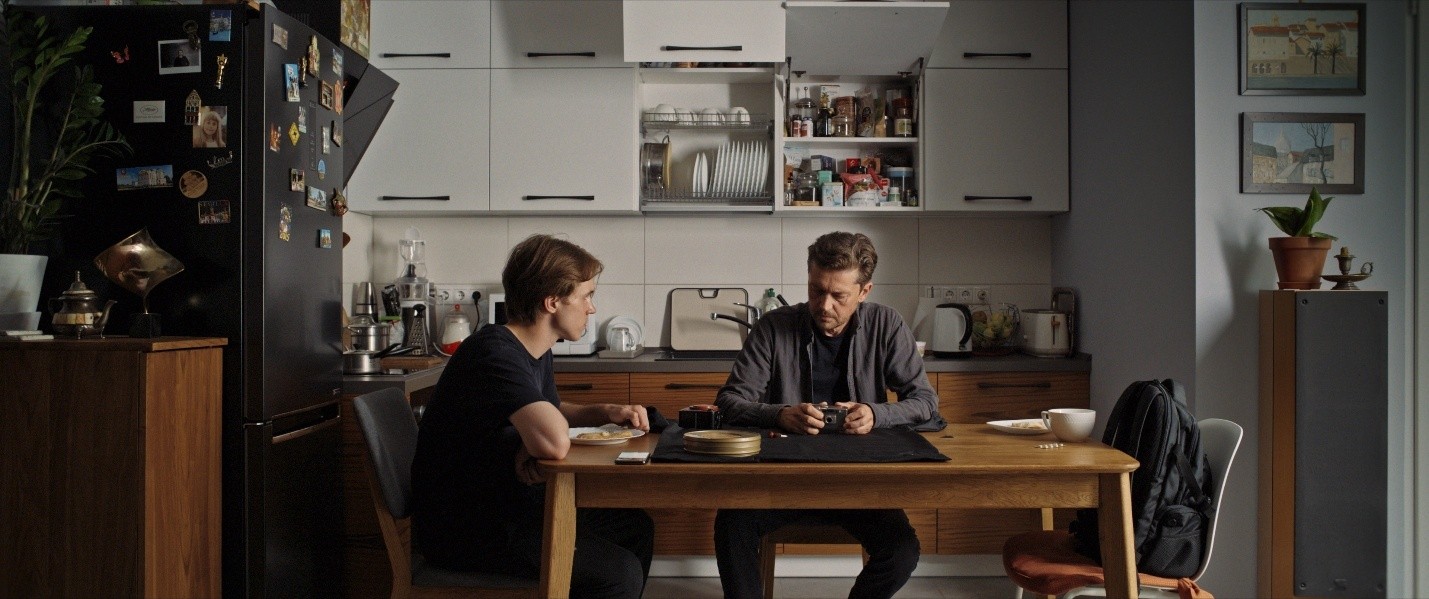
Perhaps for the first time, Vasyanovych has admitted the audience into his personal space so unreservedly, practically abandoning any emphasized artistic distance. The story he offers feels almost confessional, even though the events are set “a year after the end of the war,” as indicated by the title card. In the complex reality of post-war existence, the film’s protagonist – a filmmaker named Valentyn – is deprived of the opportunity to fully create. His family world splits in two: his wife and daughter have been living in Vienna for three years now and have no desire to return to Ukraine. Moving to be with his family would mean a loss of professional identity and a capitulation for Valentyn, who sees no purpose for himself outside his homeland.
A similar existential rift is observed in the families of his male colleagues, whose wives fled abroad with their children during the full-scale invasion. Individual personal dramas expand into a panoramic portrait of a male cinematic brotherhood. Moreover, the breakdown of family ties emerges as a systemic trauma, and a world deprived of a structuring female presence inevitably sinks into domestic and mental chaos, which then become the main interest for both Vasyanovych and his onscreen alter ego.
The “film-within-a-film” technique serves as the main dramaturgical engine of To The Victory!. Vasyanovych constructs a fluid, dynamic structure where the protagonist and his like-minded friends attempt to make a movie with zero funding.
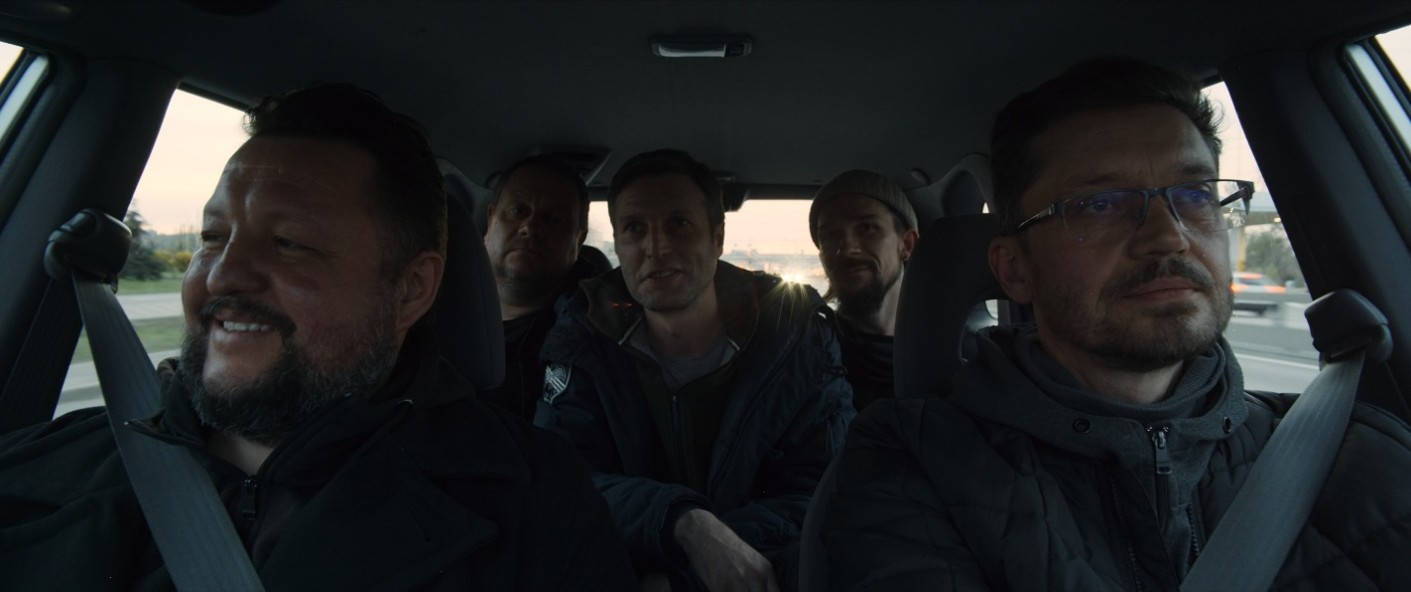
Within the autofiction’s corridor of mirrors, the crew members play themselves. Performing “unmasked,” they keep their real names: Vasyanovych himself, his longtime production designer Vladlen Odudenko, sound designer Serhiy Stepansky, cinematographer Mykhailo Liubarskyi, and producer Volodymyr Yatsenko. Vasyanovych ironically yet relentlessly documents how filmmaking amidst existential catastrophe, bewilderment, and a loss of meaning transforms into therapy, the sole ritual capable of keeping reality from total collapse.
In this sense, the film-within-a-film becomes more than a formal exercise; it serves as an exquisite way to visualize the interplay between the cinematic world, the characters’ personal realities, and a future captured as the present. Vasyanovych masterfully plays with audience expectations. The transitions between on-screen fiction and biographical truth take on tones that range from the tragic to the sharply satirical. An entirely mundane scene may turn out to be a take being filmed, while the narrative – having ratcheted up dramatic tension to a tragic pitch – may suddenly shift into an ironic register.
An apparent ease and lightness, everyday fatalism, and desperate wild dances of the characters should not be misleading: To The Victory! possesses a mathematically precise, rigorous internal architecture. Vasyanovych builds the film on intricate dramaturgical rhymes, the most striking of which connects the exposition with the finale. At the beginning of the movie, the director Valentin, modeling a tense relationship with his son, gives him a terse professional instruction before filming another take: “You need to keep your distance from me, as if we had a fight yesterday. You’ll only sit in my spot after I leave.” This attempt to direct a visual image of familial estrangement is strikingly mirrored in the picture’s closing scene.
In the finale, the father and son drive in their grandfather’s old, hand-repaired car. Valentin hands over the steering wheel to his son, keeping only the control pedals and taking on the role of a calm advisor with the words, “I’m resting.” This gesture of trust is silently decoded as an optimistic breakthrough toward intergenerational understanding.
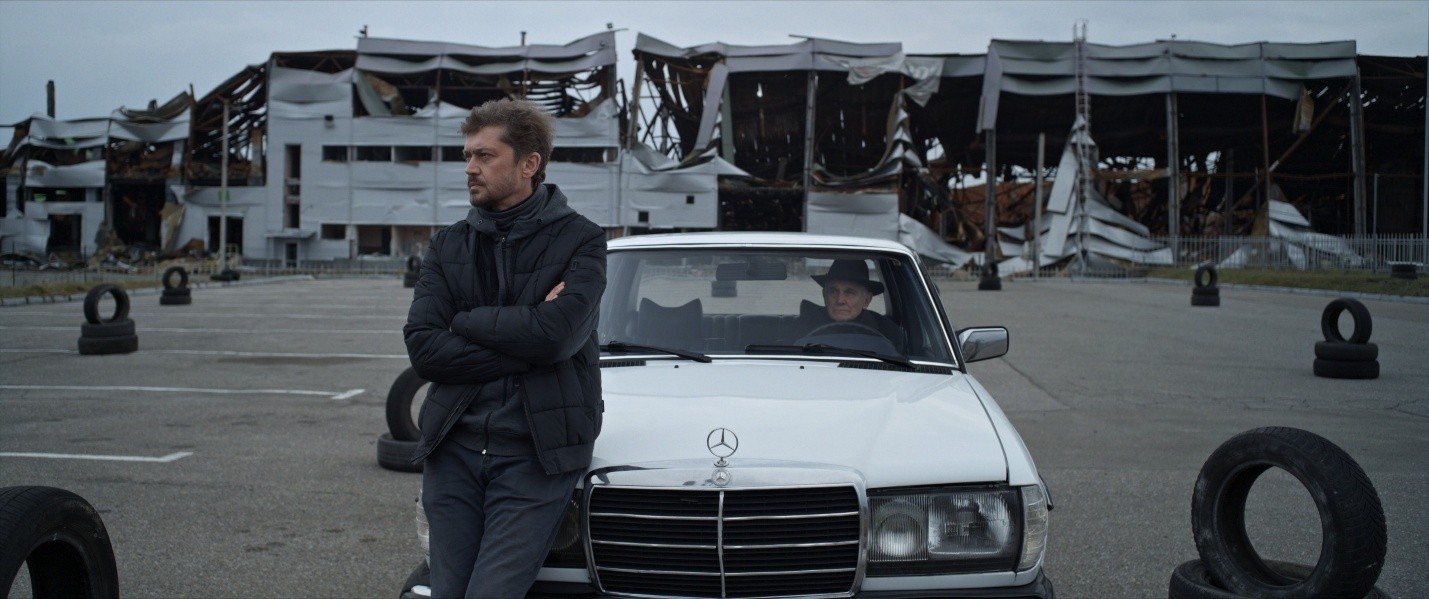
The car’s interior must be recognized as one of the physical and thematic hubs of the unfolding events. One need only recall the scene at the driving practice area, where Valentyn’s father is regaining his driving skills following a stroke. The episode concludes with Valentyn flatly refusing to let his father undertake a long journey behind the wheel. As the old man stubbornly refuses to move to the passenger seat, Valentyn steps out of the car – an action that carries significant symbolic weight.
The rooftop space also carries significant meaning – a location “between heaven and earth,” offering dazzling panoramas of the city and the picturesque horizon. Right here, on the boundary between heights and the abyss, a desperate fight ignites between best friends, Valentin and Vlad. This is not a conflict, but an explosion of pent-up emotion, where physical aggression emerges as the only available outlet for releasing existential pain. A careless touch to Vlad’s emotional wound acts as a psychological trigger, felt as acutely as touching an exposed nerve.
The filming of Valentyn’s suicide scene also takes place on the roof. This eerie act quickly morphs into a tragicomic sketch when Valentin and the cinematographer Mykhailo head back up to the roof after the fatal jump. In this way, grim psychological tension is continuously relieved through vital energy.
Precisely calibrated thematic and rhythmic counterpoints regularly disrupt the narrative’s meditative flow. At one point, Vlad unexpectedly steps on an old landmine; at another, Valentyn injures his hand while repairing a car; later, Valentyn’s son, Yaryk, breaks his leg while riding an electric unicycle.
The youth party scene celebrating Yaryk’s first paycheck – after he dropped out of university to find himself working in delivery services – deserves special attention. The party abruptly bursts into the film’s canon with a different generational tempo and elements of queer aesthetics, asserting the new generation’s right to their own “here and now.” Among the aspects that lay the groundwork for a queer reading of the movie, two key elements must be emphasized. First and foremost is the deconstruction of the classic cult of the heroic, masculine body. Corporeality in the film manifests in its vulnerability, traumatized state, and fragility; we see a queer body that resists the traditional patriarchal narrative. Second, in Vasyanovych’s film, customary families with traditional heteronormative lifestyles fall apart or are reshaped. Situational bonds and support networks emerge—forms of queer kinship built not on marriage or blood relations, but on shared trauma, the hardships of surviving under extreme conditions, and similar experiences.
Viewed in this light, Valentyn’s idea to “construct” an erotic scene for the sake of the film’s future box-office success appears symptomatic. The lack of women does not strike the director as an obstacle; in fact, after another round of drinks, it seems more like an advantage. He envisions a sexual flirtation between two heterosexual men – “It’s never been done before” – but the attempt to stage a “steamy” scene with his best friend Vlad predictably devolves into a grotesque, burlesque sketch.
These episodes, combined with the scene of “wild male dances,” function as a therapeutic carnival where absurdity, unbridled bodily chaos, and genuine “fooling around” become the only available means to overcome the tragedy of existence and neutralize the premonition of catastrophe. Such behavior represents the last bastion of freedom when the characters’ familiar world shrinks to the bare conditions of survival.
Vasyanovych’s use of sound – structured around the principle of strict materiality, where the sound source is always directly visible within the frame – merits analytical attention. The director deliberately eschews non-diegetic music, which typically manipulates the viewer’s emotions, favoring instead the documentary authenticity of the acoustic space. A striking example of this approach is the deeply dramatic scene in which Valentyn bids farewell to his close friend Vlad, who is leaving the country to join his family abroad. The slow music of J.S. Bach’s Sarabande plays from the speaker of an ordinary mobile phone. The farewell embrace between two men takes on a deeply poignant, authentic tone. The tragedy of parting arises from the vulnerability and rawness of the moment.
Specifying the same time exposure: “the film’s events take place a year after the war” – builds a direct conceptual bridge between Valentyn Vasyanovych’s two dystopian works, while simultaneously revealing a radical shift in the filmmaker’s focus. In Atlantis (2019), the year following victory was defined by the post-apocalyptic collapse of the external world; the camera captured images of a scorched Donbas, flooded mines, and an ecological wasteland. In To The Victory! (2025), by contrast, the surrounding world appears outwardly intact and undamaged. Yet the absence of ruins on the streets only intensifies the tragedy: the catastrophe has shifted entirely to the internal dimension of human existence.
Accordingly, Vasyanovych’s visual style evolved from Atlantis to To The Victory!. While remaining faithful to his signature visual and directorial techniques – such as extended unedited takes (sequence shots) and the use of a tripod to fix the point of observation (tableau shots) – Vasyanovych somewhat alters his directorial toolkit in the dystopian To The Victory!. He moves away from textural naturalism, a restrained color palette, and the stark, detached, and cold recording of industrial ruins. His narrowing of the psychological distance is reflected in the lighting and the signature visual geometry of the space, which contracts to the confines of personal autofiction; the lens captures not an abstract model of ruin, but fragments of the author’s intimate world. The frame becomes a record of his inner state.
Yet despite this intense focus on inner life, the film transcends the realm of mere autobiographical fact. Instead, it evolves into an artistically precise and unsettling diagnosis of sociological realities – trends of depopulation, the erosion of human capital, and the severance of the continuity of time between those who left and those who stayed. To The Victory! demonstrates that the most daunting challenge of the post-war future lies not in rebuilding concrete structures, but in preserving human integrity and affirming the right to live on one’s own land.
An important off-screen key to understanding the film was a press conference where Valentyn Vasyanovych was asked the same fateful question his on-screen wife poses in the movie: “So, what is more important to you – family or self-realization?” The director’s answer: “The self-realization of all family members.” This is not merely a clever way to dodge the question, but a conceptual formula summarizing the central conflict of contemporary Ukrainian reality, where the right to pursue one’s calling and the need to preserve a shared space find themselves locked in a fierce standoff.
Iryna Zubavina
Edited by Ela Bittencourt
© FIPRESCI 2026