
Six Months in a Pink and Blue Building: Reimagining Childhood Memories
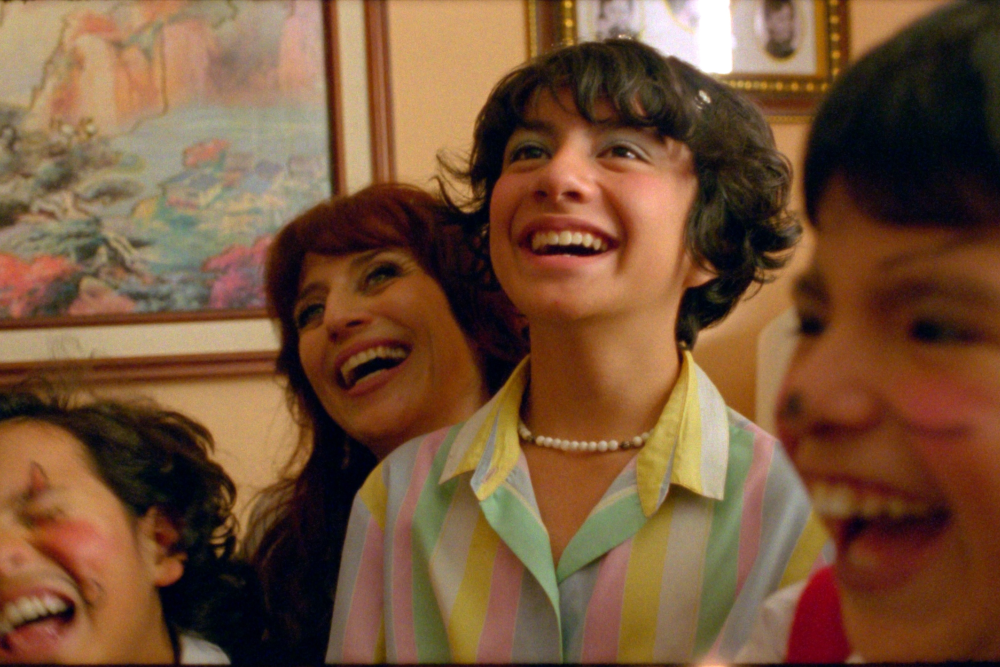
French film critic Laura Pertuy examines Bruno Santamaría Razo’s FIPRESCI-awarded Six Months in a Pink and Blue Building, a deeply personal exploration of childhood, family memory and the ethical boundaries between documentary and fiction.
The winner of the FIPRESCI Best Latin American Prize at the 28th edition of the Rio de Janeiro International Film Festival offers a deeply emotional journey into its director Bruno Santamaría Razo’s childhood, while boldly redefining ethics in contemporary documentary practice.
Mexico, in the early 90s. Bruno enjoys a carefree childhood with his flamboyant parents. When his father is diagnosed with HIV, everyone keeps on singing and dancing to ward off fate, and the young boy soon faces questions about who he is, and whom he is attracted to. Thirty years later, Bruno Santamaría Razo films and revisits the memories he couldn’t quite fathom as a child. Using the interviews of several family members as the raw material for the fiction he had in mind, while writing the script, the Mexican director—who previously directed Margarita (2016) and Cosas que no hacemos (2020)—invents a cinematographic language of his own, in which fiction and documentary escape their traditional definitions.
What are our memories but fiction, imagination, a blur between what happened and what we chose to remember, anyway? Six Months in a Pink and Blue Building (Seis meses en el edificio rosa con azul) fully immerses viewers in this fascinating question, focusing on an extremely moving premise: the director’s mother, Diana, saying—directly to her son, whom we know is behind the camera—that during the illness of Bruno’s father, she didn’t have time for memories. That original declaration sets the film in motion, skillfully blending what the director remembers from that period with what he imagines happened, as well as what he fantasizes could have been going on within his family, while also giving his mother room to explore a period of her life she missed. New memories are thus created from what has been missing—a whole aspect of an adult’s emotional life, to which the director had no access as a child. With his eyes wide open to the adult world, acting as an apprentice detective, the young Bruno (played by the wonderful Jade Reyes) leads viewers through an intimate and deeply emotional experience, in which time unravels at its own pace.
The director’s approach to the documentary form is equally remarkable. Right from the start, a pact is established with the viewer: we see the technical equipment being set up, we sense the presence of the cameras, we can make out the boom poles, and the director whispers in the voiceover “I’m ready; my mother is waiting for us to begin.” There are two essential pieces of information in these opening images and words—much like the opening lines of a novel. We’re to embark on a director’s journey into his past (“I’m ready”), with the decisive presence of his mother, who is treated as the matrix and motor of the narration (“my mother is waiting for us to begin”). The film makes consent fundamental and adapts to what the protagonists are willing to share, rather than forcing out of them information to serve the film’s narrative. The very moment his mother tells Bruno that he is making her relive something she has already explored, and put behind her in therapy, the camera stops, and we return to the fictional narrative. Boundaries have been set, and the director is clearly aware that the path he is taking must respect the limits established by his mother, who agreed to participate in this film, but on her own terms.
This is where Bruno Santamaría Razo’s own, very brief intervention in the film proves especially interesting: he clearly highlights the pact with the viewer, established at the outset. Here, there’s no question of hiding, of involving only his parents—exposure must be shared, and the relationship to the documentary material must be horizontal. We’ve become very accustomed to a vertical, dominant relationship in documentary practice—namely, a filmmaker who observes a subject under the (rather hypocritical) principle of “stepping back and letting the subject speak for themselves” which often leads to a lack of restraint, to something voyeuristic and utilitarian. In Six Months in a Pink and Blue Building, however, exposure is shared and boundaries are set; the protagonists reveal no more than they intend to at any given moment. Such gesture suggests a more ethical approach to the relationship between the viewer and the viewed, and intellectual honesty, which allows the audience to (joy)fully surrender to the film.
Laura Pertuy
Edited by Ela Bittencourt
© FIPRESCI 2026