
Criticism as a Platform for Animated Shorts: A Panel Discussion at Fredrikstad
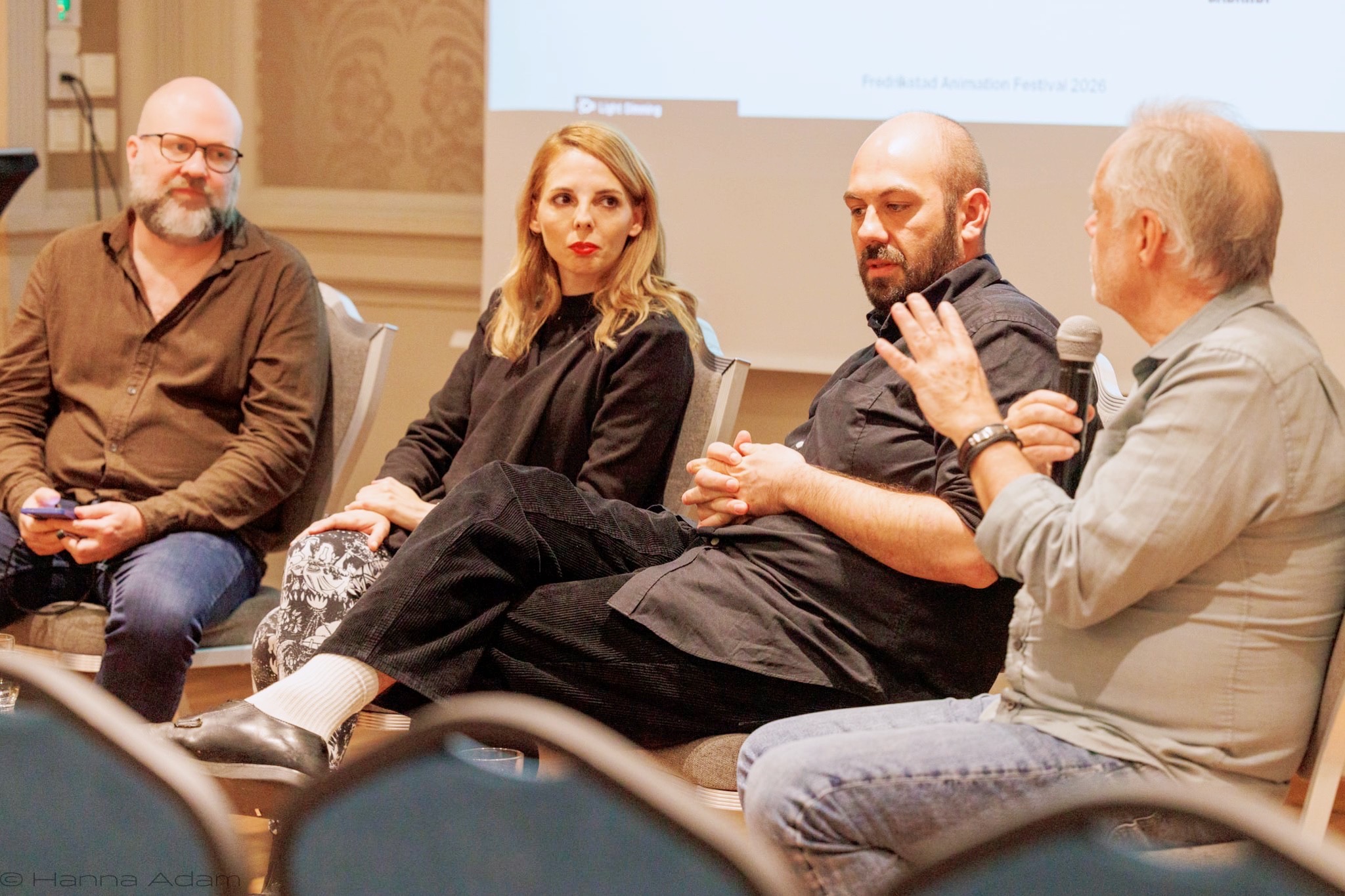
From Fredrikstad, critic Chiara Spagnoli Gabardi reports on a panel discussion that included the FIPRESCI jury, which resulted in many musings about the importance of criticism and the vitality of animated short films in today’s cinema landscape.
Film critics are often invited to panels to analyse the art form and the film industry, yet rarely are they given the opportunity to discuss their own profession. This was not the case at the 30th Fredrikstad Animation Festival, which welcomed its first FIPRESCI Jury in the festival’s three-decade history, and hosted a panel moderated by Artistic Director Anders Narverud Moen to discuss the role that film criticism plays in serving as a platform for animated shorts.
At the heart of the discussion was the idea of criticism as a form of cultural attention. It means looking closely at a film, understanding its choices, and finding the language to help others see what might otherwise go unnoticed. There is a common misconception that critics act as executioners, capable of making or breaking a film. While criticism can certainly influence a film’s reputation and discoverability, its visibility also depends on many other factors, including editorial priorities, budgets, distribution, publicity, festival selection, and audience access.
Criticism is an inherently subjective profession. Unlike a surgeon, whose work can be assessed through different practical measures, a critic operates in a field where interpretations may legitimately differ. Two critics can hold opposing views of the same film and both make valid arguments, provided they approach the work thoughtfully and support their interpretations with research and sound reasoning. Rather than standing in opposition to filmmakers, critics are fellow cinema enthusiasts who express their passion for the art form through informed analysis.
Notably, the relationship between criticism and filmmaking has a long history. Philosophers such as Aristotle developed ideas about how art and drama should be understood, while critical traditions gradually took shape across literature, theatre, music, and the visual arts. By the 17th and 18th centuries, opera had become an important subject of public review. Film criticism emerged alongside cinema in the late 19th and early 20th centuries, inheriting these traditions while helping establish cinema as an art form in its own right.
The boundary between the critic who analyses visual storytelling and the filmmaker who creates it has never been entirely fixed. During the silent era, figures such as Germaine Dulac moved between theorising about film and artistic practice. This transition became particularly influential with the French New Wave through the critics of Cahiers du cinéma who turned to filmmaking, such as François Truffaut, Jean-Luc Godard, Claude Chabrol, Éric Rohmer, and Jacques Rivette. Their movement from writing about cinema to making films demonstrated how critical reflection could become a creative force.
Whether it is writing about films or making them, what matters most is approaching the discipline with curiosity, humility, and a willingness to keep learning. Criticism allows to explore emerging tendencies, revisit classics, and reconsider a film through different perspectives. This spirit of discovery becomes particularly important when discussing animation. Critics can build bridges between animation specialists and general audiences, encouraging viewers to explore a filmmaker’s wider body of work rather than treating a film as an isolated event.
One of the strengths of criticism is its ability to reveal how a film’s meaning can evolve alongside the world around us. A compelling example that was mentioned is Japanese filmmaker Kōji Yamamura’s Mt. Head (2002), an Oscar-nominated animated short that can today be approached through an ecological perspective, even though it was not explicitly conceived as a film about climate change. This challenges another widespread misbelief: that animation is primarily intended for children. In actuality, animated films can explore the full complexity of adult experience. The works of Hayao Miyazaki demonstrate this particularly well, approaching the contradictions of life with extraordinary poetry and sensitivity.
Recognising animation’s full artistic potential also requires an understanding of its techniques and their evolution through film history. Before the advent of sound cinema, Lotte Reiniger pioneered silhouette animation in Germany, creating intricate films with paper cut-outs. In the 20th century hand-drawn animation continued to evolve, revealing the close relationship between the artist’s gesture and the moving image. Today artificial intelligence introduces new possibilities, that were discussed during the panel, in terms of making animation more accessible to independent artists with limited budgets, while emphasising the importance of clear regulations that safeguard authorship, artistic intention, and human creativity.
For critics, the central question is not just how an animated short was made, but what and how effectively its chosen technique allowed it to express its artistic vision. This also requires precision in the language used to describe cinema, beginning with the recognition that animation is a medium and not a genre. It encompasses a wider range of genres such as comedy, horror, drama, science fiction, and fantasy. The distinction matters because the words we use shape how audiences and institutions understand the films themselves.
These questions become especially relevant when considering the animated short film and the way it should be treated as a complete artistic work in its own right, rather than a stepping stone towards a feature. In fact, it can use its limited duration as an artistic principle, shaping the rhythm, structure, and intensity of the experience.
Recognising the short film as an autonomous work also means considering what happens to it after its premiere. Animated shorts often have a festival-centred life, and one of their main challenges is sustaining a public presence beyond the event where they are first presented. Online availability may be restricted, while distribution opportunities can be limited. In this context, criticism becomes particularly valuable: it can preserve these works in the public conversation, encourage further discovery, and help them reach audiences beyond the festival circuit.
Throughout the panel, one principle remained essential: critics must form an independent judgment, accompanied by fairness, an open mind, a sense of responsibility, and the ability to support their views with evidence. More than a discussion about the profession itself, it was a reminder of the role criticism can play in sustaining a vibrant cinematic culture. In doing so, the panel celebrated the critical independence and freedom of expression that FIPRESCI so strongly champions.
Chiara Spagnoli Gabardi
© FIPRESCI 2026