
The Riverbank: When the Geography of Desire Merges with Reality and Magical Myth
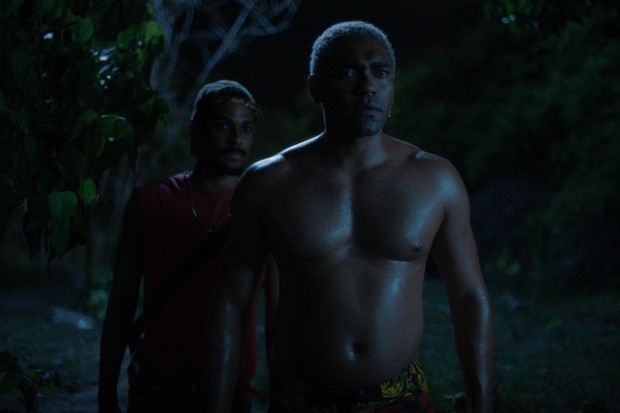
Egyptian film critic Basant Hassan explores Matheus Farias and Enock Carvalho’s The Riverbank, examining how the mangroves of Recife become a landscape of desire, religious oppression, resistance and liberation, where social reality merges with magical realism and biblical symbolism.
In the mangroves of Recife, Brazilian filmmakers Matheus Farias and Enock Carvalho transform a nocturnal search for intimate desire into a tense meditation on survival, the right to exist, and the right to freedom within an unavoidable, age-old struggle with patriarchal authority and religious patriarchy, which cloak repression in the language of religion and God. Yet such domination over others is often no more than an individual’s impulse toward authoritarian control—exercised, at times, by the religious father figure who says one thing but does another, and is driven by contradiction. Hypocrisy, promises of reward, and threats of punishment become instruments through which religious leaders subdue and humble their followers. Empowered by this authority, the cleric turns into judge and executioner, issuing verdicts as though he were God himself, deciding who may live and who must die.
The specific place chosen by the directors to bear witness to their story is more than a backdrop. It becomes a system of pressures that determines who and what may be seen, who and what must remain hidden, and which forms of life are permitted to take root. In The Riverbank (A Margem do Rio) (2026), the mangroves of Recife are central to the conflict the film depicts. Their waterways and tangled vegetation are not simply a natural setting surrounding a complex social drama; they form a shifting space in which desire, danger, and the possibility of escape become inseparable.
The film follows Izaquiel (Caique Copque), a young cleaner whose feet—and restless spirit, burdened by inner conflicts—draw him nightly to the riverbank in search of the intimacy he lacks. He repeatedly finds what he seeks in secret encounters with individuals and groups who have turned inward, seemingly cut off from the outside world. Beneath the dark sky, everything appears natural and permissible. Throughout the film, two witnesses observe the unfolding events and the growth of the conflict. The first is the riverbank itself, before which love and murder take place in absolute secrecy. It remains a silent witness and never betrays the secret—as though it possessed eyes capable of seeing everything concealed. The second witness is the bird known as the grey heron, which also observes the events.
Izaquiel’s encounter with Jeremias (Ítalo Martins), a fisherman who spends hours waiting by the river on whose bank he was born, brings another dimension to this relationship with place. The river rewards him with abundance: sometimes in the form of food and sometimes through an intimate relationship charged with tension and pleasure. These most basic human needs seem to flow generously from the riverbank, without it asking anything in return. By day, however, Izaquiel is forced to struggle for his meagre livelihood. The night provides him with a richer sustenance than the harsh and impoverished daylight. That deprivation drives him into contact with an evangelical church steeped in superstition and illusion, whose followers, thirsty for heavenly bliss and the throne of grace, submit themselves to a patriarchal institutional power that invokes the name of a holy God. This authority is embodied by Pastor Eurico (Robério Diógenes). As the violence he exercises in secret approaches and his grip tightens, the mangroves become both refuge and mysterious passage, drawing the two men into a world where reality and myth, love and murder, coexist with submission and domination.
One of The Riverbank’s most compelling ideas lies in the contrast it establishes between two environments that are more than geographical locations. On the one hand, the church is an ordered space governed by authority, discipline, and the conduct imposed by the religious leader upon his flock. The mangroves, by contrast, appear as an expansive terrain of concealment, fluidity, and encounters beyond the reach of rigid and overbearing official surveillance. Yet directors Farias and Carvalho do not allow this contrast to settle into a simplistic opposition between a repressive institution and a liberating natural world. The mangroves offer no guarantee of safety: their darkness provides protection, but also unsettles the senses; their labyrinthine passages can shelter bodies even as they expose them to violence. Freedom here is neither an abstract idea nor a secure destination. It is a provisional possibility, negotiated from one moment to the next.
This instability gives the film its distinctive atmosphere. Cinematographer Luciana Baseggio approaches the darkness and density of the mangroves in a way that makes the place feel enclosed rather than expansive. The vegetation interrupts clear lines of sight, while night withholds information from our eyes. Rather than presenting the riverbank as an open, romantic world or a distant refuge, the images make us feel that entering this space requires constant vigilance, and that every passage may hold the possibility of exposure or threat. The visual approach therefore does more than simply clarify the film’s setting: it also places the viewer inside the same state of anticipation and uncertainty that governs Izaquiel’s movements.
Sound plays an equally important role in building this tension. Daniel Turini and João Victor Coura’s sound design gives the sounds and murmuring of water a striking presence, as though it were speaking, crying out, or calling plaintively like a night bird. The respective soundscapes of the riverbank and the church receive particular attention. A sound that might otherwise remain a marginal background noise frequently becomes unsettling, charging the familiar with an unexpected significance. In this way, the film connects two apparently opposing worlds through a shared sensory element: at the riverbank, water belongs to the rhythm and movement of the mangroves; in the church, it appears through religious ritual and baptism.
The Riverbank’s editing, by Matheus Farias and Will Domingos, must navigate several narrative modes: social drama, erotic thriller, suspense, and moments that approach magical realism. This mixture is one of the film’s remarkable sources of energy, while also carrying certain risks. The story does not submit to the conventions of a single cinematic genre; instead, its transitions between generic modes create a sense of instability that is undoubtedly productive in artistic terms, allowing political, religious, erotic, and mythic elements to accumulate together.
This tension matters because The Riverbank is at its strongest when it trusts cinema to make contradictions felt rather than resolve them in advance. The film’s critique is not limited to the claim that religion and desire are incompatible. The more urgent question is what happens when religious authority becomes entangled with mechanisms of social control: when the language of salvation is used to regulate bodies, determine who is entitled to belong, and legitimise hostility toward those who depart from accepted norms. The film’s target, then, is not faith as a spiritual or personal experience, but the coercive power that can gather around institutions claiming to speak in the name of the Holy. This distinction gives the narrative conflict depth and clarity.
Izaquiel’s life beyond the church is essential to this argument. His domestic relationships with transgender women reveal a form of belonging founded on care, friendship, and shared experience rather than inherited or imposed authority. The film does not present this chosen community as an ideal refuge free of complications. Instead, it places the community in opposition to patriarchal power, aligning itself with the feminine against the masculine. Izaquiel’s mother, for example, offers him greater acceptance than his father, who seeks to constrain him and draw him under both his own familial authority and the church’s wider institutional equivalent. These two forms of authority are, in effect, two sides of the same patriarchal coin.
Elsewhere, the transgender characters’ movement from male to female identity is presented as an unmistakable assertion of freedom and difference. The Riverbank’s alignment with femininity is also expressed through the film’s celebration of beauty, adornment, colour, and self-fashioning: the women attend to their appearance, dress, makeup, nails, and hair as expressions of a life they have chosen for themselves. They embody tenderness, compassion, mercy, and warmth—the very qualities Izaquiel needs after leaving a home dominated by his father’s patriarchal authority. The transgender characters surrounding him have likewise fled the constraints imposed upon them, seeking freedom and the right to be different. Their escape has come at a cost, as the choice to live freely so often does. These characters’ embrace of intimate relationships, and the film’s sustained attention to them, can therefore be understood as both a response to repression and a means of rebellion: an attempt to create another social order, one in which bodies are not required to justify their right to exist before receiving affection, protection, or social acceptance—or before being deemed worthy of the kingdom of heaven after death.
There is, nevertheless, a contradiction in the film’s strategy that deserves reflection. On the one hand, it seeks to open a space for ambiguity through mythic atmosphere, while, on the other, its political conflicts sometimes draw sharp boundaries between the opposing sides. Even so, the directors succeed in making a film with clear political urgency that resists becoming a straightforward intellectual thesis. The Riverbank is most persuasive when it refuses to treat the margins as a place outside society. The former are shaped by the same structures of power that govern the city, even as they make other forms of encounter and connection possible. For that reason, the mangroves are at once both refuge and threat, a place of desire and a territory burdened by violence.
The Riverbank’s finale brings this many-layered, polyvocal cinematic odyssey to its conclusion, and symbolism and contradiction play a major role in creating its particular enchantment. The sanctity of religion, and the ethics and baptismal ritual that Pastor Eurico has demeaned and hollowed out, are restored to a form of sacredness in the final movement. Izaquiel and Jeremias do not kill the man who has killed; instead, they leave him bound to face the flood. It is as though the pastor himself is being baptised, while restrained in the river water that will carry him away—toward hell rather than heavenly bliss.
The film then ends with its two protagonists stepping into the river, their movement evoking the legends of prophets able to walk upon the surface of water and part it. They enter the river naked and strong, with profound confidence in themselves and in the future that awaits them, having freed themselves from the grip of patriarchy and looking toward the river’s infinite, boundless horizon. It is as though they alone have become the river’s kings: the water, emptied of everyone else, opens its arms to them and embraces them, offering peace and true sanctity. The river and its clear waters, created by God along with Nature itself, will surely baptise them. The true baptism takes place in the river—just as it did with Christ—not within the walls of a church ruled by a corrupt and murderous pastor.
The river’s waters will carry Izaquiel and Jeremias toward God and the promise of grace. After the storm and the lifting of the darkness, they may finally find stillness. More importantly, in the river and along its bank they attain the freedom whose price has been so high. At last, despite the arduous and brutal road they have travelled, the way ahead lies open before them, broad and expansive. The Riverbank leaves us with an image of freedom that is neither safe nor complete: freedom as continuous movement through uncertainty, driven by an eternal process of becoming and by the enduring aspiration for a life that is secure and joyful, without limits or walls, and without teachings imposed by human beings to confine us within a system filled with needless afflictions.
Basant Hassan
Edited by Jonny Murray
© FIPRESCI 2026