
A Community of Strangers: Beautiful Souls
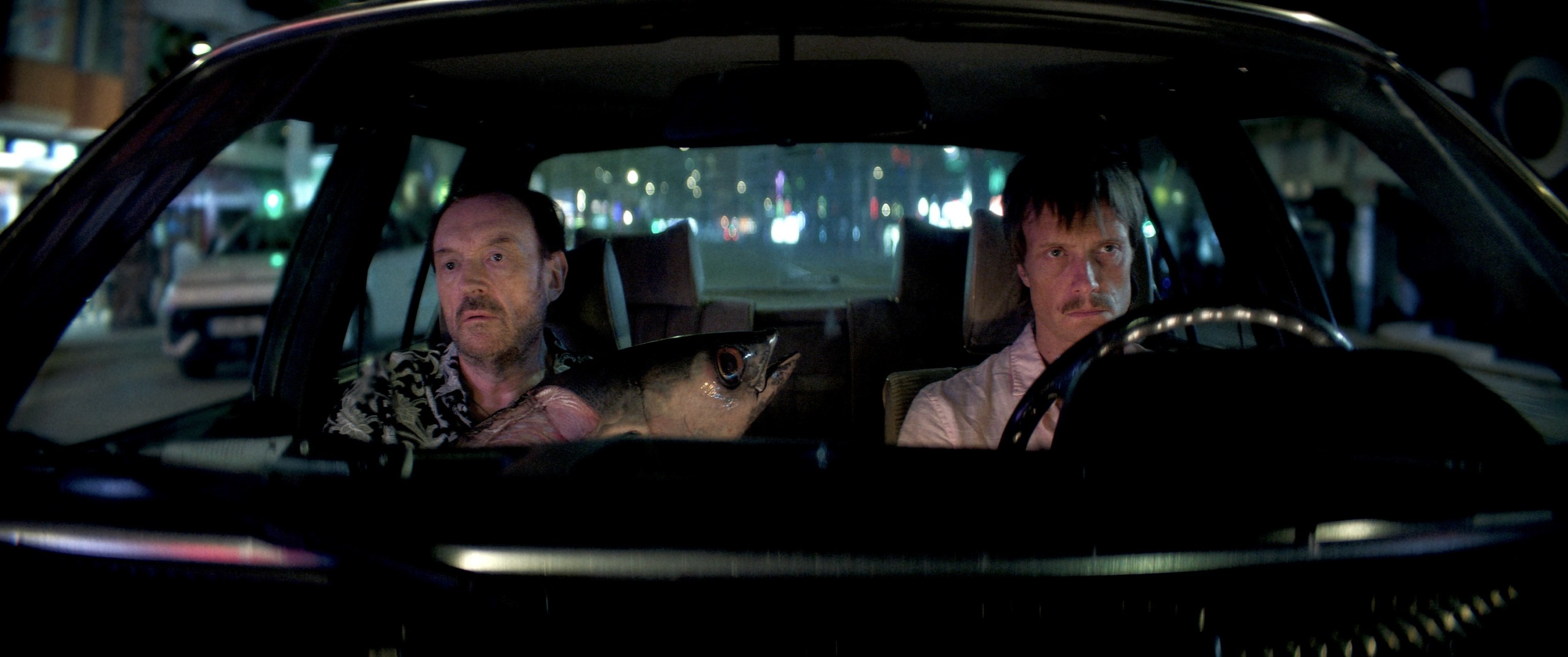
In the FIPRESCI award-winning film from the 2026 Munich FilmFest, Turkish critic Övgü Gökçe finds a work that sustains an “in-betweenness” that refuses easy distinctions.
Beautiful Souls (Schöne Seelen), the winner of the 43rd Munich International Film Festival FIPRESCI prize, is a surprising black comedy that creates a deeply humane universe out of lives lived on the margins. Rather than relying on dramatic revelations or psychological explanations, director Tom Schreiber allows his characters to drift through a world where chance encounters, fragile solidarities, and small everyday gestures matter more than conventional narrative resolutions.
The story follows Freddy (August Diehl), an ordinary working-class man living with his outspoken yet deeply affectionate mother, whose occasional reproaches do not diminish the comradeship they share. His life appears to move nowhere in particular until he impulsively boards a bus to Spain’s Costa Brava. There, he falls in with Herbert (Josef Hader) through his old friend Johannes (Thomas Schubert), who has built something more settled for himself, a car shop, a home, a Spanish wife, a baby on the way, and who represents the road not taken inside the same expatriate world. Freddy soon becomes entangled in an unlikely community that includes drug addict Charly, the elusive Niko, and a succession of drifters, workers, and dropouts whose lives intersect almost by accident. Violence, crime, romance, and even death all become part of the story, yet none of these events is treated as sensational. Instead, the film accepts them with the same quiet matter-of-factness that governs everyday existence.
What makes Beautiful Souls particularly compelling is the coherence of its seemingly improbable universe. The retro visual atmosphere juxtaposes the sunlit landscapes of the Costa Brava with faded holiday resorts, karaoke nightclubs, modest apartments standing beside luxury villas, and carefree beaches giving way to nights perpetually on the verge of slipping out of control. While its textures evoke the Germany and Spain of the 1990s, the film resists being tied to a single historical moment. Its world feels suspended between periods, allowing the specific phenomenon of German expatriate life on the Spanish coast to resonate as something both historically situated and quietly universal.
The same sense of in-betweenness extends to the characters themselves. Few possess a clearly visible past, and even fewer seem certain of their future. Instead, they temporarily occupy one another’s lives, constantly replacing, helping, abandoning, or unexpectedly caring for each other. Freddy takes Charly’s place; others disappear while newcomers quietly fill the gaps they leave behind. Nobody entirely belongs anywhere, yet together they form an unlikely community. The film refuses easy distinctions. Instead, it observes each character with the same generosity, suggesting that belonging may emerge precisely among those who have stopped searching for something more permanent.
Schreiber also reworks familiar cinematic archetypes. Herbert and the businessmen surrounding him initially evoke the world of gangster films and crime bosses. Yet these figures never become mythic patriarchs. Their authority proves surprisingly ordinary, revolving around good food, drinks, karaoke performances, and eventually even an unexpected, modest marriage. Rather than reinforcing familiar performances of male power, the film deconstructs them, relocating its characters into a world where vulnerability, companionship, and improvised forms of living together matter far more than domination.
This delicate balance is sustained by the film’s timeless visual language, exquisite ensemble performances, and witty, deeply humane dialogue. Moving effortlessly between different styles and moments, Beautiful Souls creates a cinematic world where the improbable always feels believable. The symmetry between the film’s opening and closing images carries this same control: Freddy first appears wounded at the seaside, and by the film’s final moments he is left there again, now with the dog beside him. What resolution the film allows itself, though, is modest and unsentimental. Niko, vagabond that she is, leaves, and ties to the wounded Freddy the small dog she had found earlier, while the two of them sat together on the beach, a gesture of care that stops short of commitment, an attachment offered without any promise attached to it. Without insisting on redemption or closure, the film suggests that even lives marked by uncertainty may still make room for companionship, tenderness, and the small human miracles that quietly sustain them.
Övgü Gökçe
© FIPRESCI 2026