
Love, Family and Human Contradictions in Lance Hammer’s Queen at Sea
Lance Hammer’s Queen at Sea examines the complexities of love, intimacy and consent in the lives of an elderly couple facing dementia. Rasha Hosny reflects on the film’s moral dilemmas, its nuanced characters and its moving portrayal of family relationships, ageing and the limits of care.
American director Lance Hammer opens Queen at Sea (2026), his second feature after an 18-year gap since Ballast (2008), with a tender shot of an elderly couple struggling to climb a long staircase, holding on to each other’s hands. The man waits for his wife to reach the last step and helps her up. He then puts his arm around her waist, and she does the same as they quietly walk on together. This simple moment seems to prepare us for the whole film: the journey of a man and a woman trying to carry on with their lives, holding on to each other, even as their bodies and the passing years make that increasingly difficult.
The film is not only about old age, dementia and the difficulties these bring to patients and their families. It goes further, into more complicated questions about love, care and the right to make decisions. What happens to love when one person can no longer express what they want? Can care still be an act of love when it becomes a way of imposing our own ideas about how someone else should live? And who has the right to decide for a person who can no longer make those decisions alone?
Hammer quickly moves from that gentle image of the couple to a deeply disturbing scene. Amanda, played by Juliette Binoche, walks into her mother Leslie’s bedroom and finds her stepfather, Martin, having sex with her. Amanda is furious. We learn that she has already asked him to stop, because doctors have warned that Leslie, who has advanced dementia, is no longer able to give informed consent. Martin refuses. He believes he has the right to remain physically intimate with the woman he has shared his life with for so many years, and that this closeness still brings comfort to them both.
When Martin refuses to stop, Amanda calls the police. A series of procedures follows, all intended to protect Leslie from possible abuse. The couple are separated, and Leslie undergoes medical examinations. During an attempted vaginal examination, however, she becomes terrified and distressed, and the examination cannot be completed. What was meant to protect her becomes a frightening experience. Leslie herself cannot understand what is happening or why her husband has been taken away from her.
This is where the film’s central conflict takes shape: the difficult relationship between love, care and the right to choose. Who should make decisions when someone can no longer express their wishes, as in Leslie’s case? Does her daughter have the right to decide for her? Is that an act of control, or a responsibility forced on her by the circumstances? And where do we draw the line between protecting someone and taking away their freedom?
What I particularly liked about Hammer’s approach is that he made me sympathise with both Amanda and Martin, while also questioning, and sometimes condemning, their actions. It is hard not to understand Amanda. She loves her mother and wants to keep her safe. Yet there is something controlling about the way she acts, and she does not always give enough thought to Martin’s feelings or to the life he and Leslie have shared. At the same time, I felt for Martin, an elderly man who insists on looking after his wife even though he needs medical care himself. But I could not support his insistence on continuing their sexual relationship while disregarding the doctors’ warnings about Leslie’s ability to consent.
For me, this is one of the film’s greatest strengths. It does not divide its characters into those who are right and those who are wrong. They are people full of contradictions, who may act out of love and a wish to protect someone, yet still cause harm. As a viewer, I kept reconsidering my own reactions. Just when I felt close to one character, something they did made me question them again. Understanding why someone acts in a certain way does not mean we have to agree with what they do.
The film also made me think about how the roles of parents and children change with age. We accept that parents make decisions for their young children and set limits to protect them. But when children grow up and have to make decisions for their ageing parents, the same kind of protection can begin to look like control. Is it ever possible to draw a clear line between the two?
This tension becomes even more interesting through Amanda’s relationship with her teenage daughter, Sara, played by Florence Hunt. Sara is beginning to explore love and sex and is preparing for her first sexual experience. Unlike her firm opposition to the intimacy between Leslie and Martin, Amanda accepts her daughter’s wishes. She even buys Sara contraception, offering her practical support and, in a way, her blessing.
Why does Amanda allow her daughter, who is still legally a minor, a freedom she denies her elderly mother? Is the difference simply age, or the ability to understand and make a choice? Of course, the two situations are not the same. Leslie’s dementia raises a serious question about consent that cannot be brushed aside. Still, the contrast tells us something about the different ways Amanda sees her daughter’s and her mother’s independence. Both need care, though in very different ways. And old age can sometimes bring a new dependence on others, almost like a return to childhood, but after a lifetime of making one’s own decisions.
Another aspect of Queen at Sea that I appreciated is the space it gives to elderly characters and to problems we do not often see at the centre of contemporary films. Older people are part of our everyday lives, with their own emotional, physical and social concerns. Yet on screen they are often supporting characters in stories about younger generations, rather than the main characters in stories of their own.
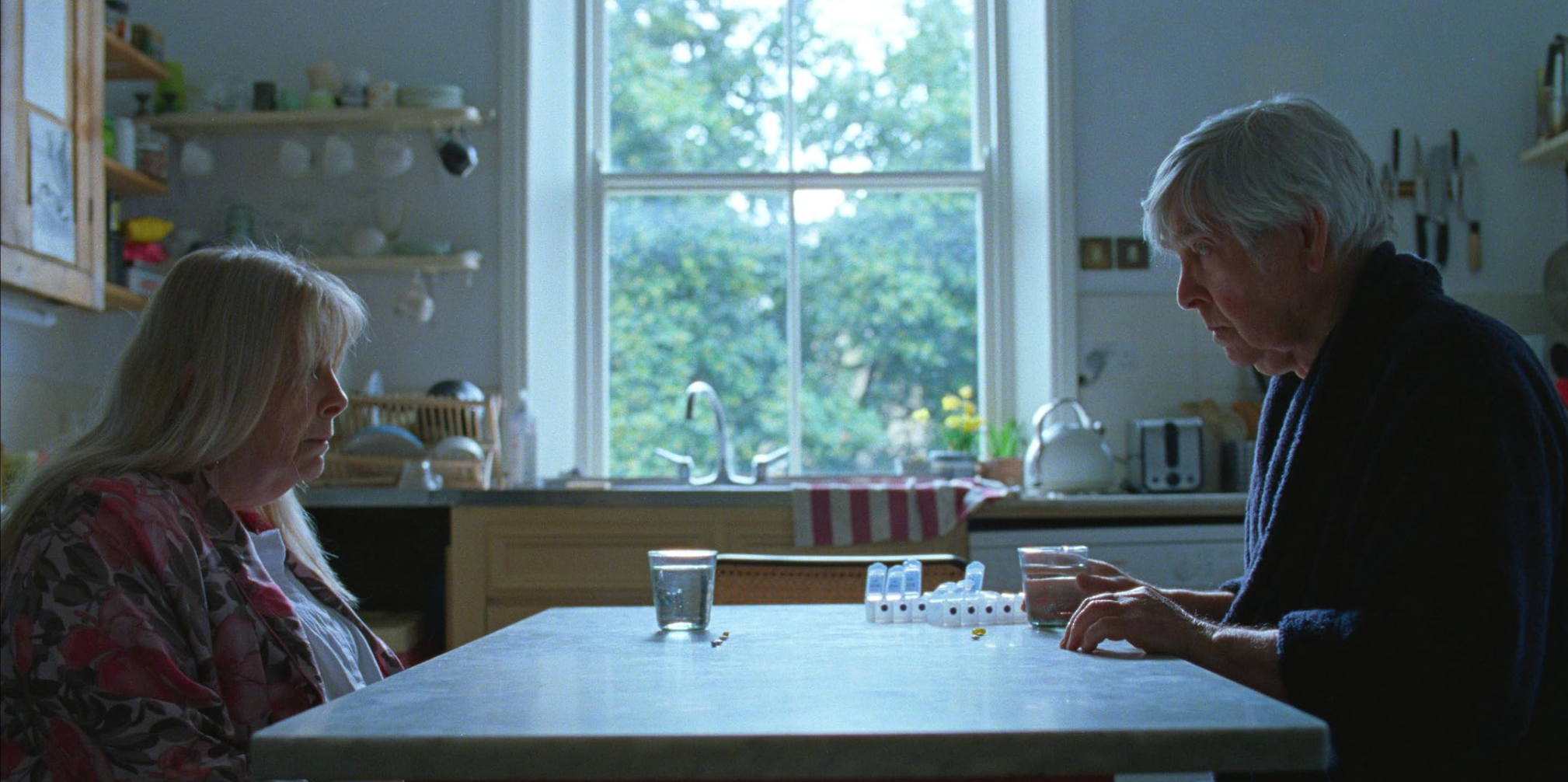
Hammer gives Martin and Leslie that space. He does not see them only as two people who need looking after, but as a man and a woman with a relationship, feelings, desires and fears. He also refuses to treat old age as the end of love or sexual desire. The need for affection, physical closeness and intimacy does not simply disappear as people grow older. At the same time, recognising that need does not make the question of consent any less important. In fact, it is what makes the film’s central conflict so difficult.
I also think the film succeeds because of the cinematic language Hammer chooses for this story. This is a family drama, with much of the action taking place inside the home of an elderly couple. Its strength lies in the relationships, the emotions and the contradictions between the characters. It does not need complicated camera movements, unusual angles or striking colours to make its point. It needs a visual approach that stays close to the people and the world they inhabit.
Hammer’s style is quiet and restrained, and I found it entirely right for the material. The camera does not try to draw attention to itself. Instead, it gives us time to notice small gestures, looks, movements and moments of silence, which can sometimes tell us more than dialogue. I do not see this simplicity as a lack of cinematic ambition. On the contrary, I think it is a thoughtful choice. Good filmmaking is not always about doing more; sometimes it is about knowing exactly what a story needs.
The performances are essential to this approach, especially those of Tom Courtenay as Martin and Anna Calder-Marshall as Leslie. Watching them together, it is almost impossible not to believe in the closeness and understanding between them. They feel like a couple who have spent decades together, rather than two actors playing husband and wife. It is there in the smallest details: the way they look at each other, touch each other, move together and sit in silence. Their performances suggest a whole shared history, even though the film tells us very little about that history. Their joint Silver Bear for Best Supporting Performance at the 2026 Berlin International Film Festival feels well deserved. The film also won the Silver Bear Jury Prize.
Juliette Binoche, meanwhile, gives Amanda the complexity the role needs, with the natural ease we have come to expect from her. Amanda is both a daughter and a mother. She wants to protect her own mother while trying to respect her daughter’s independence. She finds herself making decisions that could change her family’s life, without necessarily knowing whether they are the right ones.
There is something harsh about the film’s realism, and something very immediate about its subject. How many families face these questions about the physical, emotional and medical care of older relatives every day? How many adult children suddenly find themselves responsible for decisions that will change their parents’ lives? And how many older people lose control over their daily lives, not because their families do not love them, but because love itself can sometimes become a reason for deciding things on their behalf?
Against the cold, grey London winter, the events move quickly and often feel overwhelming. The film is full of emotion and difficult choices. It also catches us making judgments, only to make us realise a little later that the situation is more complicated than we first thought.
The ending shocked me. On my first viewing, I felt that it was not fully justified, or at least that I could not see how it followed from everything that had happened. But when I watched the film a second time, more carefully, I began to ask myself a different question: why does Martin have to die?
Could his fate have something to do with his determination to hold on to his wife and to the life they once had, even when age and illness have made it impossible for that life to continue in the same way? Was his refusal to accept how much their circumstances had changed part of his tragedy? Was he, in some sense, trying to resist time itself?
Or is that reading too harsh on a man who simply wanted to stay with the woman he loved and keep the life they had built together?
I still do not have an answer. But these questions stayed with me after the film ended. They reminded me that the best films are not necessarily the ones that give us answers. They are the ones that make us think, then think again, and reconsider the judgments we were so ready to make.
Rasha Hosny
Edited by Amber Wilkinson
© FIPRESCI 2026