
My Father’s Scent: Bitterness and Tenderness Go Hand in Hand
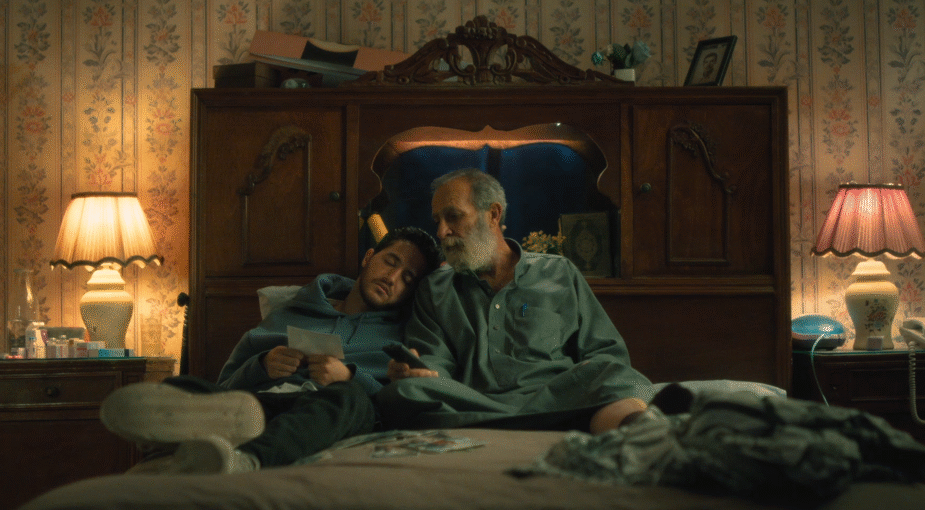
An Egyptian family drama that moves between thriller inflections and intimate character study, My Father’s Scent, explores fractured relationships, moral ambiguity, and the uneasy coexistence of care and resentment within a family. Film critic Schayan Riaz examines how the film balances emotional restraint with narrative complexity.

A young man wakes up on a beach, tired out and clearly disoriented. Conventional cinema beats dictate that this scene is the start of a dark and sombre thriller, and My Father’s Scent certainly veers into thriller territory over the course of its runtime. But not quite. All of this is by design; not everything is as it seems, there is more to things than meet the eye.
The young man from the opening scene is Farouk (Ahmed Malek), a drug dealer whose father Omar (Kamel El Basha) has returned home after six months spent in a coma (to say more, or to reveal earlier scenes leading up to what is essentially a flashback, would be spoiler territory). Farouk’s older brother Ali (Abed Anani) constantly admonishes Farouk for his criminal career path, and we very quickly see that there is no love lost between Omar and Farouk. For Omar, his younger son is no more than a useless addict, someone who isn’t making anything out of his life. But Farouk is actually the one who took care of his father; he paid all the hospital bills and treatment costs during Omar’s absence, but in turn receives no appreciation. Omar’s bickering and Farouk’s frustration form a powerful father-and-son dynamic, allowing the film to explore what it means to care for your loved ones even if the relationship has turned sour.
At its core, My Father’s Scent is about the decisions people make and the consequences they have to then live with, whether it’s a father keeping secrets from his children about his marriage, or a man spiralling when he learns that his girlfriend is unexpectedly pregnant (the script allows for a fun and mischievous turn by young Egyptian star Mayan El Sayad as Omar’s girlfriend). The film’s emotional weight is anchored by all of these scenes, because they are written and played out as genuinely as possible, with no undue melodrama, but instead real emotions. Nothing is shown in black-and-white here either, as exemplified very well by a simple moment at the start, when Farouk offers Ali some candy, which takes Ali by surprise. There was bitterness in one moment, and it gave way to tenderness in the next, both emotions coexisting in the brothers’ gestures and powering the moral ambiguity. This is how all the characters behave with one another.
The use of soft-focus cinematography and slow, drifting camera movements (by Omar Abou Doma) creates a dreamlike texture, moving from intimate close-ups to distant, isolating frames. The visual language mirrors the characters’ fractured psyches and the porous nature of time as well. As mentioned earlier, the film works with flashbacks, and the sense of a linear reality is complicated. The theme of someone “coming back from the dead” also adds to the imagery of being between two states, capturing well how one thing can also very well be another, or mean something else.
These are all universal topics, finding resonance beyond Egypt, where the film was made, or the Arab world: My Father’s Scent found success in Europe (winning awards at the Brussels Mediterranean Film Festival after its world premiere at the Warsaw International Film Festival), and also “at home”, such as the Best Actor Award at the El Gouna Film Festival or bagging the Audience Award at the Red Sea International Film Festival. And at the Malmö Arab Film Festival, which is the largest and most influential Arab film festival outside of the Arab world, the film managed to win the Best Actress Award, the Jury Award as well as the inaugural FIPRESCI Prize. This is a very finely acted and written film, offering a complex character study and resisting easy answers or even categorisation.
Schayan Riaz
©FIPRESCI 2026