
Sink: A Mother’s Unbreakable Bond Under Pressure
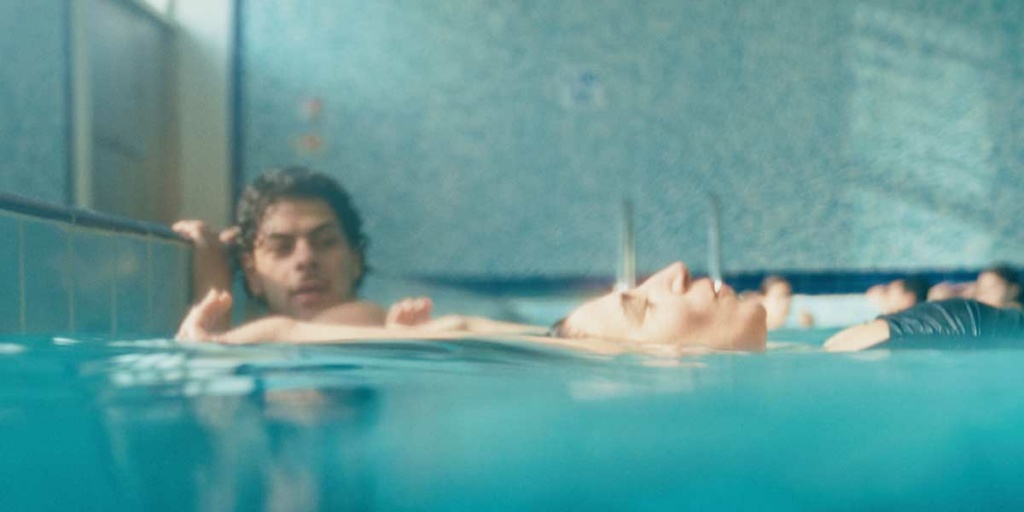
Jordanian filmmaker Zain Duraie’s debut feature Sink examines maternal devotion in the face of denial, tracing the emotional and psychological toll of confronting a child’s deteriorating mental health. Marwa Abueish reflects on a film that privileges restraint, interiority, and performance over exposition.

Sink (غرق) is a Jordanian feature written and directed by Zain Duraie, marking her debut feature film. It is an international co-production between Jordan, Saudi Arabia, Qatar, France, and Estonia. The film was screened in the Official Feature Competition at the 16th Malmö Arab Film Festival.
Sink was also screened at several prestigious international film festivals. It had its world premiere in the Discovery section of the 2025 Toronto International Film Festival, followed by its Arab world premiere at the Red Sea International Film Festival. The film also won the Ecumenical Prize at the Mannheim-Heidelberg International Film Festival and participated in Carthage Film Days.
The film tells the story of a mother who refuses to accept that her high school senior son’s mental health is getting worse. She believes he only needs guidance, even as warning signs grow and a crisis approaches.
The story focuses on the relationship between a mother, Nadia (Clara Khoury), and her son, Basel, and how their bond is strong and warm, full of care and affection. As the story develops, the mother keeps defending her son in every situation. She insists that he is intelligent and simply misunderstood. This leads her to justify his behaviour, even when it becomes more serious.
This is clear when Basel attacks his teacher after refusing his assignment and mocking the class. Despite how serious the situation is, the mother continues to defend him without hesitation.
Her strong support for her son prevents her, at first, from seeing the truth about his undiagnosed mental health condition. She only begins to understand this later, as the story unfolds.
The director, Zain Duraie, succeeds in showing powerful scenes without dialogue. She focuses on emotions expressed through the eyes. We see the mother’s inner struggle grow as she begins to see her son more clearly, almost as if he is a different person. There is a clear conflict between her love for him and her fear of accepting that he is ill.
Duraie also shows strong control in directing the actors, especially Clara Khoury as Nadia, who delivers a remarkable performance. Much of the emotion is expressed through her eyes. The silent scenes are especially powerful, allowing the audience to understand what is left unsaid.
The most powerful moment of unspoken dialogue comes in the final scene. Basel is arrested after calling for help and admitting that he is hitting his mother. We then see the mother and son sitting in the car, looking at each other in silence. Without a single word, the scene clearly shows that, despite everything, Nadia’s love remains strong and unconditional, and that she will continue to defend him for the rest of her life.
One of the interesting aspects of the film is its title, Sink, and Duraie’s choice is particularly effective. The film focuses on small emotional expressions rather than direct explanation, and the title reflects this approach. The word carries a strong meaning beyond its literal sense, as it reflects Nadia’s emotional state while she struggles to deal with her son’s condition. Her denial feels like a slow sinking, as if she is losing control and unable to stay steady.
Marwa Abueish
©FIPRESCI 2026