
Suzhou Quartet: Four Lives, One Screen
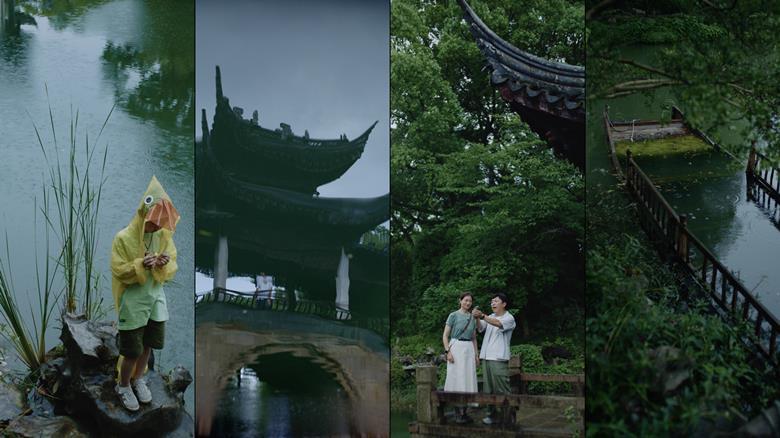
Film critic Tilda Sixue Li examines Cai Chengjie’s formally inventive Suzhou Quartet, which interweaves four lives within a divided screen. Awarded Best Director at the Warsaw International Film Festival, the film raises intriguing questions about cinematic spectatorship, human connection and the limits of visual experimentation.
Who determines where we look? And to what extent can cinema liberate the spectator’s gaze from the filmmaker’s control?
These questions lie at the heart of Suzhou Quartet (四分之四), directed by Chinese filmmaker Cai Chengjie and selected for the main competition at the 42nd Warsaw International Film Festival.
Dividing the cinematic screen into four equal vertical panels, the film presents four narratives unfolding simultaneously, inviting audiences to navigate between them and exercise a degree of freedom over their own viewing experience. Drawing inspiration from traditional Chinese folding screens and painting, while also engaging with the contemporary visual language of vertical images, Cai’s formal experiment raises a longstanding question about spectatorship: who controls the viewer’s attention, and can the audience ever truly escape the director’s guidance?
The film opens with four panels, each presenting a quarter of a clock face, its hands moving as the initially separate sounds gradually fall into synchronisation. This striking opening immediately foregrounds the question of time: how can different temporalities coexist within a shared present? What is the relationship between simultaneity and the individual experience of time?
The four-panel composition is not merely an opening device but a structural principle sustained throughout almost the entire film. Each panel introduces its own narrative in turn. Yet when one story takes centre stage, the other three do not freeze or fade to black. Their characters continue to exist, move and inhabit their respective spaces, even when the audience’s attention is directed elsewhere. The spectator is thus presented with four lives occurring at once, only one of which can be followed closely at any given moment.
The first story follows Chunyu (literally “Spring Rain”), an eight-year-old boy struggling with the absence of his parents and the emotional consequences of separation. Developing an attachment to a young woman working in a grocery shop, he begins to wish that she might adopt him. In the second panel, Lixia (“Beginning of Summer”) and her boyfriend both work in advertising. While dealing with a difficult landlord, Lixia also confronts a professional dilemma: a proposal praised by a client may have drawn on a creative idea she and her boyfriend developed together, raising uncomfortable questions about authorship and ownership that ultimately contribute to the breakdown of their relationship.
The third narrative concerns Fengshou (“Harvest”), a middle-aged employee at the city museum who is separating from his wife. He unexpectedly reunites with Wenhui, a possible romantic interest from his youth, who has since become a prominent curator and discovered a valuable thousand-year-old artefact. Under pressure from the museum’s director, Fengshou approaches her in the hope of securing a donation. Finally, Xuemei (“Plum in the Snow”), an elderly woman running a small noodle shop, finds herself confined by the responsibilities of caring for her ailing husband. An encounter with another elderly man begins to unsettle her long-held convictions about love, loyalty and the life she has chosen.
These four stories can be understood through several overlapping structures. Most obviously, the protagonists’ names evoke the four seasons, establishing a parallel between spring, summer, autumn and winter, and the successive stages of childhood, youth, middle age and old age. Another underlying framework is the traditional Chinese conception of life’s four inevitable experiences: birth, ageing, illness and death.
Through these correspondences, Cai proposes a philosophical vision of human existence as a cycle of recurring seasons. Life is both continuous and simultaneous: while one person experiences the beginning of something, another is already confronting its end. The four panels make this coexistence visible, transforming the screen into a metaphor for the passage of life itself.
Separation and the search for selfhood emerge as the strongest thematic links between the stories. Each protagonist faces a dilemma involving either actual separation from loved ones or the desire to escape an existing familial relationship. Through these experiences, they begin to question who they are, what obligations define them and whether they possess the freedom to determine their own lives.
The narrow vertical frames can therefore also be read as visual prisons. Each character is confined within a limited space, struggling against circumstances that seem to restrict their choices. The boundaries between the panels are not simply compositional divisions; they suggest the invisible barriers that separate individuals, even when their lives unfold in close proximity.
Beyond this thematic structure, Cai pursues a more ambitious experiment in mise-en-scène, orchestrating movements across the four separate frames to create visual continuity. In one particularly inventive sequence, the young boy slides down a playground slide from left to right in the first panel. His movement is picked up by a yellow car travelling in the same direction in the second, followed by another vehicle in the third, and finally by a pushchair moving across the fourth. Although these actions belong to four different narratives, their carefully choreographed trajectories form a continuous line across the entire screen.
Such moments are among the film’s most compelling formal achievements. The four images momentarily cease to function as isolated compositions and become parts of a larger visual whole. Their continuity suggests that, despite the apparent separateness of individual lives, an underlying rhythm connects them. Life moves forward, carried from one frame to another.
This idea finds its fullest expression when the four panels finally dissolve into a single image. Having experienced their respective losses and disappointments, the protagonists gather one rainy evening at Xuemei’s noodle shop. The elderly woman generously invites them to share a hotpot meal. As the four characters sit around the table, the dividing lines gradually disappear, allowing them to inhabit the same frame for the first time.
It is a quietly moving gesture. Having spent much of the film watching these people struggle within their separate worlds, the audience is finally offered a moment of togetherness. The visual transformation suggests that although human experiences are fundamentally individual, moments of understanding and connection remain possible. Perhaps such fleeting encounters are what enable people to endure the disorder and uncertainty of everyday life.
The setting of Suzhou contributes significantly to the film’s poetic sensibility. Renowned for its classical Chinese gardens and intricate landscapes, the city is presented through a succession of carefully composed images that emphasise its architectural elegance and understated beauty. Rain and humidity permeate all four narratives, lending them a shared atmosphere of melancholy. The persistent wetness of the environment becomes another unifying element, allowing the distinct stories to inhabit the same emotional and geographical landscape.
Yet the film’s considerable formal ambition also invites scrutiny. To what extent does Suzhou Quartet actually achieve its proposed liberation of the spectator’s gaze?
The experience of navigating multiple images simultaneously is hardly unfamiliar in gallery installations or experimental moving-image practices. Nevertheless, the sustained use of four vertical narratives within a feature-length theatrical film offers an unusual and potentially stimulating viewing experience.
In principle, the format grants spectators the freedom to look beyond the narrative currently foregrounded by the director. In practice, however, this freedom proves more limited than it initially appears. When one panel assumes narrative prominence, the other three frequently offer little beyond the characters’ stillness or minimal movements, with insufficient activity to reward sustained attention. This may partly reflect the considerable practical challenges of choreographing four simultaneous narratives, yet it ultimately limits the potential of the experiment. The freedom to look, therefore, does not necessarily translate into a more active or autonomous viewing experience. What initially appears to challenge the director’s control over the spectator’s gaze risks reproducing that very control through subtler means. Furthermore, the restrictions imposed by the narrow panels mean that much of the action is presented in long or medium shots, with relatively few opportunities for close-ups. Over the course of the film, this distance risks weakening the emotional engagement necessary to sustain such an extended experiment.
More significantly, the four narratives themselves do not always possess the dramatic strength required to support the complexity of their presentation. Compared with the sophistication of the film’s formal construction, the individual stories can feel relatively slight. Their thematic parallels are carefully conceived, yet their conflicts and resolutions sometimes lack sufficient depth or urgency to justify the time devoted to them.
This imbalance becomes particularly apparent in the film’s final revelation. After the four protagonists gather at Xuemei’s noodle shop, they discover an extraordinary coincidence: all of them had previously visited Suzhou’s famous Hanshan Temple and somehow appeared together in the same photograph, which now hangs on the wall of the restaurant. What begins as a delicate moment of human connection suddenly becomes an almost comically improbable coincidence. The revelation seems intended to reinforce the idea that these apparently unrelated lives have always been connected. Yet by making that connection so explicit, the film risks undermining the subtlety it has carefully established elsewhere.
Nevertheless, Suzhou Quartet remains a bold and intriguing contribution to contemporary cinematic experimentation. Its combination of traditional Chinese visual aesthetics with a four-panel structure invites audiences to reconsider the conventions of cinematic space, time and spectatorship. At its best, the film transforms the screen into a richly layered composition in which separate lives resonate through movement, rhythm and shared emotion.
Recognised with the festival’s Best Director Award, Cai’s experiment opens up compelling possibilities for the future of cinematic storytelling, even if Suzhou Quartet does not fully realise its potential. Whether other filmmakers will take up this approach remains to be seen. The more intriguing question is whether future experiments can find a more effective balance between the multiplicity of visual perspectives and the dramatic depth of the stories they tell.
Tilda Sixue Li
© FIPRESCI 2026