
Through the Wall: A Prison Love Story
Polish film critic Pawel Mossakowski examines Maciej Sobieszczański’s FIPRESCI Prize-winning Through the Wall, a remarkable love story set in a Stalinist prison, where restrained performances, evocative black-and-white cinematography and an unconventional narrative reveal the sustaining power of human connection.
At first glance, Maciej Sobieszczański’s Through the Wall (Przez ścianę), winner of the FIPRESCI Prize at the Warsaw Film Festival, appears to confront one of the darkest chapters in Poland’s recent history: Stalinism. Yet it soon becomes apparent that this grim period serves primarily as the backdrop to an extraordinary love story. So extraordinary, in fact, that were it not based on real events, we might struggle to believe it.
The year is 1947. Wiesia, a medical student, is arrested by the communist secret police on suspicion of conspiring against the regime and placed in detention. In the adjoining cell is Jurek, a young member of the anti-communist underground resistance. Drawing on the Morse code she learnt as a Girl Scout, Wiesia manages to establish contact with him by tapping her knuckles against the wall. They begin to ‘talk’. What begins as a desperate need for human contact gradually blossoms into love – a love that sustains them through the horrors of imprisonment and brutal interrogation. Wiesia falls in love with a man she has never seen, clinging to the hope that one day they will finally meet beyond the prison walls.
Through the Wall is a love story unlike almost any other. After all, Wiesia and Jurek know neither what the other looks like nor what their voices sound like. Their love is stripped of almost everything we instinctively associate with romantic attraction: physical desire, fascination, infatuation. The touch of a hand. The scent of another person’s skin. In a sense, it is not so much love itself as the promise of love. And yet we believe in it. It feels entirely convincing. The film thus poses a broader question: what does it really take to fall in love?
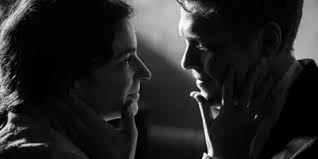
Another striking feature of this unconventional prison romance is that we are never shown what happens on both sides of the wall. Instead, the entire story unfolds exclusively through Wiesia’s eyes. We do not see Jurek until the final scene, six years later, shortly before their wedding, which has been arranged while they are still behind bars. This bold artistic decision proves remarkably effective, intensifying the dramatic tension while deepening the atmosphere of unease and mystery.
Without showy effects
The film’s pacing is equally distinctive, standing in deliberate contrast to the relentless haste of contemporary life. Its rhythm reflects the daily reality of imprisonment, where time seems to stretch endlessly and even the smallest events acquire significance. Allowing the narrative to unfold at such a measured pace is a risky choice, particularly in an age when audiences have grown accustomed to rapid editing and constant stimulation. Yet after the screening, there were no complaints that the film was boring or that it dragged.
The exchanges between the two protagonists are similarly unhurried, almost ritualistic. Since Morse code is unfamiliar to most viewers, their messages are conveyed through subtitles incorporated directly into the image. Letters appear one by one, slowly forming words, which in turn become sentences. Each message gradually takes shape before our eyes. Crucially, the subtitles appear at precisely the pace at which Wiesia receives and deciphers the signals. We are thus placed in her position, sharing her anticipation, uncertainty and suspense.
Much of the film’s power lies in its restraint and subtlety, and in its refusal to rely on showy cinematic effects. It steers clear of the sentimentality into which a story of this kind could so easily descend. Rather than attempting to wring tears from its audience, it allows emotion to emerge naturally, in its own time. Nor does it dwell excessively on the cruelty of the Stalinist prison system, despite the appalling brutality of its interrogation methods. Violence is neither gratuitous nor explicitly depicted. More often, we witness its aftermath: the physical traces left on Wiesia’s body by successive interrogations. Through the Wall also avoids a common pitfall of films driven by noble intentions and an unambiguous moral message: it is neither naive nor heavy-handed. Its underlying belief in the importance of human connection and the sustaining power of hope, even in the bleakest circumstances, feels entirely genuine.
Two women
Two women, in particular, deserve considerable credit for the film’s artistic achievement. The first is its leading actress, Maria Dębska, who gives a performance of remarkable subtlety and restraint. Her expressive range is conveyed through the smallest of gestures: an almost imperceptible shift in expression, the faintest movement of a facial muscle. Wiesia is acutely aware that, surrounded by fellow prisoners whose loyalties she cannot be sure of, she must remain constantly on her guard. She cannot afford to reveal her feelings. She must conceal her suffering, let alone her joy. Yet beneath her carefully controlled expression, we sense both. Dębska’s exceptional performance was recognised by the main jury of the Warsaw Film Festival, which awarded her a Special Prize.
The second is cinematographer Jolanta Dylewska, whose masterful handling of light creates an oppressive atmosphere of fear and confinement. Dylewska makes frequent use of close-ups – faces, hands, fingers tapping out messages through the wall – while her tightly composed frames heighten the sense of claustrophobia. Yet her black-and-white cinematography possesses a striking, almost painterly beauty, all the more remarkable for the squalor it depicts. Particularly memorable are the images in which the grimy skin of the prisoners seems almost to merge with the rough, stained surfaces of their cell walls. It is largely thanks to Dylewska’s extraordinary visual sensibility that watching Through the Wall feels like encountering a genuine work of art.
Through the Wall (Przez ścianę). Dir. Maciej Sobieszczański. Poland, 2026.
Pawel Mossakowski
© FIPRESCI 2026